
Education technology has moved past its emergency phase. The tools rushed into use during remote learning have faded or settled into everyday routines, and the interesting questions are now about quality, evidence and access rather than novelty.
This piece looks at the trends most likely to shape how students learn in 2026 and beyond, deliberately avoiding product announcements and funding news. The aim is to help you understand the direction of travel so you can make better decisions about your own learning.
AI assistants move from novelty to everyday utility
The first wave of AI in education was about wonder: a chatbot that could explain a concept or draft an essay. The current wave is quieter and more practical: doubt-solving inside learning platforms, feedback on practice answers, summaries of long readings and personalised revision prompts.
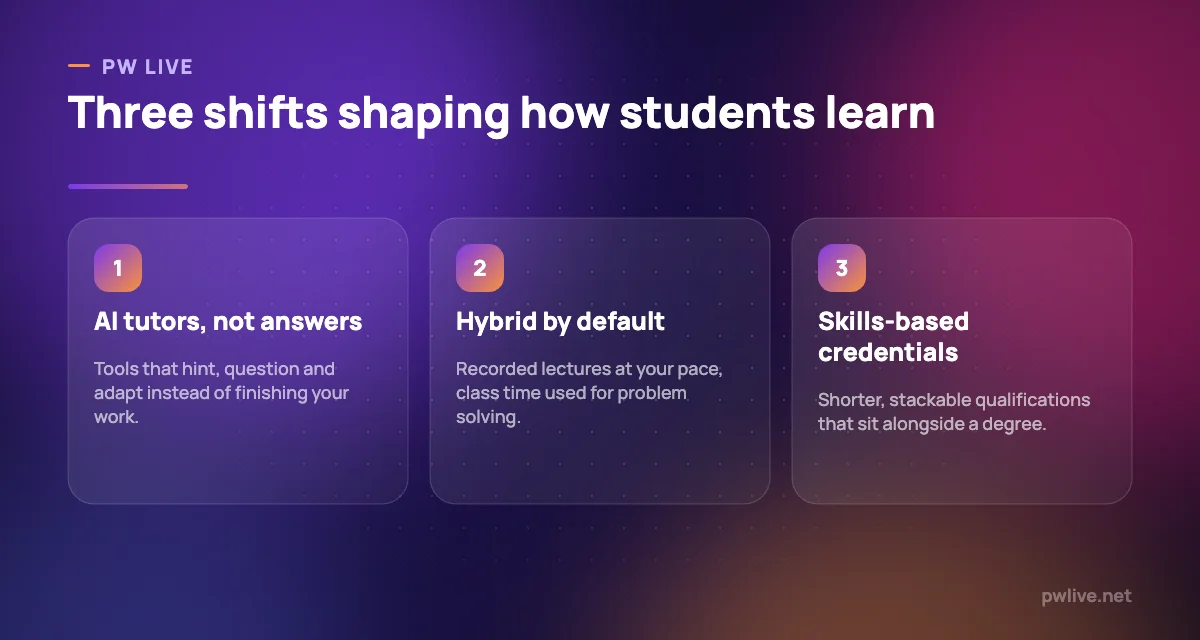
The important shift is from “AI as answer machine” to “AI as tutor.” A good AI tutor asks you to attempt the problem first, hints rather than tells, and adapts to where you went wrong.
The rule for students: use AI to check your reasoning and generate practice, not to replace the struggle where learning happens.
Hybrid learning becomes the default
Coaching institutes, universities and schools increasingly blend live classes, recorded lectures, in-person doubt sessions and app-based practice into one programme.
In practice this looks like:
- Lectures delivered once and watched at the student’s pace, with class time used for problem solving.
- Physical centres that function as study hubs and test venues rather than lecture halls.
The trend favours students who can manage their own schedules; self-direction becomes a core academic skill, and the education category will keep covering how to build it.
Skills-based credentials and micro-learning gain ground
Employers are paying more attention to what candidates can do and less to where they studied, driving growth in shorter, stackable credentials that sit alongside traditional degrees. Signs of the trend:
- Universities offering modular programmes completed in pieces.
- Industry-recognised certificates in data, cloud, design and digital marketing.
- Portfolios and project work being requested in hiring alongside marksheets.
The risk is fragmentation: a wall of certificates with no depth behind them. The credentials that hold value are attached to demonstrable work, which is the principle the Skills Development hub is organised around.
Adaptive learning matures
Adaptive learning has been promised for decades; what is changing is the volume of practice data and the models capable of using it. Platforms can now adjust difficulty, sequence topics based on demonstrated gaps, and time revision to when a student is likely to forget.
For exam preparation, this means practice sets that change as you improve, diagnostic tests that map weaknesses precisely, and less time spent revising what you already know.
The caution: adaptive systems are only as good as their content and assumptions, and a path optimised for speed can skip the foundations later topics depend on. Treat recommendations as a guide, not a replacement for a coherent syllabus.
Assessment is being rethought
High-stakes, single-sitting exams are not disappearing, especially in India, but the ecosystem around them is changing.
- Frequent low-stakes testing is replacing end-of-term surprises with continuous feedback.
- AI-assisted feedback on written work and problem solving is becoming faster and more specific.
- Project and portfolio assessment is growing in higher education and skills training.
- Remote proctoring raises concerns about privacy, fairness and stress, pushing institutions toward open-book and oral alternatives.
The direction is toward measuring understanding over time rather than performance on one day.
Access, privacy and the demand for evidence
Some of the most significant progress in Indian education technology is happening away from the metros: content in regional languages, apps designed for low-cost phones and intermittent connectivity, audio-first formats, and community learning centres that combine devices with local mentors. Access is the foundation of every other trend on this list.
As platforms collect more data, two questions are getting louder: how is student data protected, and does the technology actually improve outcomes? Parents, institutions and regulators want clear privacy practices, especially for younger students, and buyers increasingly want measurable improvement rather than testimonials. That pushes the sector away from metrics that reward screen time and toward outcomes that reward learning. The technology category covers digital safety and privacy basics.
What this means for students right now
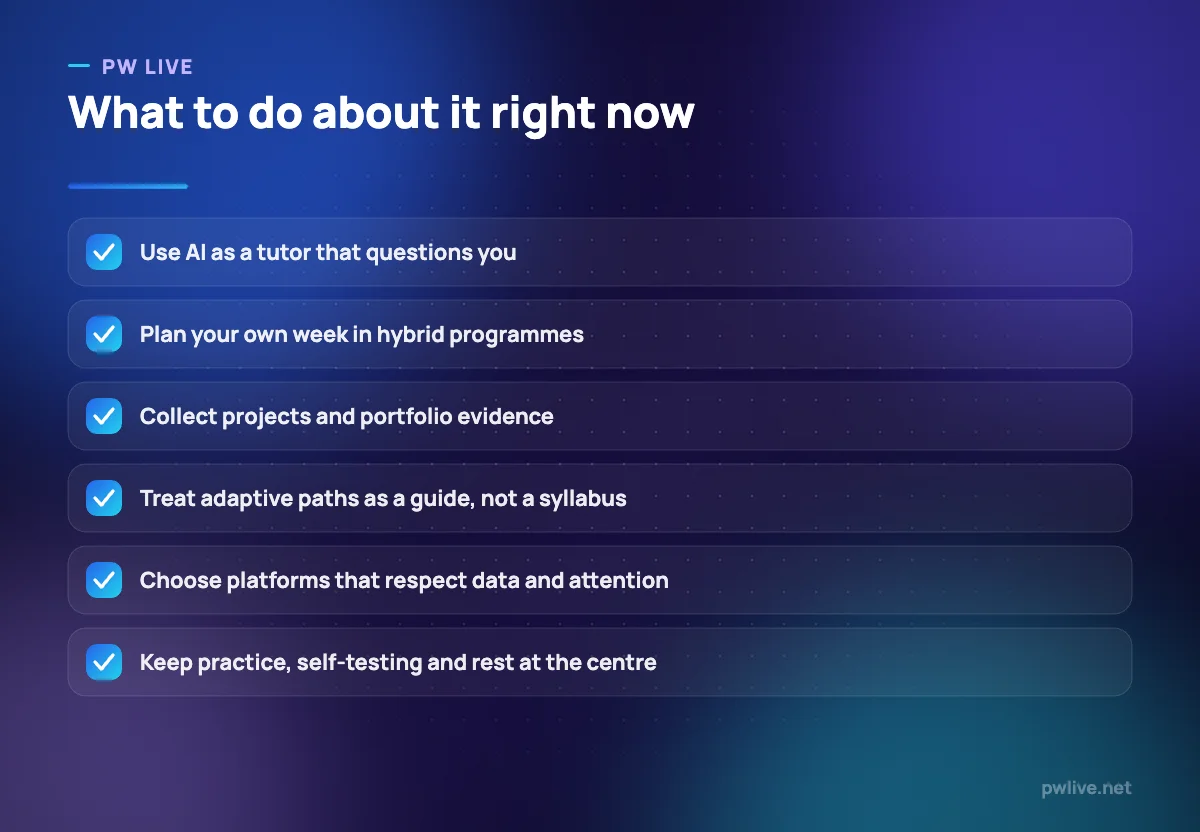
- Learn to learn with AI. Practise using assistants as tutors that question you, not engines that finish your work.
- Build self-direction. Hybrid programmes reward students who plan their own week and hold themselves to it.
- Collect evidence of ability. Projects, portfolios and applied credentials are becoming as important as marks.
- Protect your data and your attention. Choose platforms that respect both.
None of this replaces consistent practice, honest self-testing and enough rest. Technology changes the delivery; the learner still has to do the learning.
Key takeaways
- AI in education is shifting from answer machines to tutors that hint, question and adapt.
- Hybrid learning is becoming the norm, which makes self-direction a core academic skill.
- Skills-based, stackable credentials gain value when backed by real work.
- Adaptive learning is maturing but should be used alongside a coherent syllabus.
- Regional-language and low-bandwidth tools are expanding access, while privacy and evidence become decisive factors.
Frequently asked questions
Will AI tutors replace teachers or coaching classes?
Unlikely. AI is best at instant feedback and practice at scale; teachers provide motivation, judgment and the human accountability most students need.
Are online certificates worth pursuing for students in India?
They are worth it when the certificate comes with a project you can show and a skill an employer can test. A certificate without applied work adds little.
How should exam aspirants use these trends?
Use adaptive practice and AI feedback to find weaknesses faster, keep a structured syllabus and timed tests at the centre, and be selective about which platforms get your data and attention.
Keep learning with PW Live
Browse every guide in News & Updates, or pick a skill track and follow the roadmap step by step.





Leave a Reply