

Remote and hybrid work has stopped being an argument and settled into something messier: a patchwork where the arrangement depends on the employer, the role, the team and sometimes the individual manager. If you are choosing a job or trying to make your current one work, that patchwork is what you actually have to navigate.
The useful question is no longer whether remote work is good or bad. It is what a particular arrangement demands of you, and whether you are set up to meet those demands.
This guide covers the shape of where things have landed, what each model asks of you in practice, and how to build a working day that holds up whichever model you end up in.
Where things have actually settled
Three patterns are visible across most kinds of knowledge work, and they coexist rather than competing.
Fully in-office roles persist, especially where work involves physical presence, secure systems, close supervision of trainees or customer-facing service.
Hybrid has become the common middle, usually as a set number of shared days, sometimes fixed by the company and sometimes decided by the team.
Fully remote roles exist but are more selective, often going to people with a track record of working independently rather than to those at the very start of a career.
Alongside these, freelance and contract work has become a genuinely normal path rather than a fallback. Our guide to freelancing for beginners covers how that route actually starts.
What each model asks of you
The models differ less in hours than in what they quietly require.
- In-office asks for commute tolerance and comfort working amid interruption. It gives you informal learning almost for free.
- Hybrid asks for planning. You have to decide what belongs on shared days and what belongs on solo days, and stick to it.
- Remote asks for self-management and unusually clear written communication. Nothing about your work is visible unless you make it visible.
Matching your temperament to the model matters, but so does matching your career stage. Early on, proximity to more experienced colleagues teaches you things nobody thinks to write down.
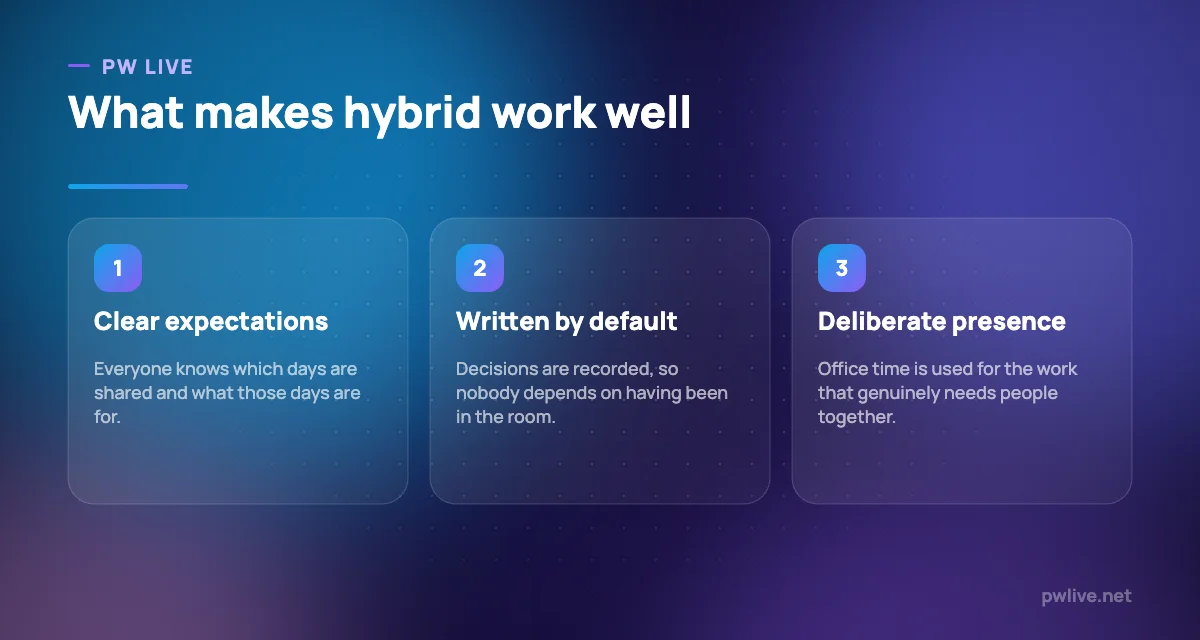
The skill hybrid work quietly demands: writing
In a shared office, decisions happen in conversations and everyone absorbs them. The moment part of the team is elsewhere, anything unwritten is effectively lost.
That makes clear written communication the highest-leverage skill in distributed work. Not literary writing, but the plain kind: what was decided, why, who is doing what, and by when.
Three habits are worth building:
- End every meeting with a short written summary of decisions and owners.
- Write updates that a busy person can read in thirty seconds, with the conclusion first.
- Ask questions in a form that can be answered asynchronously, including the context needed to answer.
Our communication skills track covers this in more depth, and it transfers to every other part of your career.
Building a remote day that actually works
Most remote-work misery comes from a day with no edges. Work leaks into the evening, focus never quite arrives, and nothing feels finished.
Structure fixes more of this than motivation does.
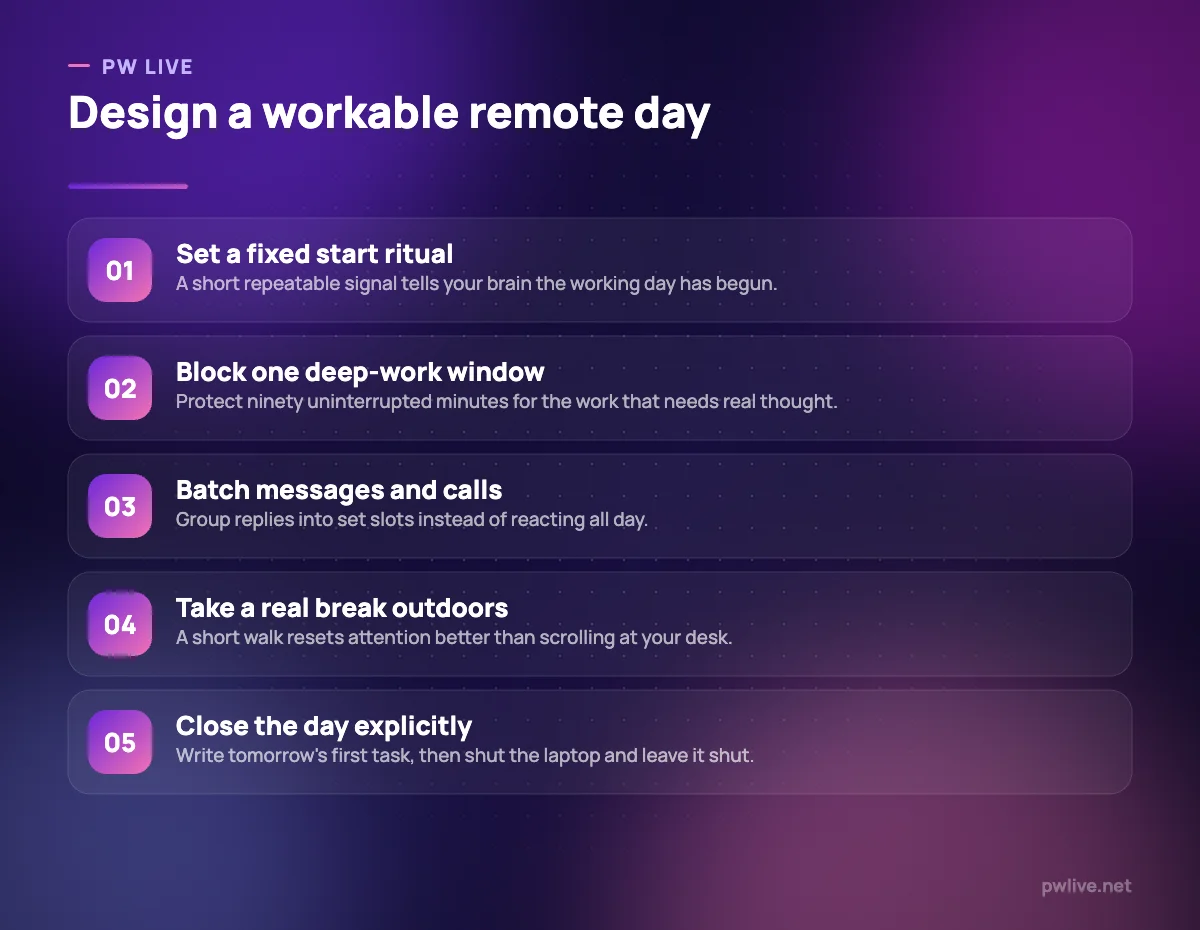
- Start with a short ritual: same time, same first task, same place.
- Protect one long block for demanding work before the day fills with messages.
- Batch communication into two or three fixed windows.
- Step outside once during working hours.
- Close the day deliberately by writing tomorrow’s first task.
Our guides to staying focused while working from home and time blocking cover the mechanics, while managing your energy rather than your time explains why the same schedule works some days and collapses on others.
The health and workspace side
Working from home for years is physically different from working from an office. Chairs, desk height and screen position matter more when nobody has set them up for you.
You do not need expensive equipment. You need your screen roughly at eye level, your forearms level with the desk, your feet flat, and a reason to stand up every hour. Our guide to studying and working without back, neck and wrist pain covers the adjustments that make the biggest difference.
The other health issue is isolation, which builds slowly and is easy to miss. Deliberate contact with colleagues that is not about tasks is not a luxury in distributed work; it is what keeps the working relationship functional.
What this means when you are job hunting
Treat the working arrangement as a real term of employment and check it as carefully as you check the salary.
Ask specific questions rather than general ones:
- How many days in the office, and are they fixed or flexible?
- Who decides, the company or the team?
- Is the arrangement described in the offer letter?
- How are people who work remotely included in decisions?
- What does the team do when someone needs to relocate?
Vague reassurance during interviews is worth very little. Anything you are relying on should be written into the offer. If you are also negotiating pay, our guide to negotiating your first salary covers how to raise terms without damaging the offer.
Also confirm the arrangement in the employer’s own job posting and offer documents rather than from a job aggregator’s tag, which is frequently out of date.
Careers in a distributed team
Being remote does not automatically slow your career, but being invisible does. The two are easy to confuse.
Make your work legible. Short, regular written updates on what you shipped and what you learnt are the simplest way. Volunteer for work that requires you to talk to other teams, since visibility follows collaboration.
Ask for feedback explicitly and often, because casual corrective feedback is the first thing lost when people are not in the same room. And when you do meet the team in person, spend that time on relationships and hard conversations rather than on tasks you could have done alone.
For more on structuring your days and energy around work you care about, browse the lifestyle and productivity category.
Key takeaways
- Remote, hybrid and in-office arrangements now coexist, and the details vary by employer and team.
- Each model demands something different: presence, planning or self-management and clear writing.
- Written communication is the highest-value skill in any distributed team.
- A remote day needs deliberate edges: a start ritual, a protected deep-work block and an explicit close.
- Confirm the working arrangement in the employer’s own posting and your offer letter, not from a job listing tag.
Frequently asked questions
Is remote work a bad idea early in a career?
Not necessarily, but it makes learning harder, because much of what you pick up early comes from overhearing and asking quick questions. If you work remotely early, compensate with deliberate mentoring and frequent feedback.
How do I ask about hybrid policy in an interview without sounding uncommitted?
Ask factually: how many days, fixed or flexible, and how the team uses shared days. Framing it as planning your logistics rather than negotiating less work keeps the tone right.
What if my employer changes the policy after I join?
Policies can change, which is why anything you depend on should be in your offer letter. If a change affects you significantly, raise it early and in writing rather than waiting.
How do I stay visible while working remotely?
Publish short, regular written updates on what you completed and what you learnt, and take on work that involves other teams. Visibility follows written output and collaboration, not hours online.
Keep learning with PW Live
Browse every guide in News & Updates, or pick a skill track and follow the roadmap step by step.





Leave a Reply