

Product descriptions that convert do one job: they remove the reasons a buyer would not press the button. Most descriptions do the opposite. They pile on adjectives, repeat the title three times and leave the genuinely useful details out.
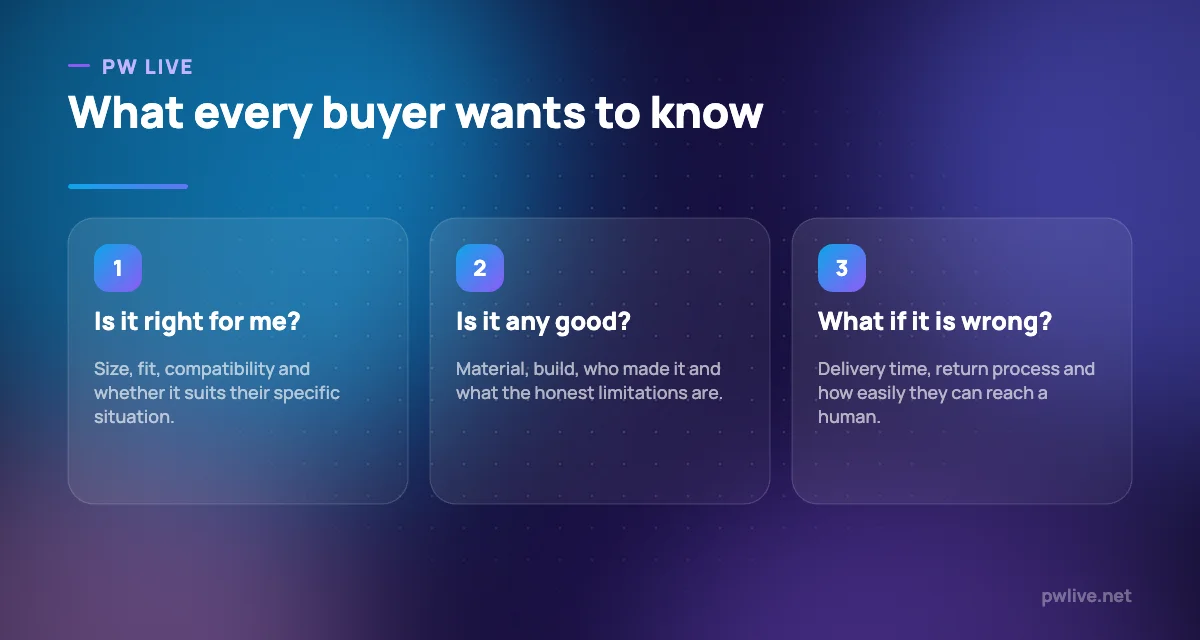
A buyer landing on your page is not looking to be impressed. They are checking whether this product fits their situation, whether it is well made, and what happens if it turns out wrong. Answer those three things clearly and you will outperform pages with better prose.
This guide shows you how to write descriptions that answer real questions, stay honest, and still read well.
Start by collecting the questions, not the adjectives
Before you write anything, gather the questions buyers ask about this kind of product. You already have several free sources.
- Messages and calls from your own customers. Every repeated question is a gap in your page.
- Reviews on competing listings, especially the two- and three-star ones where people explain what surprised them.
- Search suggestions that appear when you type your product name into a search box.
- Return reasons, if you have any history. A return is a question you failed to answer in advance.
Write those questions down as a list. Your description is simply the shortest honest answer to each, in the order a buyer would ask them. This is the same research habit described in keyword research without expensive tools.
Write a title that describes, not decorates
The title is doing more work than the paragraph below it. It appears in search results, in listings, in cart summaries and in order confirmations.
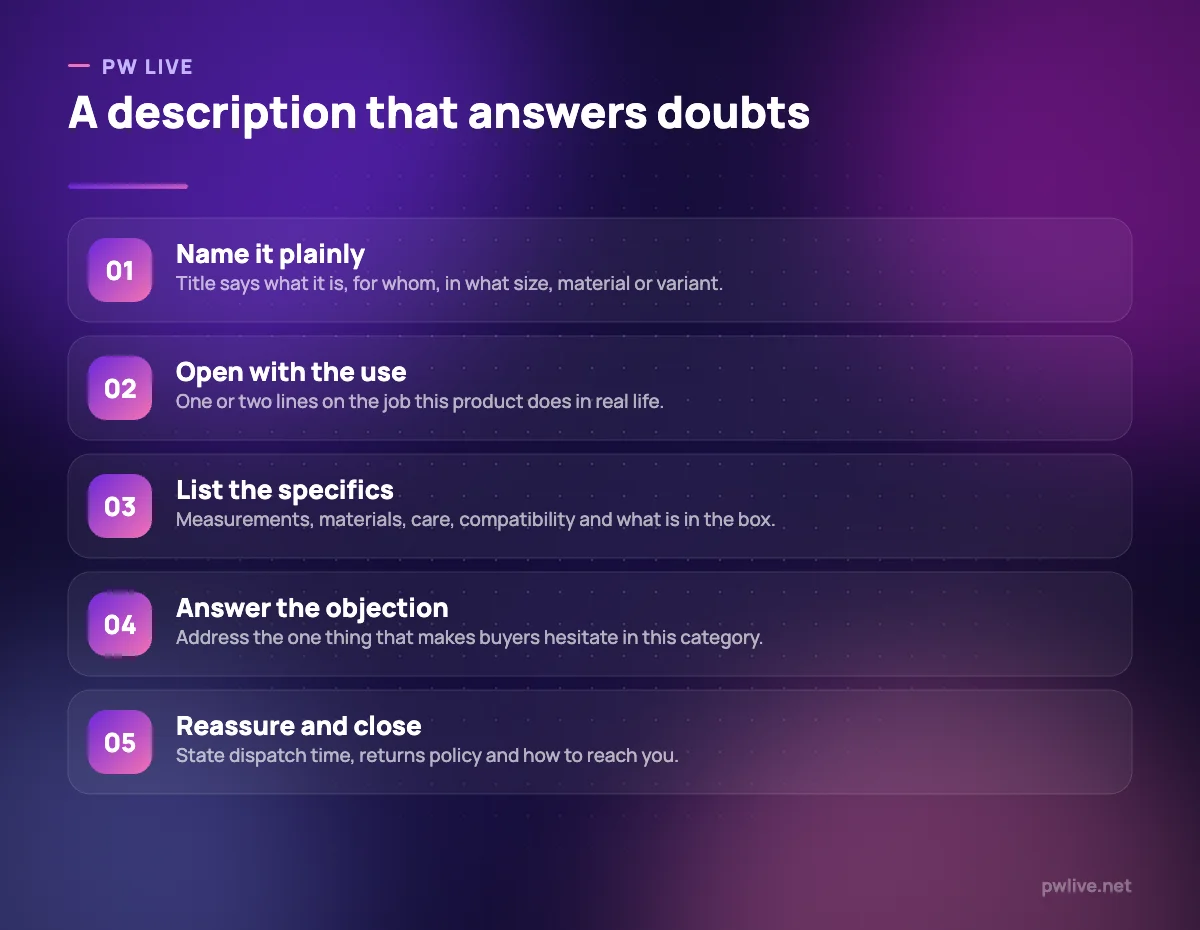
A useful title pattern is: what it is, key attribute, variant, quantity. For example, “Cotton kurta, full sleeve, navy, size M” tells a buyer more than “Premium designer kurta for men”.
Avoid stuffing keywords. A title crammed with repeated terms reads as spam to both buyers and search engines, and marketplaces often penalise it. Include the words people actually search once, in a sentence that a human would say aloud.
Lead with the job the product does
The first two lines should describe the situation the product is for, not the product’s virtues.
Compare these. “Superior quality steel water bottle with premium finish.” Versus “Keeps water cold through a full college day and fits standard bag side pockets.” The second tells a buyer whether it solves their problem.
Think about the moment of use. Where is it used, by whom, how often, and what irritation does it remove? That framing also gives you honest, specific language instead of empty superlatives.
Give the specifics people are quietly scanning for
This is where most descriptions fail. Buyers skim for facts and leave when they cannot find them.
Include, where relevant:
- Exact measurements in numbers, not “medium size”. Length, width, height, weight, capacity.
- Material and composition, including blends and any coating or finish.
- What is in the box. Cables, spares, mounts, instructions, batteries or the absence of them.
- Compatibility. Which devices, models, sizes or standards it works with, and which it does not.
- Care instructions. Machine washable, hand wash only, dishwasher safe, storage advice.
- Country of origin and manufacturer or importer details where the rules for your category require them.
Numbers beat adjectives every time. “Holds 750 ml” is more persuasive than “generous capacity”, because it lets the buyer decide for themselves.
Be honest about limits, and say so plainly
Honesty is not a compliance chore, it is a conversion technique. Buyers are already suspicious of listings that sound too good, and a page that names a limitation earns trust for everything else it claims.
Some rules worth treating as non-negotiable:
- Do not claim results, benefits or health effects you cannot support. Health, beauty and supplement claims are regulated, and overstating them is both a legal and a reputational risk.
- Do not describe a product as certified, tested or approved unless it genuinely is, and be ready to show the documentation.
- Do not use a competitor’s brand name to imply an association that does not exist.
- Do not hide the awkward detail. If the fabric is sheer, the colour differs slightly across batches, or assembly is required, say it in the description.
Saying “runs slightly small, we suggest sizing up” costs you a few sales and saves you many returns, which is almost always the better trade. Our guide to logistics basics for Indian sellers shows why every avoided return matters to your margin.
Format for scanning, because nobody reads top to bottom
Very few buyers read a description as prose. They scan in a rough Z shape, stopping on anything that looks like a fact.
Structure accordingly:
- Two or three short lines at the top for the use case.
- A bulleted specification block that a buyer can scan in five seconds.
- A short paragraph for anything that needs context, such as how it is made or how to choose a size.
- A closing block covering dispatch time, returns and how to contact you.
Keep paragraphs to one to three sentences. Bold only the two or three terms that genuinely matter, such as a size or a material. Bold everything and you have bolded nothing. The principles in copywriting fundamentals apply here in miniature.
Write for the person who is nervous, not the person who is sold
Somebody who is already convinced will buy regardless. Your description exists for the person hovering with a doubt.
Name that doubt directly. In apparel it is fit. In electronics it is compatibility. In food it is freshness and shelf life. In furniture it is assembly and whether it fits through a door.
A short paragraph headed “How to choose your size” or “Will this fit my model?” does more for conversion than another round of adjectives. Where a genuine question keeps coming up, add it as a short FAQ block on the page itself.
Add search terms without wrecking the writing
Descriptions still need to be findable. The good news is that answering real questions naturally includes the words people search.
Use the main phrase once in the title, once in the opening lines and perhaps once in a specification. Use variations elsewhere: material, colour, use case, the problem it solves. Then stop. If a sentence exists only to hold a keyword, delete it.
Pair this with clean image file names and complete attribute fields on marketplaces, since those often influence filtering more than the description text does. For the broader approach, see SEO for beginners.
Test, then rewrite the losers
Treat descriptions as drafts. After a few weeks, look at which products get questions, which get returned and which convert well relative to their views.
Rewrite the worst performer first, changing one thing at a time so you learn something: a clearer title, a fuller specification block, an added size guide. Keep the version that wins.
You can browse more guides in the e-commerce category, and if writing is the bottleneck, the communication skills track is a good place to build it.
Key takeaways
- Collect real buyer questions from messages, reviews and return reasons before writing a word.
- Titles should describe plainly: what it is, key attribute, variant and quantity.
- Open with the job the product does in real life, then give exact measurements, materials and contents.
- Name limitations honestly, and never make claims about performance, certification or health you cannot support.
- Format for scanning with short lines, a specification block and a closing note on dispatch and returns.
- Use search terms once each in natural sentences, then rewrite your weakest pages based on questions and returns.
Frequently asked questions
How long should a product description be?
Long enough to answer every reasonable question and no longer. Simple accessories may need a hundred words; a technical or sized product often needs three hundred with a specification block.
Can I use the manufacturer’s supplied description?
You can, but everyone else selling the same item is using it too, and it rarely answers your buyers’ specific questions. Rewrite it with your own measurements, use cases and returns information.
Should I mention flaws or limitations?
Yes. Stating that an item runs small, needs assembly or varies slightly in shade reduces returns and builds trust, and it protects you from complaints that the listing was misleading.
Do descriptions matter if my photos are strong?
Photos sell the look; descriptions close the sale by confirming size, material, compatibility and returns. Strong images with a vague description simply move the doubt further down the page.
Keep learning with PW Live
Browse every guide in E-commerce & Retail, or pick a skill track and follow the roadmap step by step.





Leave a Reply