

Six months is long enough to cover a large syllabus properly and short enough that every week matters. It is also long enough to drift, which is how aspirants reach month five with half the syllabus untouched.
The fix is a timeline that decides, in advance, what each month is for. Not a rigid daily timetable that breaks on day three, but a phased plan with checkpoints.
This guide gives you that plan: how to split six months into phases, divide time between subjects, use mocks well, and adjust when reality disagrees with the schedule. It works for JEE, NEET, state entrance exams and most recruitment tests.
Start with the syllabus, not the calendar
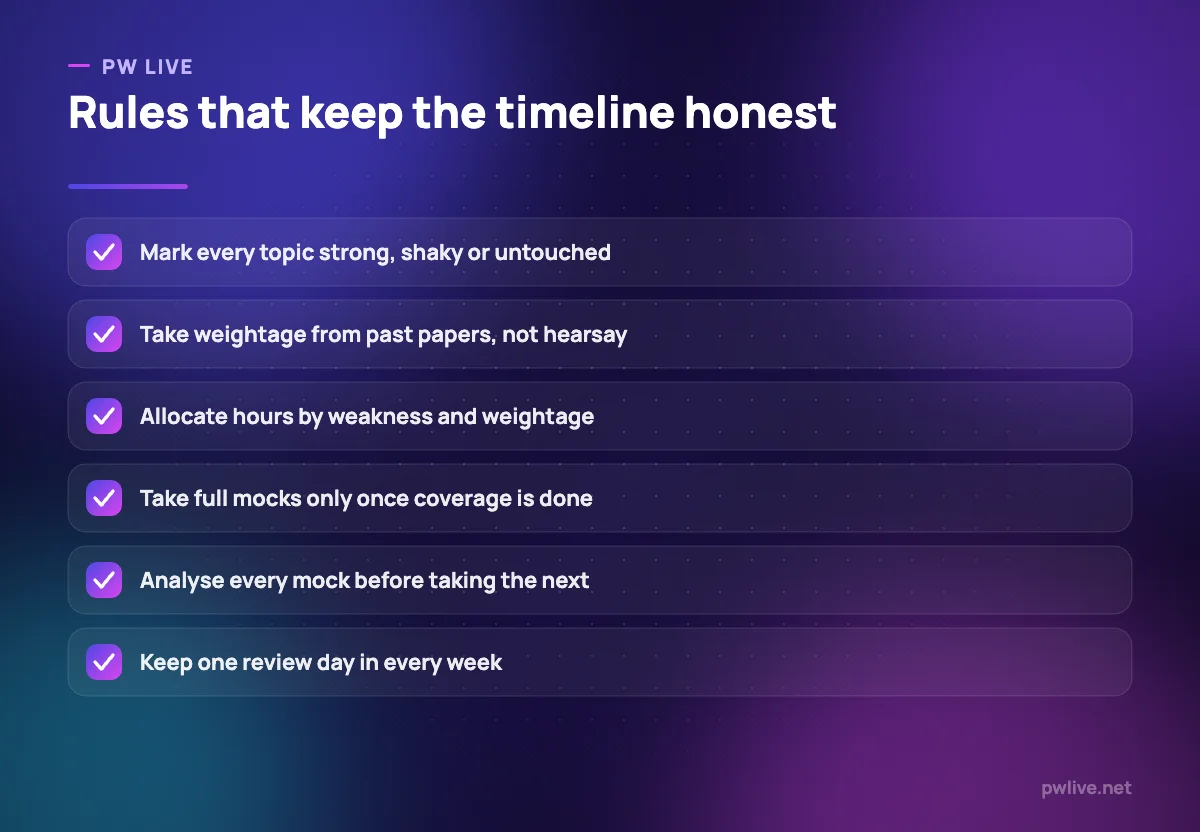
Get the official syllabus and go through it line by line, marking each topic:
- Strong: you can solve typical questions confidently today.
- Shaky: you know the theory but make mistakes under time pressure.
- Untouched: you have not studied it, or would need to start from scratch.
This audit takes a weekend, and it is the most valuable weekend of the six months. It shows where the hours should go and stops you re-studying chapters you like.
Also note each topic’s weightage, using past papers rather than hearsay. A high-weight topic marked shaky is your first priority.
The three-phase structure
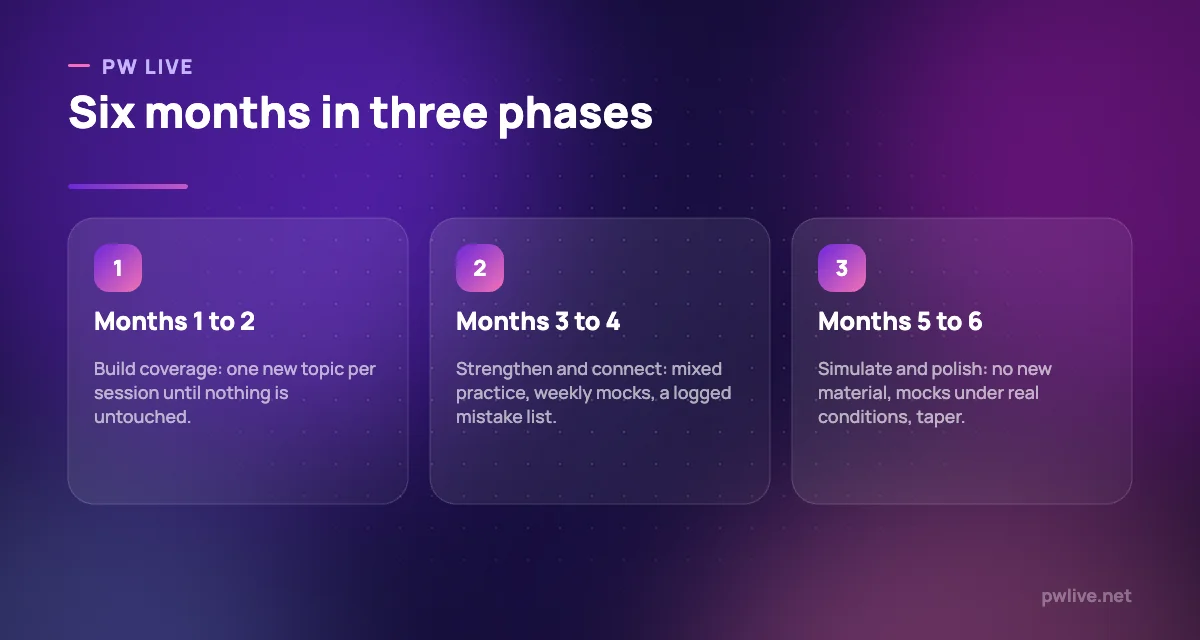
Six months divides naturally into three phases of roughly two months each. The proportions can shift, but the sequence should not.
Phase 1 (months 1 to 2): Build coverage
The goal is to remove every untouched label.
- Study one new topic per session, followed by a short set of basic problems.
- Do not chase difficult questions yet. Get the concepts and standard question types.
- End each week with mixed problems from everything covered.
Phase 2 (months 3 to 4): Strengthen and connect
This phase converts shaky into strong.
- Revisit topics in order of weakness multiplied by weightage.
- Move from chapter-wise problems to mixed practice, which is what the exam looks like.
- Start full-length mocks, one every week or two, under real timing.
- Log every mistake with its reason: concept gap, careless error, or timing.
Phase 3 (months 5 to 6): Simulate and polish
This phase is about performance, not new learning. Nothing new enters the plan after month five begins.
- Treat each mock like the real day: same start time, same breaks, no phone.
- Spend the next day analysing each mock. The analysis is worth more than the test.
- Revise from your mistake log and summary notes, not the full textbook.
- Taper in the final week: lighter sessions, more sleep, formula sheets only.
Dividing time between subjects
A common trap is spending most hours on the subject you enjoy. Allocation should follow the audit.
- Give each subject a base share according to its marks in the exam.
- Add a bonus share for subjects with more untouched and shaky topics.
- Re-check the split monthly and shift hours towards whatever the mocks show is weakest.
If one subject is far behind, front-load it in Phase 1 rather than spreading it thinly.
Structuring a normal week
Within each phase, the week is the unit that matters. A typical week:
- Five study days with two or three focused sessions each, one per subject.
- One test day for mixed problems in Phases 1 and 2, or a full mock in Phase 3.
- One review day, shorter, for the mistake log, next week’s plan and rest.
The review day is not optional; it is where the timeline gets corrected. Our productivity skills page covers defending fixed slots in a busy week.
Using mock tests without letting them derail you
Mocks train stamina and generate data. They do neither if taken carelessly or too early.
- Phase 1: chapter tests only. A full mock before coverage is complete measures only what you have not studied.
- Phase 2: one full mock every one to two weeks, each analysed before the next.
- Phase 3: increase frequency, but never two mocks without analysis between them.
Analysis means sorting every lost mark into a category and acting on it. A careless error needs a checking habit; a concept gap needs a revision slot; a timing problem needs a new question order.
Scores will jump around. A single bad mock is data, not a verdict.
Adjusting when the plan slips
It will slip. What matters is how you respond.
- Behind by days? Compress or drop the lowest-weightage topic still pending.
- Behind by weeks? Cut Phase 1 short, move to mixed practice, and accept basic coverage of some low-weight topics.
- Ahead? Do not add new material. Deepen high-weightage topics and take an extra mock.
Our exam strategy page covers prioritising when the syllabus is bigger than the time.
Look after the person doing the studying
A six-month timeline is a physical undertaking. Keep a consistent sleep schedule, move most days, and protect one evening a week for something unrelated to the exam. Burnout in month four costs more than rest in month one.
For more guides, browse our exams category.
Key takeaways
- Audit the syllabus first: mark every topic strong, shaky or untouched, and weight it.
- Split six months into three phases: coverage, strengthening, and simulation.
- Allocate hours by weakness and weightage, not by preference.
- Take full mocks only once coverage is complete, and analyse every one.
- Use a weekly review day to correct the timeline, and treat rest as part of the plan.
Frequently asked questions
Is six months enough to prepare for JEE or NEET from scratch?
It is enough to prepare seriously if you follow a phased plan and are honest in your audit. How far you get depends on your starting point.
How many mock tests should I take in total?
Enough that the format feels familiar, but never more than you can properly analyse. Quality of analysis matters more than the count.
Should I use coaching material, textbooks or online courses?
Any combination that covers the official syllabus works. Pick one primary source per subject and use others to fill gaps.
Keep learning with PW Live
Browse every guide in Exams & Admissions, or pick a skill track and follow the roadmap step by step.





Leave a Reply