

A degree tells an employer or a client one thing: you can complete a long, structured programme and pass its exams. That is worth something. It is also not enough on its own, and most graduates find this out in their first job.
The gap is rarely subject knowledge. It is the practical skills no module teaches directly: explaining an idea in writing, reading a spreadsheet, managing your own time, handling money.
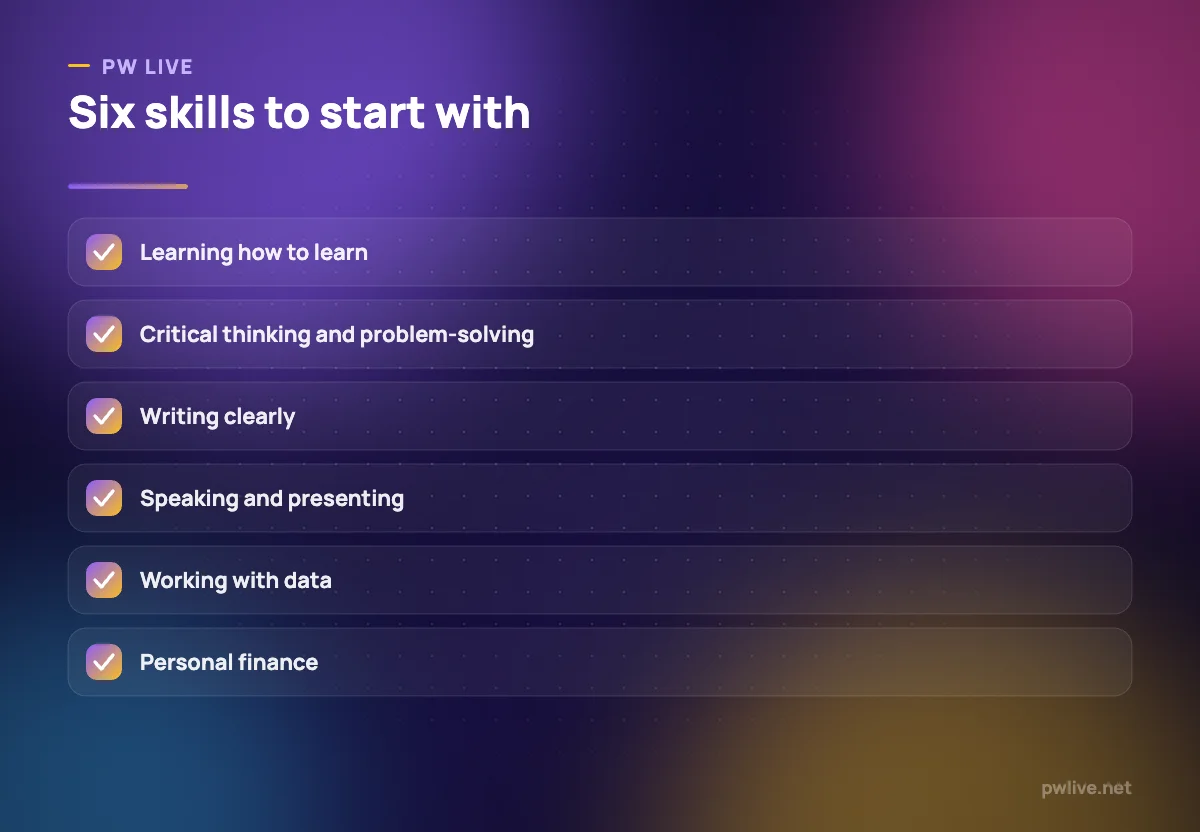
This guide lists ten of those skills, grouped into four areas, with a concrete way to start building each one while you are still a student. You do not need to master all ten. You do need to be competent in most of them.
Thinking and learning skills
1. Learning how to learn
The most durable skill is the ability to pick up any new subject efficiently: breaking a topic down, testing yourself instead of re-reading, and scheduling revision so it sticks.
Start by taking one topic outside your syllabus and teaching it to yourself in two weeks, using only active recall and practice problems.
2. Critical thinking and problem-solving
Employers and founders alike need people who can take a messy situation, work out the real question, and reason towards an answer without waiting for instructions.
Start by picking apart arguments you read online. Ask what evidence supports the claim, what is assumed, and what would change your mind.
3. Writing clearly
Almost every job runs on written communication: emails, reports, proposals, documentation. Clear writing is clear thinking made visible, and it is rare.
Start by writing a short explanation of something you studied this week, then cutting it by a third without losing meaning.
Communication and people skills
4. Speaking and presenting
You will pitch ideas, present projects, answer interview questions and explain your work to people outside your field. Comfort in front of a room is trained, not inherited.
Start by volunteering for every presentation slot in group projects and joining a society where you have to speak regularly.
5. Collaboration and feedback
Working well with others means dividing work fairly, keeping people informed, and giving and receiving feedback without drama. Group projects are unpopular precisely because these skills go untrained.
Start by being the person in the next group project who writes down decisions, sets check-in times and asks for feedback on your own work first. Our communication skills page goes deeper on this.
Digital and technical skills
6. Coding and computational thinking
You do not need to become a software engineer. You do need to understand how software thinks: breaking a task into steps, handling data, automating repetitive work. Basic scripting saves hours in almost any career.
Start by learning one general-purpose language well enough to automate a small, boring task in your own life. Our coding and programming guide explains where to begin.
7. Working with data
Every field now produces data, and the person who can turn a spreadsheet into a clear answer is valuable everywhere. This means comfort with tables, basic statistics, charts and asking where the numbers came from.
Start by taking a dataset connected to your course, cleaning it in a spreadsheet, and producing one chart that answers a real question.
8. Digital literacy and online presence
Knowing how to research properly, judge sources, protect your accounts and present yourself online is a baseline skill. So is a basic grasp of how businesses reach people through search and social platforms.
Start by setting up a professional profile that clearly describes what you do, and learning to verify a claim before you share it.
Life and career skills
9. Personal finance
Budgeting, saving, understanding interest and avoiding bad debt compound for decades. Graduates who never learn them pay for it, often literally.
Start by tracking every rupee you spend for one month and building a simple budget from what you find. Our personal finance skills page has a step-by-step guide.
10. Self-management and productivity
Nobody will set your timetable after graduation. Planning a week, protecting focused time and following through is what separates people who have ideas from people who deliver them.
Start by running a weekly review: what you planned, what you did, and what changes next week.
How to build these while you are still studying
Ten skills sounds like a lot alongside a full course load. It is manageable if you treat them as habits, not projects.
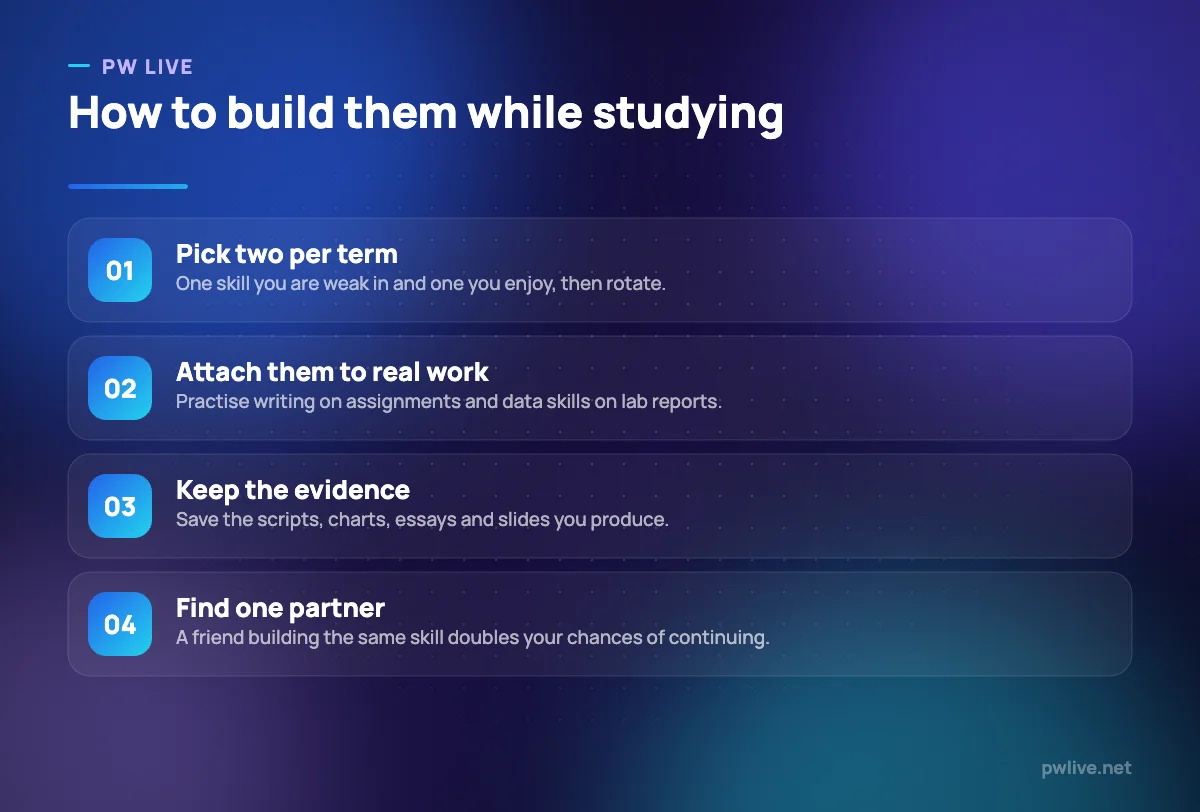
- Pick two per term. One skill you are weak in and one you enjoy. Rotate each term.
- Attach them to existing work. Practise writing on assignments, data skills on lab reports, presenting in seminars.
- Keep evidence. Save the scripts, charts, essays and slides you produce. In a year they become a portfolio.
- Find one accountability partner. A friend building the same skill doubles your chances of continuing.
The point is not to add hours to your week. It is to do the work you already have in a way that builds something you keep.
Key takeaways
- A degree proves persistence and subject knowledge; practical skills prove usefulness.
- The ten skills fall into four groups: thinking, communication, digital, and life management.
- Each can be started with a small exercise attached to work you already do.
- Focus on two skills per term rather than all ten at once.
- Keep the artefacts you produce; they become your portfolio.
Frequently asked questions
Which skill should I start with if I can only pick one?
Writing clearly. It improves your thinking, your grades and your job applications at once, and makes every other skill easier to demonstrate.
Do I need to learn coding if my degree is not technical?
You do not need to become a developer, but basic scripting and an understanding of how software handles data help in almost any field.
How do I show these skills to employers?
Through evidence rather than claims. A portfolio of projects, a well-written application and a confident interview demonstrate skills better than a list of adjectives on a CV.
Keep learning with PW Live
Browse every guide in Skills Development, or pick a skill track and follow the roadmap step by step.





Leave a Reply