

Most people who start an online course never finish it. That is rarely a motivation problem. It is a systems problem: the lectures are excellent, but nothing around them tells you when to study, what to do when stuck, or whether you are actually learning.
A study system fixes that. It is the set of habits and routines that turn a playlist of lectures into steady, measurable progress.
This guide builds one from scratch: a realistic schedule, a way to capture what you learn, a feedback loop that catches gaps early, and a fallback for the weeks when everything goes wrong.
Why online learning needs a system
A classroom hands you structure for free. Someone else sets the timetable, checks your homework and notices when you fall behind.
Online, all of that becomes your job. The platform cannot make you show up on a Tuesday evening or notice that you keep re-watching an easy chapter to avoid a hard one.
Structure is learnable, though. You do not need more willpower. You need fewer decisions, made once, in advance.
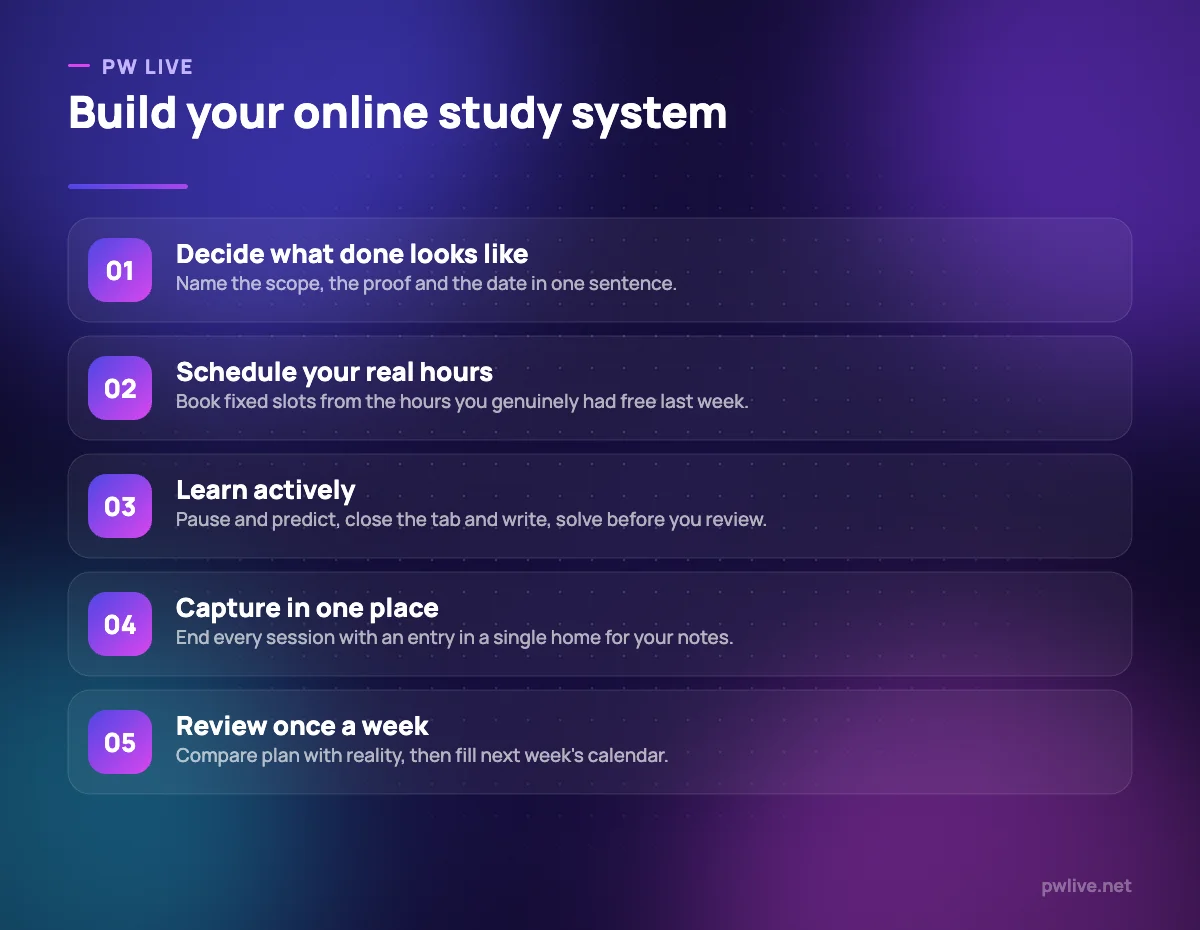
Step 1: Decide what done looks like
Before you touch a schedule, write one sentence that describes the finish line. “Complete the organic chemistry module and score above my target in the mock test” is a finish line. “Get better at chemistry” is not.
A good finish line has three parts:
- A scope: which course, module or syllabus section.
- A proof: a test, a project or a set of solved problems that shows you have learnt it.
- A date: even a rough one, so the plan has an end.
Write this at the top of your notes and re-read it at every weekly review.
Step 2: Build a schedule you can actually keep
The most common mistake is planning for your best week rather than your normal one. Ambitious timetables collapse in the first fortnight and take your confidence with them.
- Count real hours. Look at last week’s calendar and count the hours you genuinely had free. That is your budget.
- Book fixed slots. Treat sessions like appointments with a start and end time. “Tonight sometime” is not a slot.
- Keep sessions short and specific. A block of, say, 45 minutes with one named task beats a vague three-hour marathon.
- Leave one buffer slot per week. A missed session moves into the buffer instead of vanishing.
If you are preparing for a competitive exam, our exam strategy guide covers spreading a full syllabus across months.
Step 3: Learn actively, not passively
Watching a lecture feels productive because it is easy. Recognising an idea is not the same as recalling it under pressure.
Build active steps into every session:
- Pause and predict. Before the instructor solves an example, try it yourself.
- Close the tab and write. After each lecture, write the three most important ideas from memory, then check what you missed.
- Solve before you review. Attempt questions cold, then use the solutions to find the gap.
- Teach it once. Explain the topic aloud. Wherever you stumble is what to revise.
A simple session template
- Two minutes: re-read yesterday’s summary.
- Twenty to thirty minutes: new material, with pauses and predictions.
- Ten minutes: closed-book recall and a written summary.
- Five minutes: log what you did and any open question.
Step 4: Capture everything in one place
Scattered notes are worse than no notes. Screenshots, a half-filled notebook and a folder of PDFs cannot be reviewed together, so they never are.
Pick one home for your learning, paper or digital. What matters is:
- Every session ends with an entry, even a short one.
- Open questions are tagged so you can find them later.
- Summaries are in your own words, not pasted from slides.
Keep the tool stack small. Our productivity skills page covers choosing tools that serve the habit rather than replacing it.
Step 5: Close the loop with a weekly review
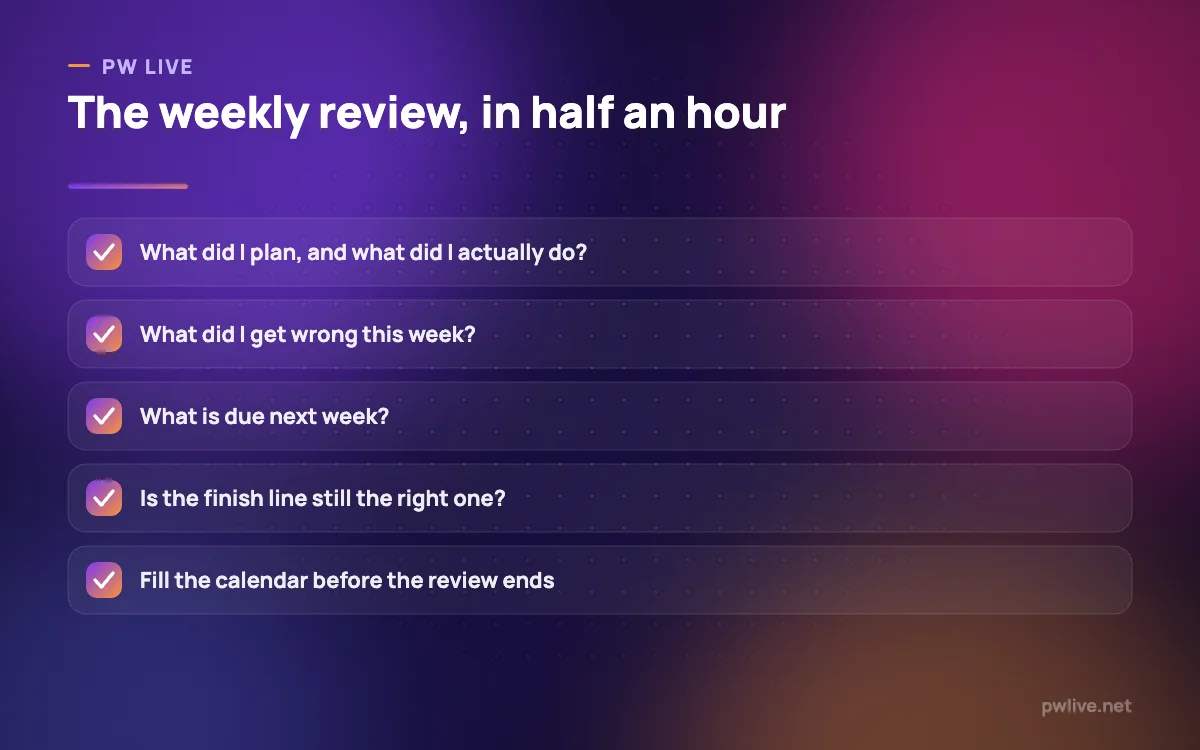
The weekly review is the part most learners skip and the part that makes the system work. It takes about half an hour, at the same time each week.
- What did I plan, and what did I actually do? No judgement, just the gap.
- What did I get wrong? Pull from your practice logs and open questions.
- What is due next week? Adjust for known disruptions.
- Is the finish line still right? Sometimes the goal itself needs revising.
Then schedule next week’s sessions. The review ends when the calendar is filled.
Step 6: Plan for the bad weeks
Every system meets an exam week or a lost weekend. A good one bends instead of breaking.
- Define a minimum day. One recall exercise or ten questions, small enough to do when everything else slips.
- Never miss twice. One skipped session is life. Two in a row is a pattern.
- Restart without redesigning. After a bad week, resume the existing plan. Rebuilding it from scratch is procrastination in disguise.
For more guides on studying well, browse our education category.
Key takeaways
- Online learning fails on structure, not motivation. Build the structure once so daily study needs fewer decisions.
- Define a concrete finish line with a scope, a proof and a date.
- Schedule around your real available hours and keep a weekly buffer.
- Replace passive watching with recall, prediction and problem-solving.
- Keep notes in one place, review weekly, and have a minimum day ready for bad weeks.
Frequently asked questions
How many hours a day should I study online?
Fewer than you think, done consistently. Start with what you can sustain for a month, then increase in small steps.
Should I take notes while watching lectures or afterwards?
Mostly afterwards. Brief notes during the lecture are fine, but the closed-book summary you write after it is where the learning happens.
What if I fall behind the course schedule?
Use your weekly review to reset the plan rather than trying to catch up in one sitting. Steady progress on a revised timeline beats burning out on the original one.
Keep learning with PW Live
Browse every guide in Education & Learning, or pick a skill track and follow the roadmap step by step.





Leave a Reply