

A student today can paste a chapter into an AI tool and get a summary, practice questions, a worked solution and an explanation pitched at their level, all in under a minute. Not long ago that needed a tutor, a textbook and an afternoon.
That is genuinely useful. It is also the fastest way ever invented to feel like you are learning while learning nothing at all.
This guide looks at what AI study tools do well, where they quietly undermine you, and simple rules for using them so that the learning stays in your head rather than in the chat history.
What AI study tools do well
Used deliberately, AI tools solve real problems that students have always had.
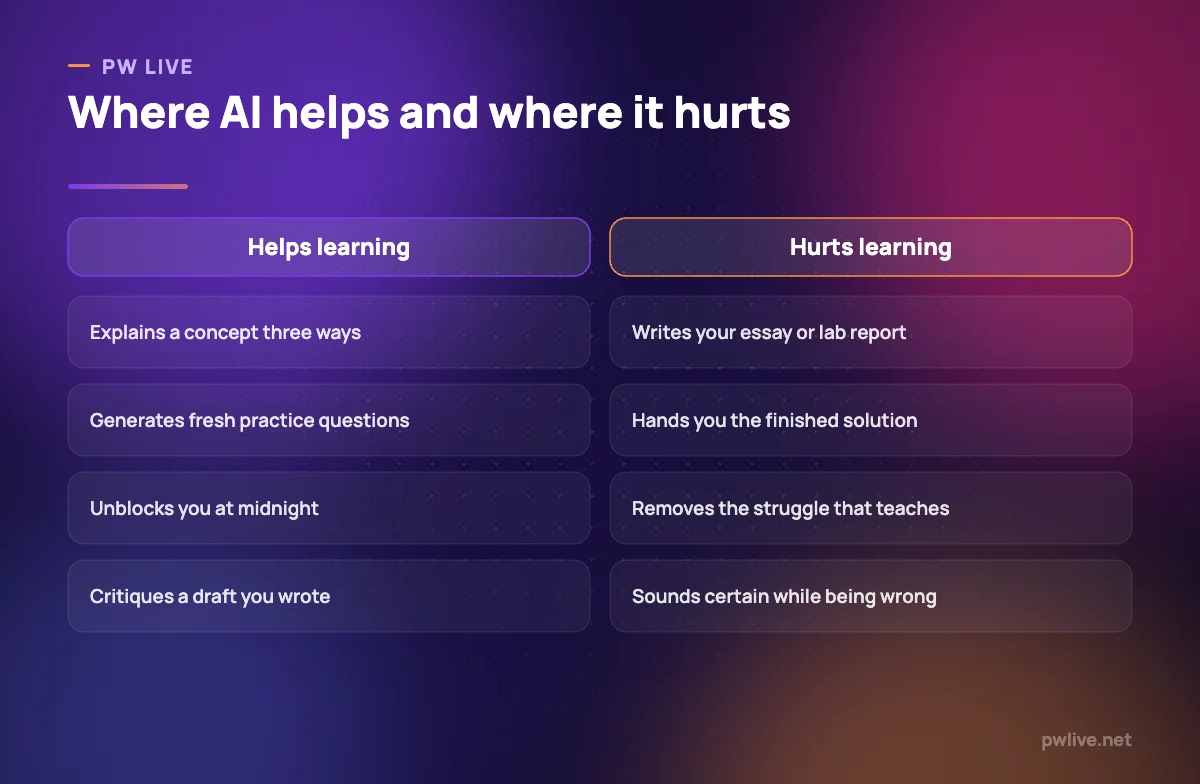
- Explaining at your level. You can ask for the same concept three different ways until one clicks, without embarrassment.
- Generating practice. Endless fresh questions on any topic, at any difficulty, with instant feedback.
- Unblocking you at midnight. When you are stuck on step four of a derivation and nobody is awake, help is available.
- Summarising and organising. Long readings can be condensed into structured notes you then refine yourself.
- Language support. Students studying in a second language can check understanding and improve their writing.
None of this replaces a good teacher. It fills the gaps between lessons, which is where most learning is lost.
Where they quietly hurt your learning
The speed that makes these tools helpful also makes them dangerous. Three failure modes recur.
The illusion of understanding
Reading a clear explanation produces a feeling of understanding. That is not the same as being able to reproduce the idea in an exam. If the tool does the thinking, you get the feeling without the ability.
Confident mistakes
AI tools can be wrong while sounding certain, especially in multi-step maths, niche syllabus details and anything that changed recently. A student who cannot judge the answer cannot catch the error.
Outsourced writing
Letting a tool write your essay or lab report removes the one activity that builds clear thinking. You hand in something polished and learn nothing, which shows up later in the viva.
Rule 1: Struggle first, then ask
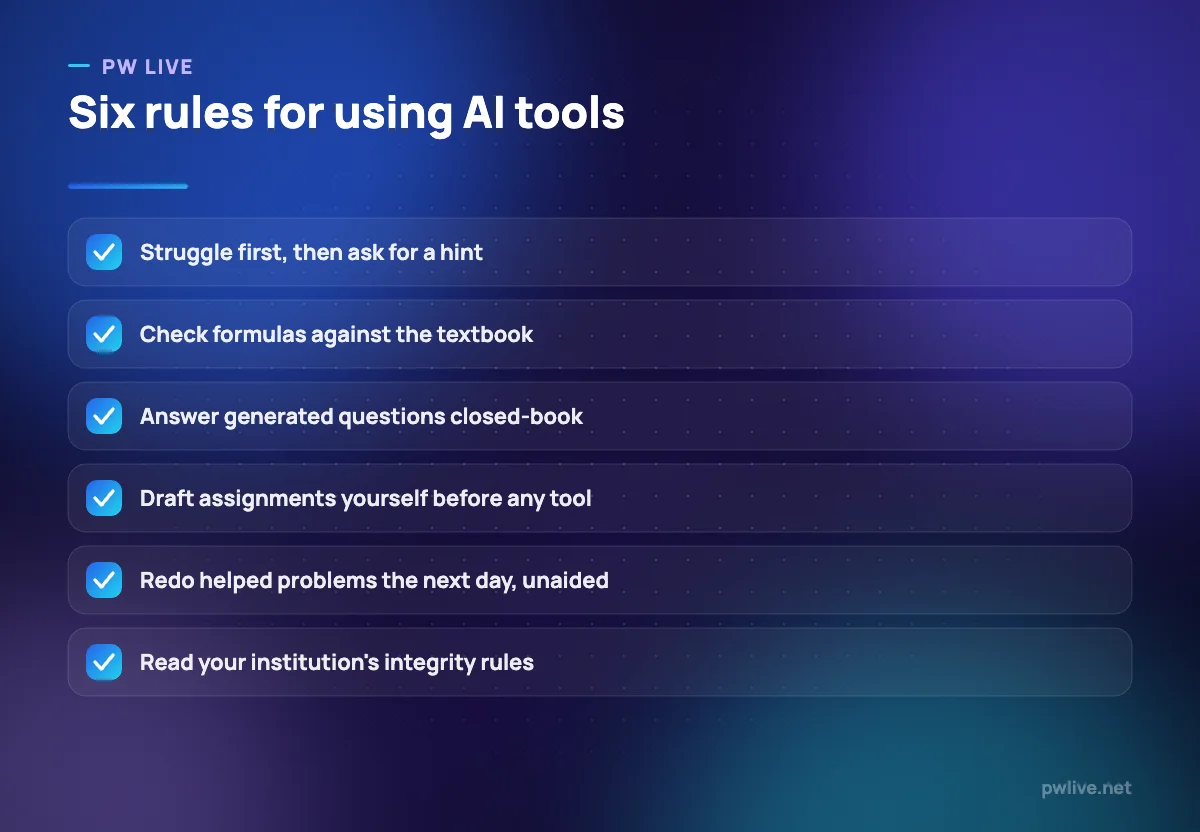
The learning happens in the struggle. Set a minimum effort before you open the tool: for example, ten genuine minutes on a problem, or one full attempt at a proof.
When you do ask, ask for a hint rather than a solution. “What concept applies here?” teaches you more than “solve this”.
If you got the answer with help, redo it from scratch the next day without the tool. If you cannot, you have not learnt it yet.
Rule 2: Verify anything that matters
Treat AI output like a clever classmate’s notes: helpful, probably right, occasionally wrong in costly ways.
- Check formulas and definitions against your textbook or official syllabus.
- For numerical answers, work the problem backwards or estimate the expected size of the result.
- Be especially cautious with dates, names and citations.
Verification is not wasted time. It is active learning in disguise: checking an answer forces you to understand it.
Rule 3: Generate practice, do not consume answers
The highest-value use of an AI study tool is as a question machine.
- Ask for ten questions on a topic, at exam difficulty, and answer them closed-book before requesting solutions.
- Ask it to quiz you on a chapter until you get three in a row correct.
- Paste your own written explanation and ask what is missing or unclear.
In each case the tool sets the challenge and you do the work. Our exam strategy page covers fitting this kind of practice into a revision plan.
Rule 4: Protect your own thinking
For any assignment meant to develop your reasoning or writing, draft it yourself first.
- Write the full draft without any tool.
- Ask the tool to critique the structure and point out weak arguments.
- Revise it yourself, in your own words.
- Use the tool for a final grammar and clarity check only.
This keeps the thinking yours while improving the result. It also keeps you on the right side of your institution’s academic integrity rules, which you should read before using any tool on graded work.
A simple weekly workflow
How the rules fit together in a normal study week:
- Learning new material: watch or read first, attempt the examples, then ask the tool to explain only what you got wrong.
- Practising: generate fresh questions, answer them closed-book, verify the solutions.
- Revising: ask the tool to quiz you from your own notes, and log every mistake.
- Writing: draft alone, critique with the tool, revise alone.
Note how often you needed help. If every problem did, you are practising above your level and should step back a chapter.
To understand how these tools work, see our data science and AI skills page. For more on technology in education, browse our technology category.
Key takeaways
- AI study tools are excellent at explaining, generating practice and unblocking you outside lesson hours.
- They are dangerous when they replace the struggle that produces real learning.
- Set a minimum effort before asking for help, and ask for hints rather than solutions.
- Verify anything that matters against a textbook or official source.
- Use the tool as a question generator and a critic, not a writer or a solver, and check your institution’s rules first.
Frequently asked questions
Is it cheating to use AI tools for studying?
Using them to explain concepts, generate practice questions or check your understanding is studying. Submitting work the tool produced as your own usually breaches academic rules.
Can an AI tool replace a tutor or coaching?
It can replace some of what a tutor does, such as explaining and setting problems, but it cannot judge your progress, spot patterns in your mistakes or hold you accountable over months.
Which AI study tool is the best?
The one you use with discipline. Features matter less than your habits: struggling first, verifying answers and doing the writing yourself.
Keep learning with PW Live
Browse every guide in Technology & Software, or pick a skill track and follow the roadmap step by step.





Leave a Reply