

Spaced repetition is the practice of reviewing material at increasing intervals rather than in one long block. It is one of the few study techniques that reliably beats the alternative, and it is also one of the easiest to set up badly.
The reason it works is not mysterious. Memory fades on a predictable curve, and each successful recall just as it starts to fade flattens that curve. Reviewing something you have almost forgotten strengthens it far more than reviewing something you just read.
This guide covers what to review, when to review it, and how to run the system in twenty minutes a day rather than letting it become a second syllabus.
What spaced repetition is actually for
Spaced repetition is a retention tool, not a learning tool. It keeps things you already understand from leaking away. It cannot teach you a concept you never grasped.
That distinction saves a lot of wasted effort. If you do not understand why a formula holds, putting it on a card produces a student who can state it and cannot use it. Learn the concept first, then schedule its retention.
The technique is at its most valuable for:
- Formulas, constants, definitions and standard results
- Vocabulary in any language
- Dates, sequences, classifications and named processes
- Reaction conditions, exceptions and special cases
- The specific method that applies to a specific question type
It is least valuable for long derivations, essay arguments and open problem-solving skill, which need practice under realistic conditions instead.
Choose your intervals and stop optimising them
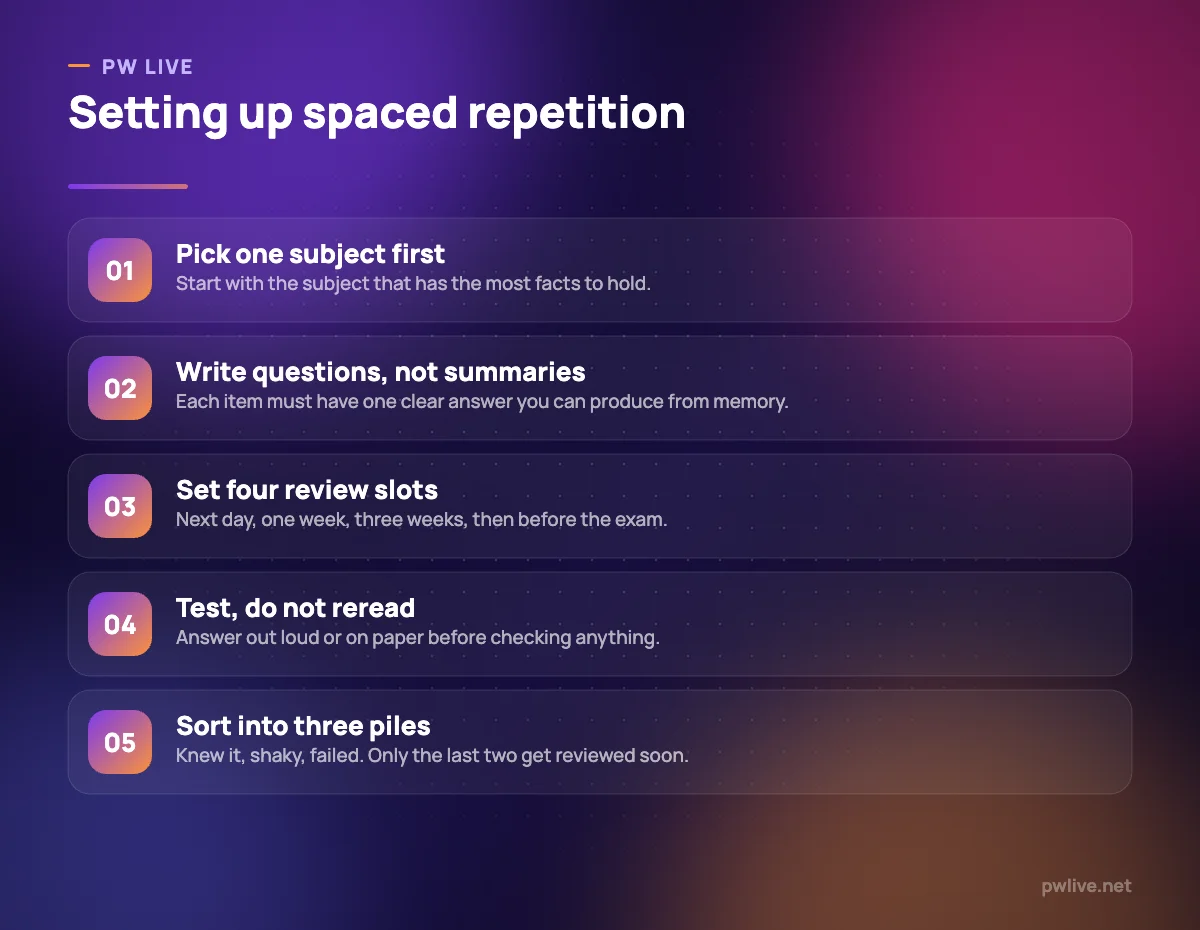
Students lose more time choosing a schedule than following one. Any increasing sequence works. Start with this and adjust later:
- Same day, briefly, within a few hours of first learning it
- Next day
- After about a week
- After about three weeks
- A final pass in the last month before the exam
The rule underneath the numbers: if you got it right easily, push the next review further out. If you failed it, bring it back to tomorrow. Precision does not matter; increasing gaps do.
For a long preparation, this naturally folds into your overall plan. Our six-month exam preparation timeline shows where review blocks sit alongside new chapters, and the weekly study timetable guide covers protecting the daily slot.
Write items you can actually answer
A card or a review item is only useful if it demands one specific answer. Most beginners write items that are really paragraphs, then feel vaguely satisfied after reading them.
Rules that make items work:
- One question, one answer. If your answer has three parts, make three items.
- Ask for production, not recognition. “What is the condition for X?” beats “Is X true?”
- Include the context. “In which reaction” or “for which case” prevents you learning an answer that floats free of its use.
- Keep the answer short enough to say out loud. If you cannot say it, you will skip it.
- Write in your own words, so the item connects to the way you actually think about the topic.
Two useful item types beyond simple facts. A worked-step item asks “what is the first step when you see this kind of question?”, which trains method selection rather than recall of a result. An error item records a mistake you actually made, phrased as a question: “what do you always forget in unit conversions here?”
Those error items are usually the highest-value ones you own, and they come straight out of the analysis you do after a test. Our guide to analysing a mock test properly is where most of them will originate.
Paper or app, and how to run either
You do not need software. Both routes work, and the right one is the one you will open daily.
The paper method. Keep index cards or a slim notebook with questions on one side and answers on the other. Use three envelopes or dividers labelled daily, weekly and monthly. Every card you get right moves one box out; every card you get wrong moves back to daily. Review the daily box every day, the weekly box on a fixed weekday, the monthly box on a fixed date.
The app method. A spaced-repetition app schedules the intervals for you and handles thousands of items without administration. Look for one that lets you export your data, works offline, and does not require you to download somebody else’s decks. Building your own items is most of the benefit, because writing the question is itself a study act.
Whichever you use, our roundup of free apps and tools for studying and staying organised explains what to look for before you commit your data to anything.
Keep the daily load small and honest
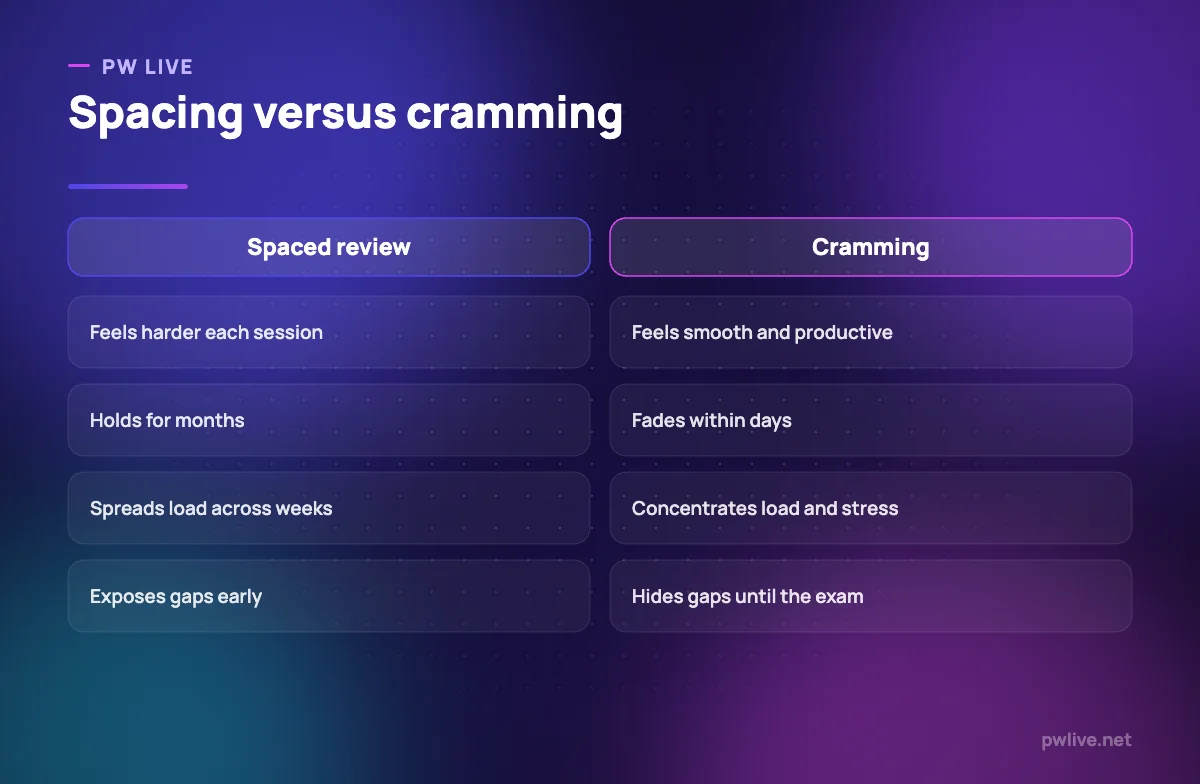
The most common failure is not forgetting to review. It is building a backlog so large that opening the deck feels like punishment.
Protect yourself with three limits:
- Cap new items per day. A modest, fixed number you can sustain beats a burst of two hundred cards in one enthusiastic evening.
- Cap review time. Twenty minutes is enough for most school and exam preparation. If it exceeds that regularly, your items are too long or too many.
- Delete ruthlessly. An item you have got right five times in a row can leave the system. An item you keep failing needs to be rewritten, not repeated, because failing repeatedly usually means the underlying concept is missing.
When the backlog does build up, do not try to clear it in one sitting. Review only the oldest portion each day for a week and let the rest wait. A partial system running daily beats a complete system you avoid.
Combine it with active recall and practice
Spaced repetition schedules retrieval; retrieval is what actually builds the memory. The two ideas are inseparable, and our guide to active recall as a study technique covers the retrieval side in detail.
A study week that uses both looks roughly like this:
- Learn a new topic properly, from a book or lecture
- Make short, question-shaped notes you will actually revise the same day
- Convert the facts and methods into review items
- Do problem practice on the topic within a few days, under time
- Let the review system bring the facts back at widening intervals
Notice that spaced repetition sits alongside problem practice, not instead of it. Cards keep the ingredients available. Solving full questions under time is what teaches you to cook.
What to do in the last month
Close to the exam the intervals compress, because there is no point scheduling a review for after the paper.
Switch the system in three ways. Bring everything into a single sweep, so every item is seen at least once in the final weeks. Prioritise the items you have failed most often rather than covering everything evenly. And convert as much as possible into full-question practice, because at that stage speed and selection matter more than isolated recall.
Our guide to revising an entire syllabus in the last 30 days sets out how the whole schedule changes at that point. For related study techniques, browse the education and learning archive or the exam strategy skill track.
Key takeaways
- Spaced repetition maintains what you already understand; learn the concept first
- Any increasing interval sequence works, so pick one and stop optimising it
- Write one-question, one-answer items you can produce from memory out loud
- Paper boxes and apps both work; choose the one you will open every day
- Cap new items and review time, and delete items you have mastered
- Pair it with problem practice, and compress everything into one sweep before the exam
Frequently asked questions
How many minutes a day does spaced repetition need?
Fifteen to twenty-five minutes is enough for most students. If it takes longer, you have too many items or your answers are too long to be recalled properly.
Can I use decks made by other students?
You can, but you lose most of the value. Writing the question forces you to decide what matters, and other people’s phrasing rarely matches how you understand the topic.
Does spaced repetition help with problem-solving subjects?
Partly. It keeps formulas, conditions and method choices available, but you still need timed practice on full questions to build the actual solving skill.
What if I miss a week of reviews?
Restart with the oldest items and work forward over several days. Do not clear the whole backlog at once, and do not abandon the deck because it has grown.
Keep learning with PW Live
Browse every guide in Education & Learning, or pick a skill track and follow the roadmap step by step.





Leave a Reply