

Most study timetables fail in the second week. They are built for an imaginary version of you who wakes at five, never gets tired and has no family, and the first ordinary Tuesday breaks them. A weekly study timetable that survives real life is built the opposite way, starting from the hours you genuinely have.
The purpose of a timetable is not to maximise study hours. It is to remove decisions. If you have to decide what to study every time you sit down, you will burn energy on the choice and default to whatever feels easiest.
Here is how to build one in about forty minutes, and how to keep it alive after the first bad week.
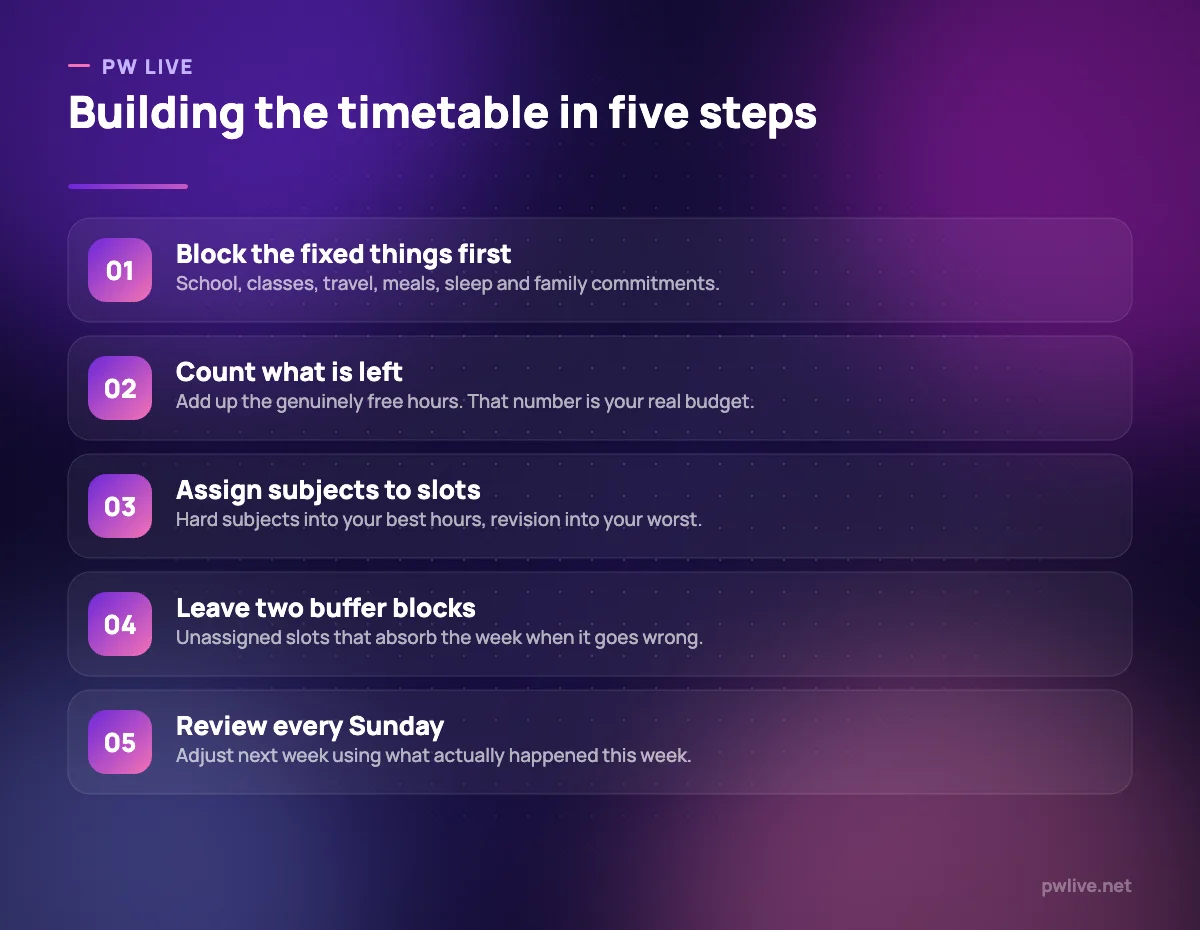
Start with the immovable things
Before you allocate a single study hour, put in everything that is not negotiable.
- School, college or work hours
- Coaching or class timings
- Travel time, both ways, realistically
- Sleep, at a fixed and sufficient length
- Meals and getting ready
- Regular family commitments and one weekly rest block
Do not shave these to make room. Sleep in particular is not spare capacity; cutting it reduces the value of every hour you then add, and the effect on recall and exam performance is well documented in our guide to sleep and study performance.
Now add up what is left. That total, whatever it is, is your real weekly study budget. Five hours a day for a working candidate is fiction; two focused hours is a plan.
Assign subjects to the hours that fit them
Not all hours are equal. Your concentration follows a rough daily pattern, and matching tasks to it is free performance.
Your sharpest hours should hold the thing you find hardest: new concepts, problem-solving in your weakest subject, mathematics. Most people have a clear window in the morning or late evening, and you probably already know which is yours.
Your medium hours hold reading, lectures and note processing.
Your low hours, such as the tired slot straight after a heavy meal or a long commute, hold review, flashcards, formula sheets and organising. Those still count and still matter.
Guard against the most common allocation error: giving your best hours to the subject you enjoy. Enjoyment already makes that subject easy. The weak subject needs the good hours, and it needs them before the enjoyable one, not after.
Write tasks, not subjects
“Physics, 7 to 9 pm” is not a plan; it is a category. When 7 pm arrives you will spend fifteen minutes deciding what to do and then reread something comfortable.
Write blocks as specific, finishable tasks:
- “Rotational motion: 12 problems from the chapter set, then mark errors”
- “Organic reactions: build review cards for the three named mechanisms”
- “Read chapter 4 and write the one-page summary”
Three tests for a well-written block. Can you start it within a minute of sitting down? Can you tell at the end whether you finished it? Is it sized to the block rather than infinite? If any answer is no, rewrite it.
The output requirement matters most. Every block should produce something visible: solved problems, a summary page, a set of review items, a marked test. Blocks with no output are the ones that turn into scrolling.
Build in the buffer that keeps the plan alive
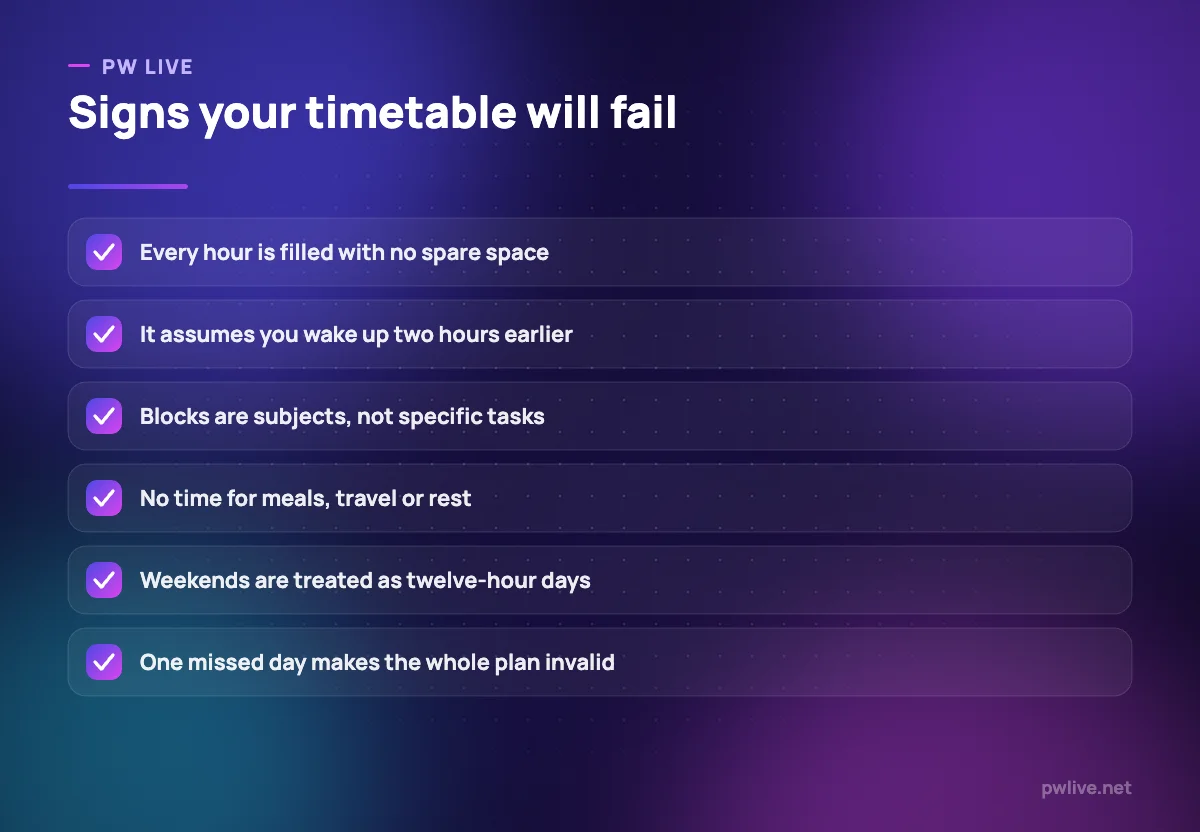
This is the step almost every student skips, and it is the reason timetables collapse.
Leave at least two blocks a week completely unassigned. Call them catch-up blocks. Their job is to absorb the guest who arrived, the class that ran long, the day you felt ill, or the topic that took twice as long as expected.
If nothing went wrong, use a catch-up block for revision or take it off. Either is a win. What you must not do is fill them in advance, because a timetable with no slack transmits a single disruption through the whole week.
Similarly, keep one evening genuinely free. A plan with no rest in it is not sustainable for a six-month preparation, and the burnout it produces costs far more weeks than it saves hours. Our guide to exam stress and burnout covers the warning signs worth watching for.
Balance new learning, practice and revision
A timetable can be full and still fail if the mix is wrong. Across a typical week, your hours should split roughly into three jobs.
- New learning: reading chapters, attending or watching lectures
- Practice: solving problems, writing answers, taking timed sections
- Revision: returning to older topics through self-testing
Students in the early months usually over-allocate to new learning and end up covering the syllabus once, badly. Students in the final months often over-allocate to revision and stop practising under time.
Two practical rules keep the mix honest. Never let a week pass with zero timed practice, however early you are in the preparation. And schedule revision as fixed slots rather than as something you will do “when there is time”, using the widening intervals described in our practical guide to spaced repetition.
A weekly test slot, followed by a dedicated block to analyse it, is the highest-value pairing in most timetables. The analysis block is not optional; our guide to analysing a mock test properly explains why the test itself teaches you very little without it.
Choose a format you will actually open
The best format is the one that is in front of you when you sit down.
Paper on the wall or the desk works because it is always visible and takes no unlocking. It suits students with a stable weekly pattern.
A calendar app works because it reminds you, repeats automatically and syncs across devices. It suits people whose weeks vary. Our guide to using a calendar app as your study planner covers the setup.
A spreadsheet works if you want to track planned versus actual hours and see patterns over months, as described in our piece on using spreadsheets for study planning.
Whatever you choose, keep the whole week visible on one screen or one page. A timetable you have to scroll through is a timetable you will stop consulting.
Run a thirty-minute Sunday review
A timetable is a hypothesis about your week. The review is where you test it.
Every Sunday, sit down for half an hour and answer four questions:
- Which blocks did I actually complete, and which did I skip every time?
- What took longer than I planned?
- What is the single weakest topic right now?
- What is the one change I will make to next week?
Then rewrite the coming week. A block you have skipped three weeks running is not a discipline problem, it is a badly placed block: move it, shorten it or delete it.
One change per week is the right pace. Rebuilding the entire timetable every Sunday is a form of procrastination that feels like planning. Our piece on the weekly review habit sets out the full routine, and more study-system material is collected in the education and learning archive and the productivity skill track.
Key takeaways
- Block fixed commitments and sleep first, then count the hours that genuinely remain
- Give your sharpest hours to your weakest subject, not your favourite one
- Write specific, finishable tasks with a visible output, never subject names
- Leave two unassigned catch-up blocks and one free evening every week
- Keep a weekly mix of new learning, timed practice and scheduled revision
- Review on Sunday and change exactly one thing for the coming week
Frequently asked questions
How many hours a day should I study?
There is no universal number. Count the hours you actually have after fixed commitments and sleep, then aim for consistency in that budget rather than for a figure you saw someone else quote.
What should I do when I miss a whole day?
Use a catch-up block, drop the lowest-priority task from the week, and restart from today’s block. Do not attempt to replay the missed day on top of a full one.
Should my weekend look different from weekdays?
Yes. Weekends are best used for longer blocks that do not fit on weekdays, such as full-length tests, test analysis and revision of older chapters, with one genuine rest block kept intact.
How often should I rebuild the timetable?
Adjust weekly with one small change, and rebuild fully only when something structural shifts, such as new class timings, exam proximity or a change in your weakest subject.
Keep learning with PW Live
Browse every guide in Education & Learning, or pick a skill track and follow the roadmap step by step.





Leave a Reply