

Active recall is the practice of pulling information out of your memory instead of putting it in again. It is the single technique with the biggest gap between how effective it is and how often students use it, because it feels much worse than re-reading while working much better.
That feeling is the whole problem. Re-reading a chapter produces fluency: the words look familiar, so your brain concludes you know the material. The exam then asks you to produce it from nothing, which is a completely different task you never practised.
This guide covers what to do instead, three retrieval methods you can start today, and how to handle the discomfort that makes most students quit in week one.
Why re-reading feels productive and fails anyway
When you read a page for the third time, processing is smooth and nothing surprises you. Your brain reads that smoothness as competence. This is why students walk out of an exam genuinely shocked, having “known everything” the night before.
Retrieval breaks the illusion in the most useful way possible. When you close the book and try to write the topic out, the gaps appear immediately and unarguably. Every gap you find in your room is a mark you do not lose in the hall.
There is a second, larger benefit. The act of retrieving strengthens the memory itself. Each successful effortful recall makes the next one easier, which is why testing yourself is not merely a measurement of learning but a cause of it.
The blank page method
This is the simplest version and requires nothing but paper.
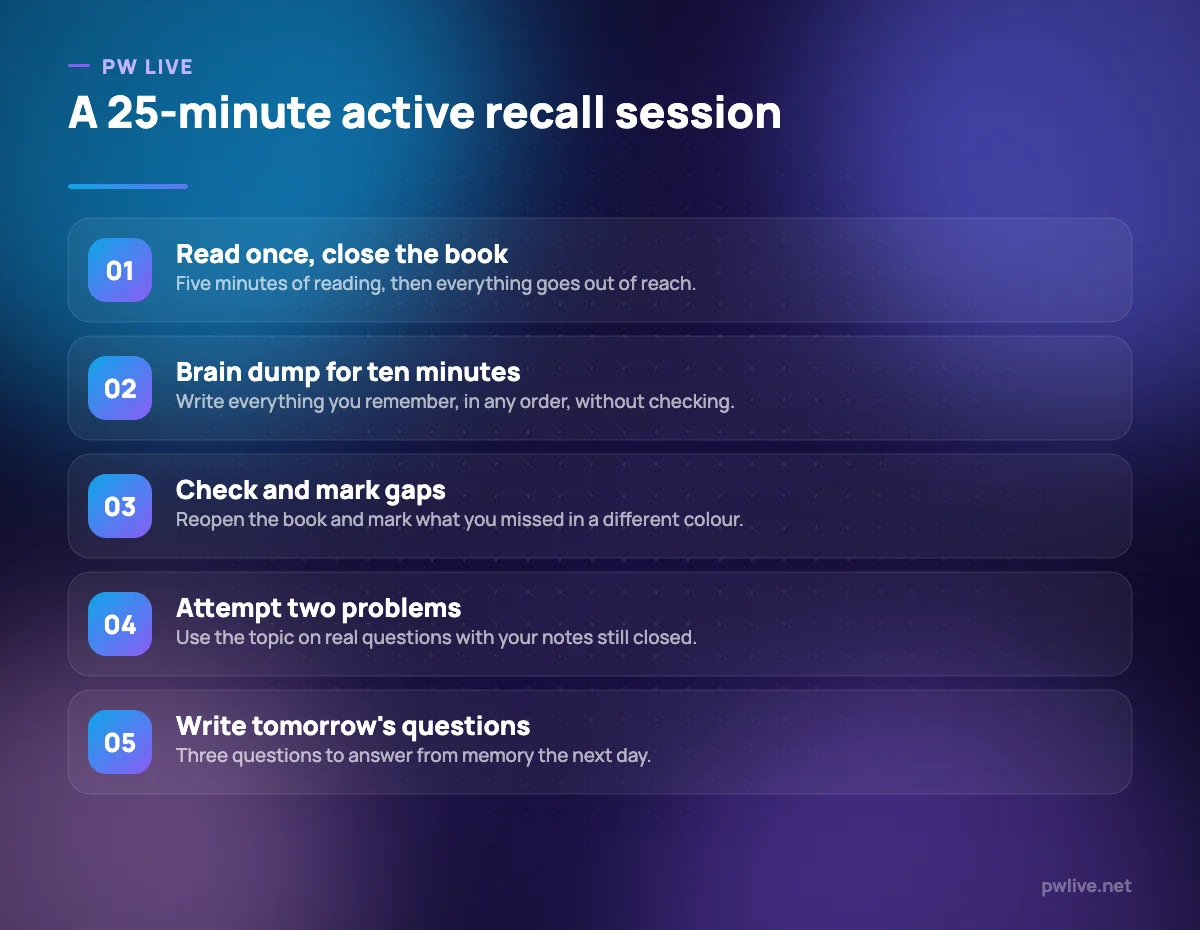
- Study a topic normally for a short block, then put everything away
- Take a blank sheet and write the topic name at the top
- Write everything you can remember: definitions, formulas, the logic, worked steps, diagrams, exceptions
- Stop when you genuinely run dry, not when it gets uncomfortable
- Reopen the source and mark what you missed in a different colour
Do the marked version again two days later. The second attempt is where the real gain shows up, and the coloured gaps tell you exactly what to focus on rather than making you revise the entire chapter evenly.
For most students, the first blank page attempt on a chapter they “know well” is a genuinely humbling experience. That reaction is a sign the technique is working, not that you are behind.
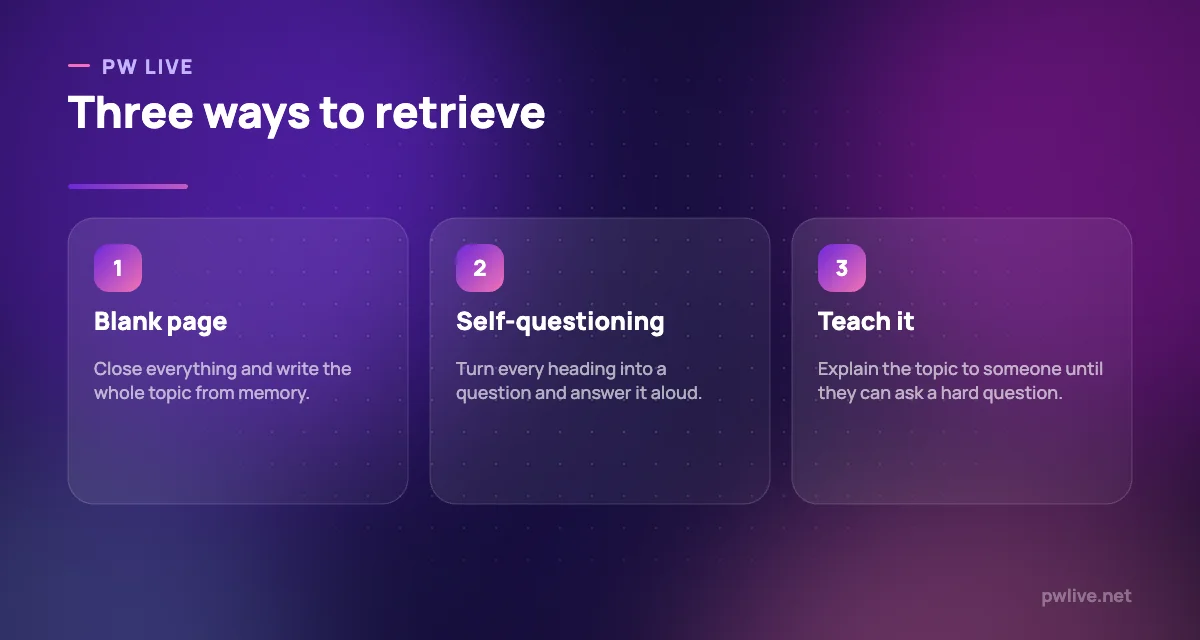
Turn everything into questions
The second method converts your material into a question bank as you study, so retrieval practice is always available.
Take any set of notes and turn each heading, bold term and boxed formula into a question. “Photoelectric effect” becomes “what does the photoelectric effect show that the wave model cannot explain?” A boxed formula becomes “when does this formula apply, and what breaks it?”
Good questions share three features:
- They demand production, not recognition
- They have one clear answer you can state in under a minute
- They include the context in which the answer is used
Write these questions in the margin of your notes rather than in a separate file, so testing yourself needs no setup. The page layout that makes this fast is described in our guide to taking notes you will actually revise.
The act of writing the question is itself powerful, because deciding what a section is really asking forces you to identify the point of it. Students who write their own questions consistently outperform those who use somebody else’s.
Teach it to somebody
Explaining a topic out loud, without notes, exposes gaps that silent recall hides. You can be vague inside your own head; you cannot be vague to another person’s face.
Practical versions, in order of usefulness:
- Explain to a classmate who is allowed to interrupt with “why?”
- Explain to a family member who knows nothing about the subject, which forces plain language
- Explain to an empty room, out loud, standing up. It works better than it sounds
- Record a two-minute voice explanation and listen back for the parts where you hesitated
The hesitation is the data. Wherever your explanation went quiet, hedged or jumped ahead, you have found the boundary of your understanding. Study groups are useful mainly for this reason, and our guide to building a support system when studying gets hard covers how to set one up without it becoming a social hour.
Use past papers as recall, not as assessment
Most students treat past papers as a final test of readiness and save them for the end. That wastes their best use.
Attempt questions on a topic as soon as you have studied it, with notes closed, even if you can only do a third of them. This is retrieval under the exact conditions the exam will demand, which is far more useful than clean flashcard recall.
Then mark honestly, and for every wrong answer write the cause rather than the topic. “Did not recall the formula” leads to a review item. “Recalled the formula, applied it to the wrong case” leads to more practice on selection. “Ran out of time” leads to a timing change. Our guide to analysing a mock test properly sets out that classification in detail, and the negative marking strategy guide covers the decision layer on top of it.
Handle the discomfort, because it is the point
Active recall feels bad in a specific way: slow, effortful and slightly humiliating. Students abandon it in the first week for exactly that reason and return to highlighting, which feels calm.
Four things make it survivable.
Start small. One ten-minute blank page per day is enough to begin. Do not convert your entire study routine at once.
Expect a low first score. Recalling only a fraction of a chapter you just read is normal, not evidence of a bad memory.
Track the second attempt, not the first. The number that matters is how much you recall on the repeat, and it rises quickly.
Separate learning from testing. Understand a topic first, properly, through reading or a lecture. Retrieval is for material you have already made sense of, not a substitute for the explanation.
Fit recall into your existing routine
Active recall does not need extra hours. It replaces the least useful parts of what you already do.
- Replace re-reading with a blank page, same time cost
- Replace copying notes with answering your own margin questions
- Replace watching a solved example with attempting it first, as described in our guide to studying from video lectures
- Replace passive revision slots in your plan with self-testing slots, using the weekly study timetable approach
Then schedule the repeats. Retrieval is most powerful when it happens just as material starts to fade, which is what our practical guide to spaced repetition handles. Active recall is the action; spacing is the calendar. Neither works nearly as well without the other.
More techniques of this kind are collected in the education and learning archive, and the exam strategy skill track covers how they map onto specific papers.
Key takeaways
- Re-reading creates fluency, which your brain mistakes for knowledge
- Retrieval both reveals gaps and strengthens the memory being retrieved
- The blank page method needs nothing but paper and exposes gaps in minutes
- Write your own questions in the margins so testing needs no setup
- Explaining out loud finds gaps that silent recall hides
- Expect the first attempts to feel bad and score low; judge the technique on the repeats
Frequently asked questions
How is active recall different from spaced repetition?
Active recall is the act of retrieving from memory. Spaced repetition is the schedule that decides when you do it. Used together, the recall does the work and the spacing decides the timing.
Does active recall work for theory-heavy subjects?
Yes, and it is arguably more useful there. Blank page recall of a full topic, followed by writing structured answers from memory, is the closest practice to what a descriptive paper actually asks.
How much should I recall on a first attempt?
Recalling around a third to a half of a freshly studied chapter is normal. What matters is the improvement on the second and third attempts, not the first score.
Can I use active recall the night before an exam?
Yes, on material you already know, using quick self-testing rather than fresh reading. Avoid starting a completely new topic through retrieval at that stage; it will cost confidence you need the next morning.
Keep learning with PW Live
Browse every guide in Education & Learning, or pick a skill track and follow the roadmap step by step.





Leave a Reply