

If you want to know how to analyse a mock test properly, start with an uncomfortable fact: the test itself teaches you almost nothing. The learning happens in the two hours after it, when you find out exactly why each mark went missing.
Most students check the score, feel something about it, glance at a few solutions and move on. Three mocks later the same mistakes are still there, because nobody ever named them.
A good analysis turns a number into a list of actions. This guide gives you a repeatable process you can run after every paper, whether you are preparing for an engineering entrance, a medical entrance or a university admission test.
Why your score is the least useful part of the paper
A score tells you where you stand today. It does not tell you what to do tomorrow, and it is the part students stare at longest.
Two people can score identically for completely different reasons. One knows the syllabus but panics and rushes; the other is calm but has three chapters missing. The same score, two opposite study plans.
So treat the score as a headline and the paper as the article. What you actually need from a mock is a breakdown: which chapters failed, which mistakes repeat, and where your time went. Everything below is about extracting those three things.
Set up the review before you start
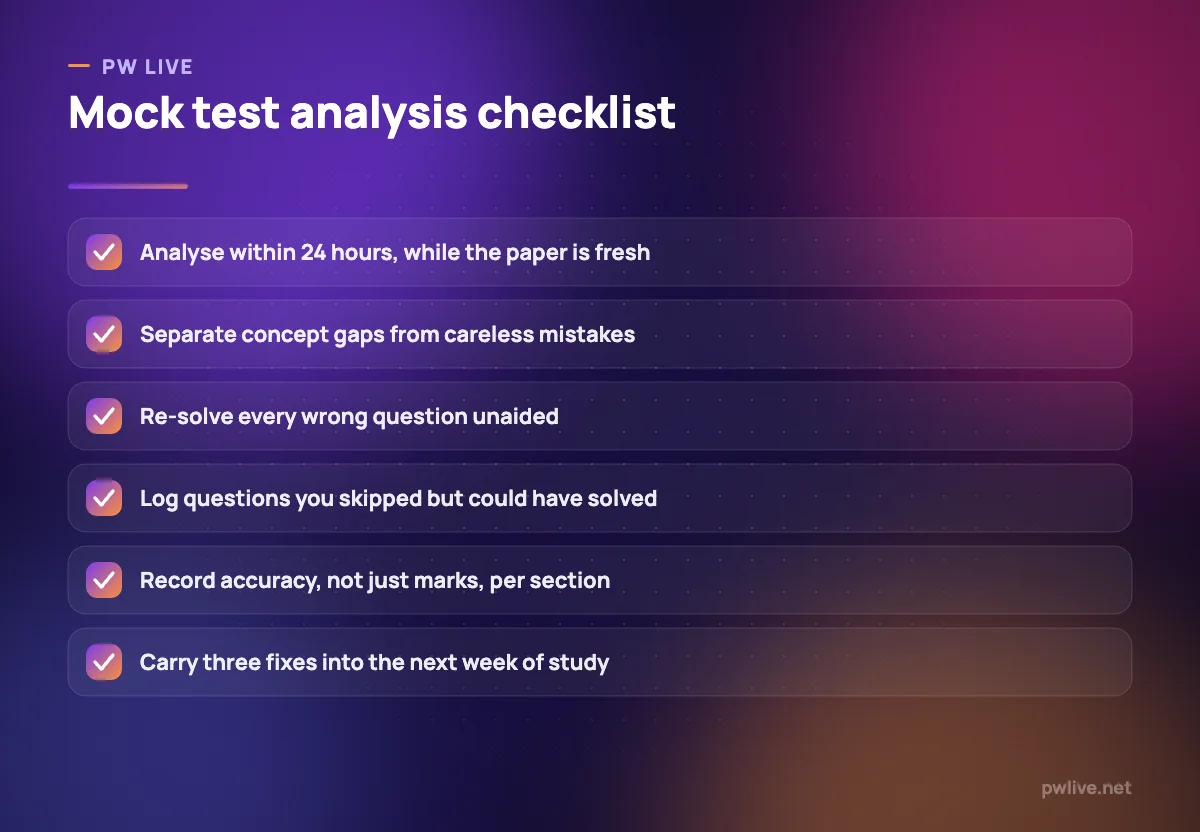
Do the analysis within a day, while you still remember what you were thinking during each question. After that, your memory of your own reasoning fades and you are left guessing.
Give it a fixed slot. A three-hour paper deserves roughly ninety minutes to two hours of review, and that time is more valuable than another mock taken carelessly.
You need three things in front of you: the question paper, your own answer sheet or attempt log, and blank paper. Keep the solutions closed for now. If your test platform shows time spent per question, screenshot it or note it down before it disappears.
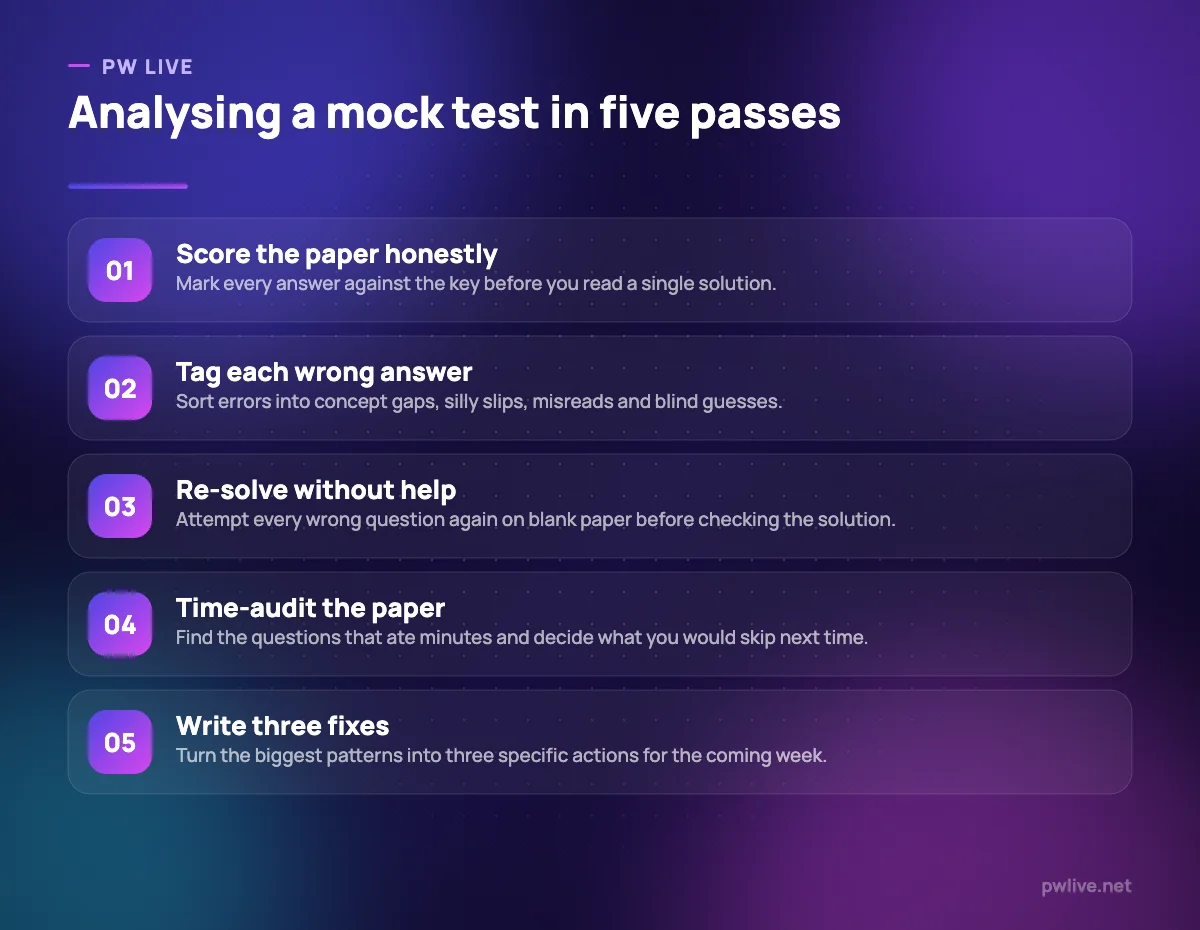
Sort every mistake into one of four buckets
This is the heart of the method. Go question by question through everything you got wrong or skipped, and label it:
- Concept gap. You did not know the idea, formula or method. This is a study problem.
- Application error. You knew the concept but could not see how to apply it here. This is a practice problem.
- Careless slip. Sign error, wrong unit, misread option, calculation mistake, right answer marked in the wrong row. This is a process problem.
- Time or nerve. You could have solved it, but you rushed, panicked or ran out of clock. This is a strategy problem.
Do not let “silly mistake” become a bucket for everything. If you keep dropping negative signs, that is a repeatable pattern with a repeatable fix, not bad luck.
Count the buckets at the end. The largest one tells you what next week’s study plan should mainly be about. A paper full of concept gaps needs revision; a paper full of slips needs slower, cleaner solving habits, not more chapters.
Re-solve before you read the solution
For every wrong question, close the solution and try it again on blank paper with no time limit.
What happens next is the real diagnosis. If you solve it comfortably, it was never a knowledge problem, it was pressure or speed. If you stare at it blankly, you have found a genuine gap and you know which chapter to open.
Only after that second attempt should you read the official solution. Read it looking for the step you missed, not the final answer, and note that step in your own words.
Audit your time and your skipping decisions
Marks are lost in two invisible places: questions you spent too long on, and questions you should have attempted but did not.
Look for any question that took more than roughly twice your average time per question. Ask what the exit signal should have been. Deciding in advance “if I have no route after ninety seconds, I move on” is more useful than promising yourself you will be faster.
Then find the questions you left blank and could clearly have solved. These are pure lost marks and usually the fastest gains available to you. Read them alongside our guide to deciding when to attempt and when to skip, because skipping well is a trainable skill.
Also check accuracy per section, not just marks. Attempting 40 questions at 60 per cent accuracy and 30 at 85 per cent are very different papers, and only one of them is improving.
Keep an error log you actually reread
One notebook or one spreadsheet, used for every mock. Columns work well: date, question topic, what went wrong, and the one-line correction.
Keep the entries short. “Ignored the direction of friction on an inclined plane” is useful; a full copied solution is not, because you will never reread it.
Before your next mock, read the last two pages of this log. That five-minute habit is the single cheapest way to stop repeating an error, and it pairs naturally with active recall as a revision method. If you prefer a digital version, a simple spreadsheet with a filter by chapter does the job better than any complicated system.
Turn the analysis into next week’s plan
End every review by writing exactly three actions. Three is enough to be honest and few enough to actually finish.
A good set looks like this:
- One concept fix. Revise a named topic and redo ten questions from it, scheduled on a specific day.
- One process fix. A concrete habit, such as writing units at every step, or re-reading the question stem before marking the answer.
- One strategy fix. Something about the paper itself, such as attempting the section you are strongest in first, or capping time on any single question.
Put those three items into your weekly study timetable immediately, while the paper is still fresh. Analysis that never reaches your schedule is just reading.
If a whole chapter turns out to be missing rather than weak, treat that separately with a proper plan to catch up in a subject rather than trying to patch it in an evening.
How often to take mocks, and what to expect
There is no universal number, but the useful ratio is simple: never take a new mock until you have analysed the last one. An unanalysed paper is an expensive way to feel busy.
Expect scores to wobble. Papers vary in difficulty, and a dip after you change your strategy is normal while the new habit settles. Judge yourself on accuracy and on repeated errors disappearing, not on a single number.
More articles on test preparation are collected in our exams and admissions section, and the wider exam strategy track covers planning, revision and paper technique in more depth.
Key takeaways
- The score is a headline; the analysis is the actual content of a mock test.
- Review within 24 hours, before you forget your own reasoning.
- Sort every mistake into concept gap, application error, careless slip, or time and nerve.
- Re-solve wrong questions unaided before opening the solution.
- Track accuracy and time per section, and log the questions you wrongly skipped.
- Finish with exactly three fixes, written into next week’s timetable.
Frequently asked questions
How long should I spend analysing a mock test?
Roughly half to two-thirds of the time the paper itself took, so about ninety minutes to two hours for a three-hour test. If that feels long, take fewer mocks rather than shortening the review.
Should I analyse questions I got right?
Scan them quickly. Flag any you guessed correctly or solved by a long route, because a lucky right answer hides a real gap and a slow right answer costs you marks elsewhere.
My score keeps dropping. Should I stop taking mocks?
No, but check whether the papers are getting harder or your strategy recently changed. Look at accuracy and repeated errors instead of raw marks, and give any new approach three or four papers to settle.
Do I need to analyse sectional tests the same way?
Yes, though it takes less time. Sectional tests are actually better for isolating concept gaps, because the smaller topic range makes patterns in your mistakes easier to see.
Keep learning with PW Live
Browse every guide in Exams & Admissions, or pick a skill track and follow the roadmap step by step.





Leave a Reply