

A good study space setup has almost nothing to do with owning a desk. It has to do with light, posture, noise, storage and a clear signal to everyone else that you are working. All of that is achievable in a shared room, on a dining table, or in the corner of a bedroom that three people use.
The aim is not a photogenic corner. The aim is a place where sitting down means starting, and where you are not fighting your chair, your neck or your family for the next ninety minutes.
Here is how to build one in a small or shared home, in an afternoon, with what you already have.
Choose the spot by light and traffic, not by size
Walk through your home at the hours you usually study and look for two things: where the light is, and where people walk.
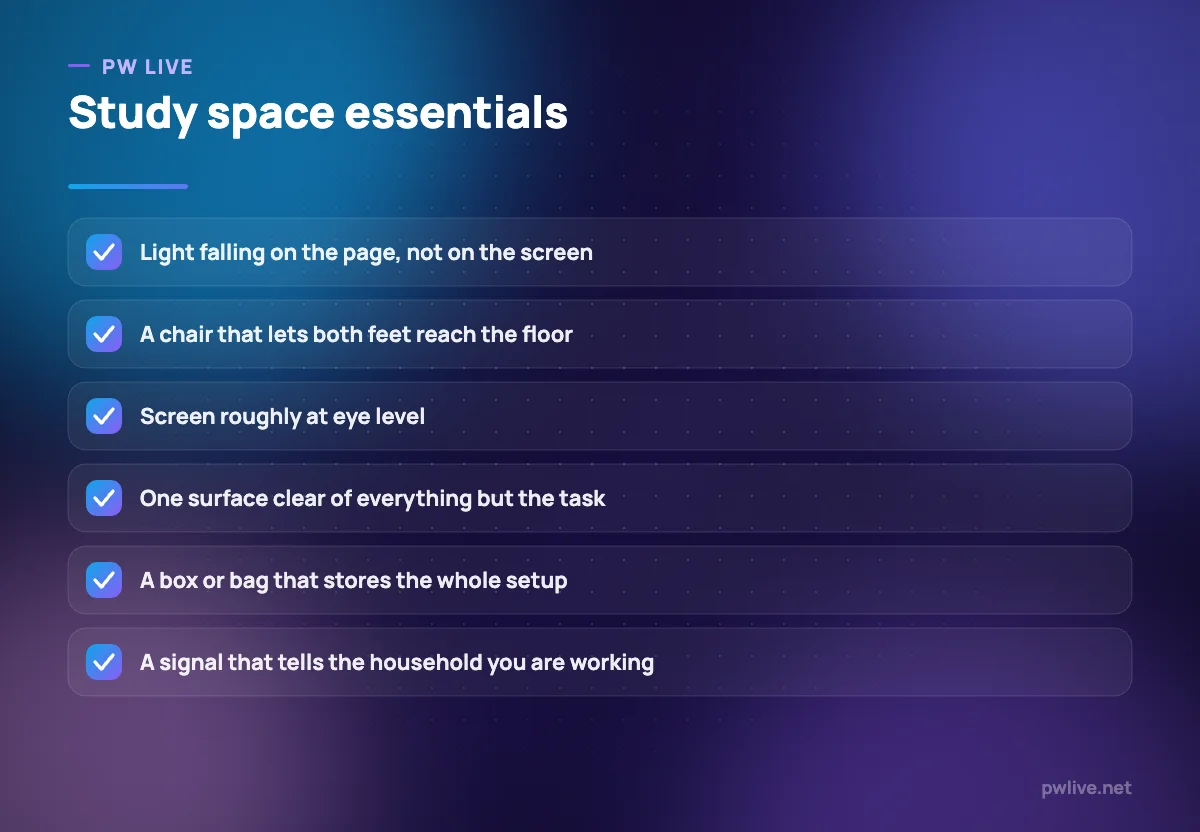
Light should fall across your page from the side, not behind your screen and not directly into your eyes. A window on your left or right is ideal for most people. If you study at night, one warm lamp near the page plus a general room light is far more comfortable than a single bright ceiling bulb.
Traffic matters more than square footage. A small corner off the walking route beats a large table in the middle of the house. If you can sit with your back to a wall and your eyes away from the door, you will be interrupted less by movement you cannot control.
Fix the chair and the screen height first
Discomfort ends more study sessions than boredom does, and it builds slowly enough that you blame the subject instead of the seat.
- Both feet should rest flat on the floor. If they dangle, put a stack of books or a bag under them.
- Hips slightly higher than knees. A folded towel or cushion on the seat fixes most chairs.
- The top of your screen should sit roughly at eye level. A pile of textbooks under a laptop costs nothing and saves your neck.
- If the laptop is raised, use a separate keyboard if you have one, or accept shorter sessions.
This is the cheapest health investment in your whole setup. Our guide to studying without back, neck and wrist pain has the full set of adjustments, including what to do when the only seat available is a bed or the floor.
Make one surface genuinely clear
The single strongest cue for focus is a surface with nothing on it except the task. Not a tidy desk. An almost empty one.
Everything you are not using in the next hour goes into a box, a drawer or a bag. Charging cables, other subjects, cosmetics, cricket balls, yesterday’s dishes. If it is in your field of view, it is competing.
The exception worth keeping: one scrap sheet and a pen for stray thoughts. When something unrelated arrives, you write it and carry on rather than opening your phone to deal with it.
Store the whole setup in one container
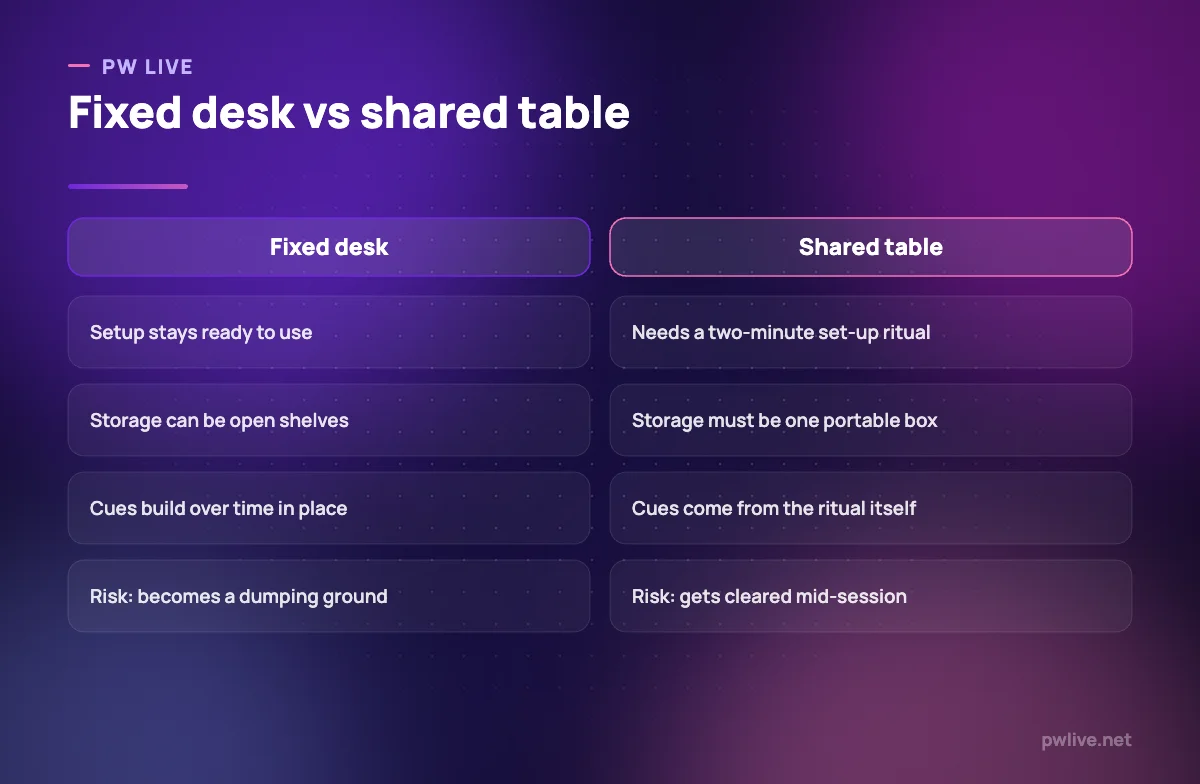
This is the trick that makes a shared table work. Your entire study kit lives in one box, tray or bag: current books, notebook, pens, charger, headphones, sticky notes.
Setting up becomes a two-minute ritual. Take out the box, clear the table, arrange the same four items in the same four places. Packing down is the reverse.
That ritual does the job a permanent desk would do. The repetition itself becomes the cue, so your brain learns the sequence rather than the location. It also means nobody has to ask you to clear the table for dinner, which removes a recurring source of friction at home.
For everything digital, apply the same discipline: one folder structure, one place for current work, and a copy somewhere safe. Our guide to backing up your notes so you never lose work is worth twenty minutes of setup.
Deal with noise honestly
Most shared homes are not quiet, and pretending otherwise leads to blaming yourself for a problem that is environmental.
Options, roughly in order of cost:
- Time shift. Move demanding work to the quietest hour you reliably get, even if that is 6am or 10pm.
- Position. Rooms away from the kitchen, television and front door. A wall between you and the noise helps more than distance.
- Masking sound. Steady, wordless audio, a fan, or rain-type sound. Anything with lyrics competes with reading.
- Earplugs or over-ear headphones. Foam earplugs are inexpensive and surprisingly effective for reading and problem solving.
Match the noise strategy to the task. Memorising and reading need quiet; practice questions and revision of familiar material tolerate more.
Set a visible signal for the people you live with
Family members interrupt because they cannot see the difference between you studying and you sitting with a laptop. Make it visible.
- A physical marker: headphones on, a card on the door, a lamp switched on
- A stated end time: “I am free at 8:45” is far more respectable than “do not disturb me”
- A weekly announcement of your two or three protected slots, so it is not a negotiation every day
Ask for a small, specific window rather than blanket quiet. Most households will honour ninety minutes if they know when it ends. Our guide to saying no and protecting your study time has phrasing that works with parents, flatmates and siblings.
Manage the screen so it does not manage you
Your device is part of the space. Arrange it as deliberately as the chair.
- Keep the screen a little further away than feels natural, roughly an arm’s length
- Match screen brightness to the room rather than running it at maximum in a dark room
- Keep only the tabs the current task needs, and make the study profile or workspace different from the leisure one
- Put the phone across the room, face down, on silent
Long screen days cause a specific kind of tiredness that reduces comprehension before you notice it. Our guide to screen fatigue and focus covers breaks and eye strain, and if you are choosing hardware, how to choose a laptop for studying, coding or design explains what actually matters.
Test the space for a week, then adjust one thing
Do not redesign everything at once. Use the space for a week and note where sessions ended early and why: back ache, glare, noise, a sibling, a dead battery.
Then change one thing. Usually it is the chair height, the light position, or the storage box. Small corrections compound, and you will know which change did what.
If the space is right but the sessions still fall apart, the problem is probably the routine rather than the room. The deep work routine for students and the wider education and learning archive are the next places to look, along with the productivity skill track.
Key takeaways
- Pick your spot by light and foot traffic rather than by available space.
- Fix chair height, foot support and screen height before buying anything.
- Keep one genuinely clear surface with only the current task on it.
- Store the whole kit in one box so a shared table can be set up in two minutes.
- Choose a noise strategy that matches the task and give the household a visible signal.
- Test for a week, then change one variable at a time.
Frequently asked questions
Can I study effectively on my bed?
For short reading sessions, yes, but it works poorly for long or demanding work because posture collapses and the bed is strongly associated with sleep. If it is your only option, sit upright with back support and keep sessions under 40 minutes.
How do I study when I share a room with someone who is not studying?
Agree on fixed windows rather than expecting permanent quiet, use earplugs or steady background sound, and face away from the room. Two protected 90-minute slots a day are usually enough to cover the demanding work.
What is the minimum equipment I actually need?
A stable surface, a chair that lets your feet reach the floor, one good light source, and a box to store everything. Everything beyond that is a convenience, not a requirement.
Should my study space be different from where I relax?
Ideally yes, even if the difference is only which chair you sit in or which direction you face. When the same spot serves both, the set-up ritual and clearing the surface are what create the separation.
Keep learning with PW Live
Browse every guide in Lifestyle & Productivity, or pick a skill track and follow the roadmap step by step.





Leave a Reply