

Most students have an attention problem, not a time problem. Four hours at the desk with a phone face-up beside the notebook often produces less than ninety minutes of undisturbed work.
Deep work means giving one demanding task your full attention for a fixed period, with nothing competing for it. This article turns that idea into a daily routine designed around a student’s day, with classes, family, hostel noise and exams built in.
What deep work is, and what it is not
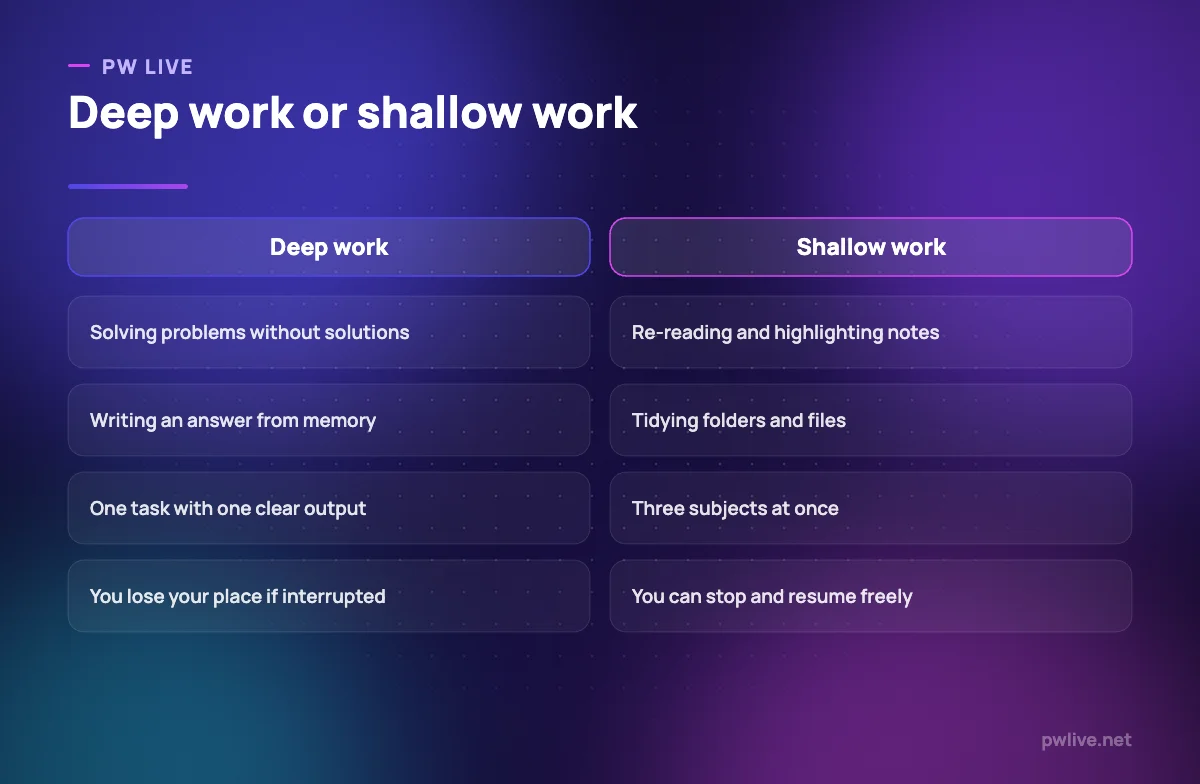
Deep work is cognitively demanding, uninterrupted, and produces something: a solved problem set, a written argument, a derivation you can now reproduce. Shallow work is everything that feels productive but asks little of your mind: re-reading notes, highlighting, tidying folders, checking the group chat.
It is not sitting at the desk for hours, studying with videos in the background, or juggling three subjects because you feel behind in all of them.
A useful test: if someone interrupted you mid-task, would you need a minute to recover your place? If yes, it was deep work.
Why it matters more for students
Retrieval, problem solving and building understanding from scratch all require sustained attention, and they are the activities that actually move marks.
Re-reading a chapter creates familiarity, which the brain mistakes for knowledge. Deep work replaces that illusion with a test: can you do it without looking? The exam strategy page explains how this connects to revision and mock tests.
The routine: an illustrative student day
Treat the times as placeholders.
- Early morning (one block): your hardest subject, before the world wakes up and starts messaging you.
- Classes or coaching: shallow by necessity; take notes and mark what you did not understand.
- Afternoon (one block): problem practice on the morning’s or the class’s topic.
- Evening (one block): revision, error analysis or a timed test.
- Night: a short shutdown review, then no more study.
Three blocks of real focus, separated by real rest, beats ten hours of scattered effort.
Before the block: a five-minute setup
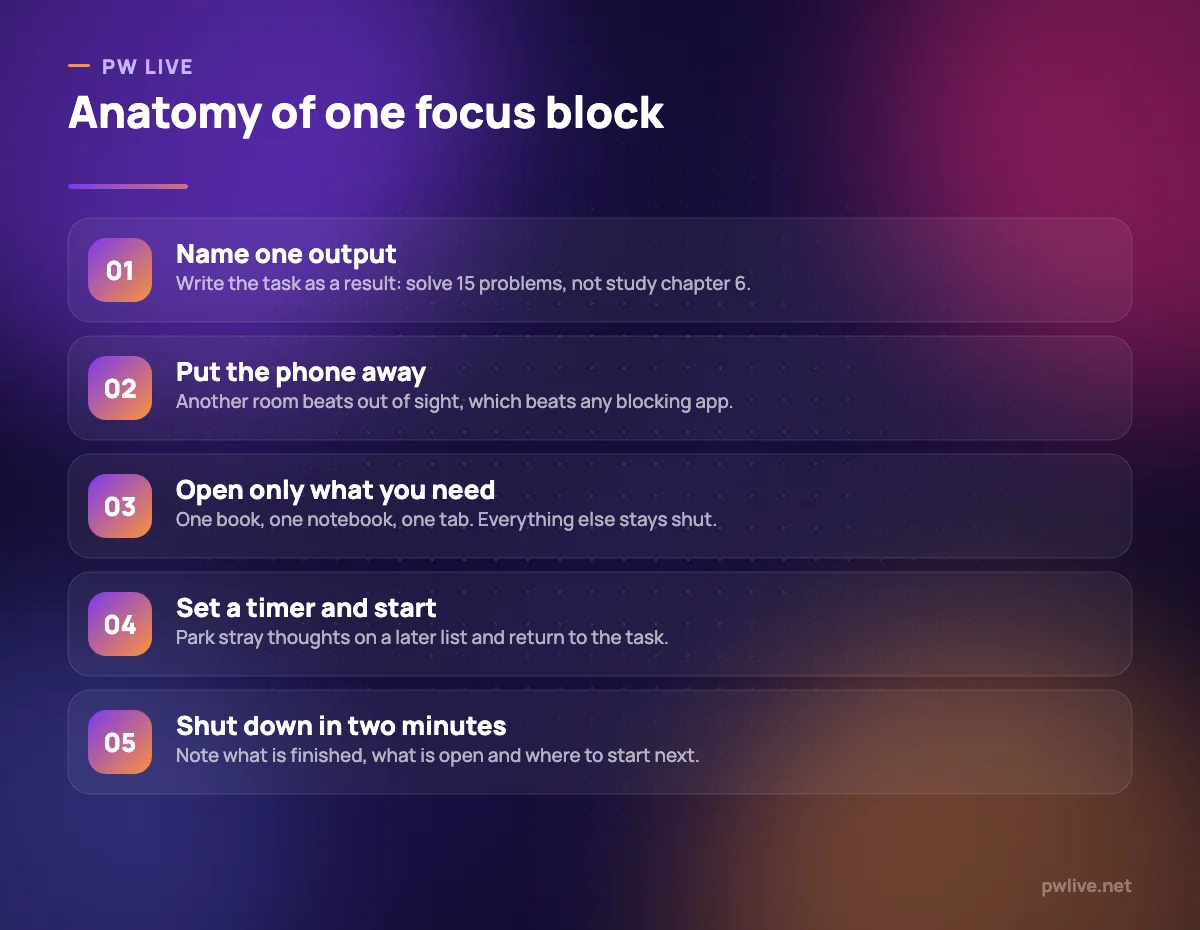
- Write the single task for this block as an output: “solve 15 problems from chapter 6,” not “study chapter 6.”
- Put the phone in another room, or at least out of sight and silent.
- Open only what the task needs: one book, one notebook, one tab.
- Set a timer. For example, 50 minutes.
During the block: one task, one output
If another thought or task appears, write it on a “later” list and return. If you get stuck, stay with the problem for a few minutes before consulting a solution; the struggle is where learning happens.
After the block: a two-minute shutdown
Note what you finished, what is still open and what the next block should start with. The next session then starts instantly.
Choose the right task for deep work
Reserve focus blocks for:
- Solving problems without worked solutions in front of you.
- Writing answers, essays or derivations from memory.
- Timed mock tests and their error analysis.
- Learning a new, difficult concept from the primary source.
Push everything else into shallow time: organising notes, watching lectures, replying to classmates.
Design your environment so focus is the default
Willpower is unreliable. Environment is not.
- Phone: physically away is far more effective than any app-based blocker.
- Desk: clear except for the current task, with other subjects out of sight.
- Noise: if you cannot control it, use earplugs or steady background sound without words.
- Signals: tell family or roommates your block times and use a visible signal, such as headphones or a closed door.
Build stamina and handle interruptions
Nobody starts at three hours of unbroken concentration.
- Start with blocks you can complete: for example, 25 to 30 minutes.
- Extend by five or ten minutes each week as it becomes comfortable.
- Track blocks completed, not hours sat.
- Expect the first ten minutes to feel uncomfortable; that is the cost of entry, not a sign you are doing it wrong.
Student life is full of legitimate interruptions: family meals, hostel announcements, a class that overruns. Schedule blocks in the quietest windows, batch messages into fixed times, and if a block breaks, note where you stopped and restart a shorter one later. Protect one block absolutely, even on chaotic days.
A weekly review to keep the routine alive
Once a week, spend fifteen minutes on three questions:
- How many deep blocks did I complete, and when did they work best?
- What broke the ones that failed, and can I redesign around it?
- What three outputs should next week’s blocks produce?
A routine that adapts survives exam season; a rigid one collapses at the first disruption. For more on habits and planning, see the productivity page and the lifestyle category.
Key takeaways
- Deep work is uninterrupted effort on one demanding task that produces a visible output.
- Learning depends on it: retrieval and problem solving move marks, re-reading does not.
- Plan two or three focus blocks a day around your timetable, with real rest between them.
- Change the environment rather than relying on willpower, starting with the phone.
- Build stamina from short blocks, and review weekly to keep the routine working.
Frequently asked questions
How long should a deep work block be for a beginner?
Start with a length you can finish, such as 25 to 30 minutes, and extend gradually. Completing blocks matters more than their length at first.
Can I listen to music during deep work?
Music with lyrics competes for the attention you need for reading and problem solving. If silence is impossible, use steady, wordless background sound.
What if my timetable leaves no free mornings?
Use whichever window is quietest for you and protect it consistently. The principle is a predictable, undisturbed slot, not a specific time of day.
Keep learning with PW Live
Browse every guide in Lifestyle & Productivity, or pick a skill track and follow the roadmap step by step.





Leave a Reply