

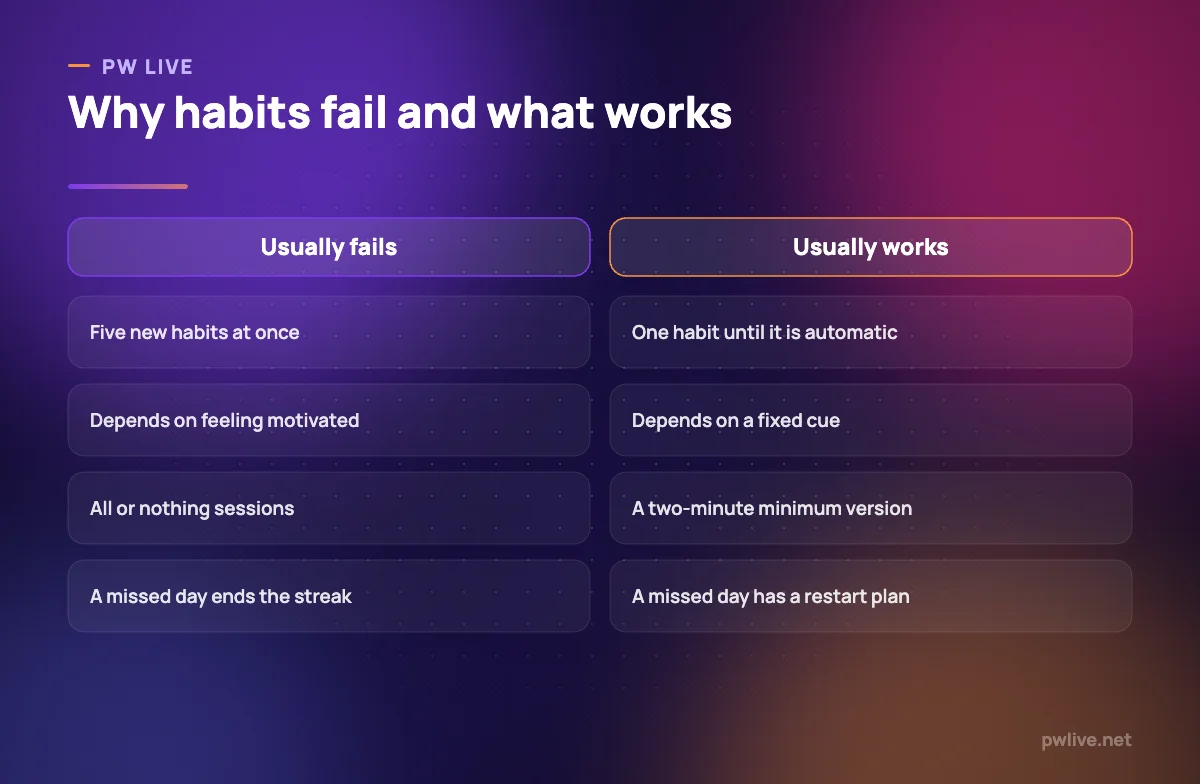
Habit building fails for a predictable reason: people start too many habits, at too large a size, with no cue attached, and then treat the first missed day as proof that they cannot change. None of those are character flaws. They are design errors, and they are fixable.
A habit is a behaviour that has stopped requiring a decision. Until it reaches that point, every repetition costs you something, which is why the early weeks feel disproportionately hard.
This guide covers what actually makes a routine stick when your weeks are irregular, your home is busy and your energy varies.
Pick one habit, and make it the load-bearing one
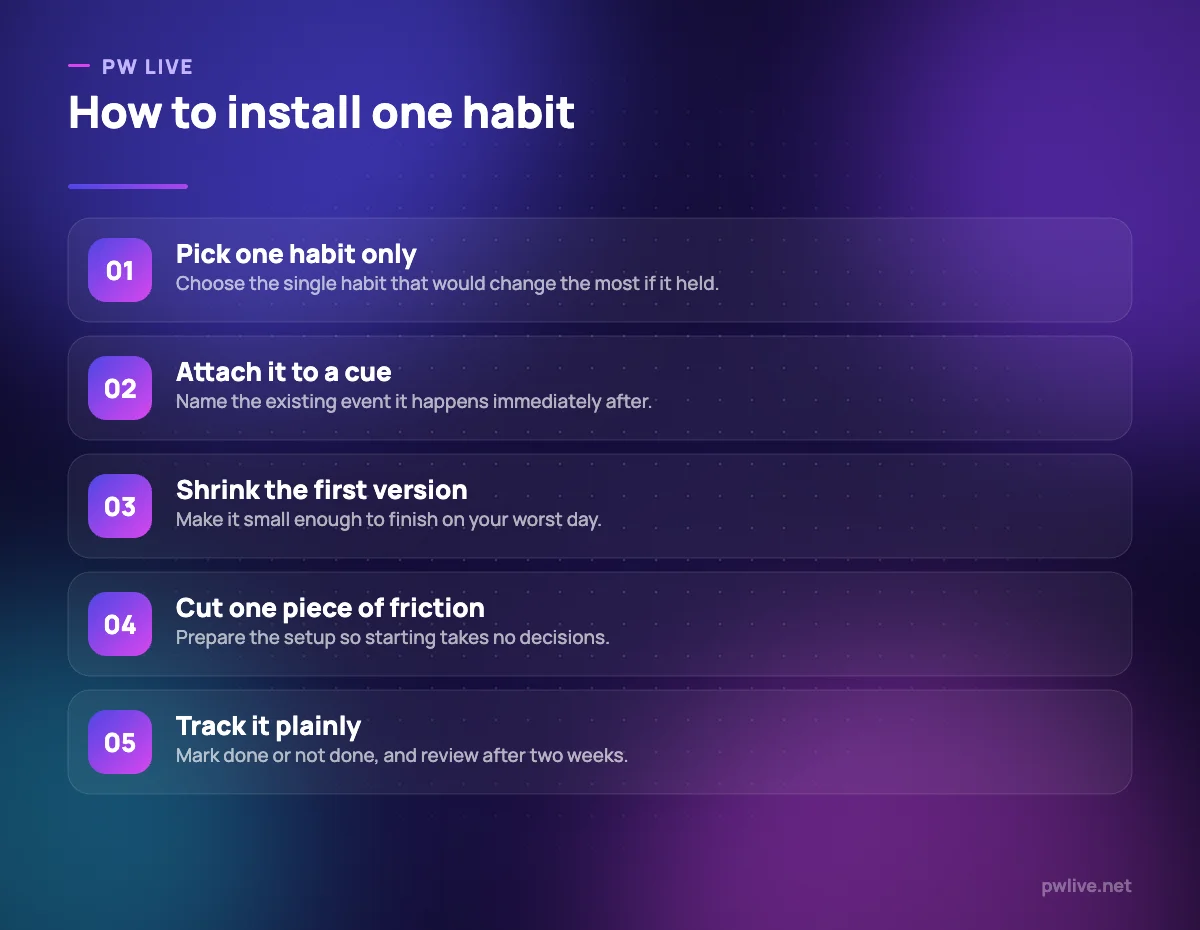
Choose a single habit. Not a morning stack, not a life overhaul. One.
Pick the one that, if it held for three months, would make the most difference to everything else. For students that is often a fixed daily revision slot. For someone working and studying it might be a twenty-minute session before the shift. For a freelancer, a weekly review of money and invoices.
Adding a second habit before the first is automatic halves your odds on both. The discipline is in the restraint.
Attach the habit to a cue that already exists
New behaviours need a trigger, and the most reliable triggers are events you already perform without thinking.
- After I put my bag down, I open my notebook and review yesterday’s notes
- After I finish dinner, I do fifteen minutes of practice questions
- After the bus reaches the second stop, I revise flashcards until my stop
Time-based cues work only if your day is genuinely regular. Event-based cues survive irregular schedules, night shifts, exam weeks and travel, which is why they are the better default for most readers.
Write your cue as a full sentence and say it out loud once. Vagueness is where habits die: “revise more” has no trigger, and therefore no moment at which it is supposed to happen.
Shrink the first version until refusal feels absurd
The version of the habit you install is not the version you eventually want. It is the smallest version that still counts.
Ten flashcards. One page. Five questions. Two minutes of stretching. The goal in the first weeks is not output, it is attendance.
Two reasons this works. First, a small habit survives bad days, and bad days are when habits actually break. Second, you almost always do more than the minimum once you have started, but you cannot get that bonus without starting.
Set the minimum deliberately low and let the good days take care of themselves. Our guide to building a morning routine that fits your life applies the same full, short and minimum structure to a whole sequence.
Cut friction before you rely on willpower
Every extra step between you and the habit is a chance to abandon it. Remove steps in advance, when you are calm and not yet tired.
- Leave the book open at the right page rather than closed on a shelf
- Keep the kit in one place so setup is a single movement
- Charge the device the night before so a dead battery cannot end the session
- Put the phone in another room, not just face down
The same principle works in reverse for habits you want to reduce. Add friction: log out, delete the shortcut, keep the snacks out of the room, leave the game controller in a cupboard.
Track it in the simplest way that survives
Tracking works because it turns an abstract intention into a visible record, and because it makes the streak feel like an object worth protecting.
Keep it plain. A row of boxes on paper, a mark in a diary, a column in a spreadsheet. Mark done or not done, nothing more. Elaborate tracking systems become their own procrastination.
Review every two weeks and ask three questions: Did I do it? If not, was the cue unclear, the size too big or the friction too high? What is the one adjustment for the next two weeks?
For habits tied to a skill you are building, our guide to tracking your skill progress so you stay motivated shows how to measure output rather than just attendance.
Plan the missed day in advance
You will miss days. Illness, a wedding, a power cut, a shift that ran long, a day when you were simply flat. The habit does not break because you missed once. It breaks because of what happens next.
Decide your rules now, in writing:
- Never miss twice in a row. One miss is an event. Two is a new pattern.
- Return at the minimum version. After a gap, do the two-minute version, not the full one. Rebuild the pattern before rebuilding the volume.
- Do not add punishment sessions. Doubling tomorrow to make up for today makes tomorrow harder to start, which is the opposite of what you need.
- Treat a week off as a restart, not a failure. Restarting is a normal part of habit building, not evidence against you.
Rest is part of the design. A routine that punishes you for sleeping when ill is a routine you will eventually resent and drop.
Let habits carry study and money, not just mornings
The mechanics are general. Once one habit holds, the same structure works elsewhere.
- Revision. A daily slot for short, spaced review beats occasional long sessions, and our practical guide to spaced repetition explains the schedule.
- Movement. Ten minutes attached to an existing event, as in our simple exercise routine for students.
- Money. A fixed monthly transfer on salary day, covered in our guide to setting money goals you will stick to.
- Planning. A short weekly review that keeps everything else honest.
Each of these works for the same reason: a specific action, attached to an existing event, at a size you can repeat.
Know when to change the habit rather than force it
Sometimes the habit itself is wrong. If you have restarted three times and it has never held past a week, look at the design before you look at yourself.
Ask whether the cue actually happens daily, whether the size is honest about your energy, and whether the habit still matches your term, job or family situation. A habit built for last semester’s timetable is under no obligation to fit this one.
Change one variable, keep the rest, and run another two weeks. That is slower than a dramatic overhaul, and considerably more likely to work. Browse the lifestyle and productivity archive or the productivity skill track for related routines to attach once this one holds.
Key takeaways
- Install one habit at a time and leave the second until the first is automatic.
- Attach the habit to an existing event rather than to a clock time.
- Set a minimum version small enough to complete on your worst day.
- Remove friction in advance instead of relying on willpower in the moment.
- Track done or not done, and review the design every two weeks.
- Decide your missed-day rules now: never twice in a row, and restart small.
Frequently asked questions
How long does it take to build a habit?
It varies widely by person and by how complicated the behaviour is, so treat any single number with suspicion. A more useful signal is when starting stops requiring a decision, which usually takes several weeks of near-daily repetition.
Should I build habits or set goals?
Both, for different jobs. The goal tells you which direction to face; the habit is the repeated action that gets you there, and only the habit happens on an ordinary Tuesday.
What if my schedule changes every week?
Use event-based cues rather than fixed times, since events like finishing a shift or arriving home happen regardless of the clock. Keep the minimum version very small so it fits into your shortest possible day.
Is it bad to break a streak?
No. A streak is a motivation aid, not a measure of your worth, and the useful rule is simply not to miss twice in a row before returning at the minimum version.
Keep learning with PW Live
Browse every guide in Lifestyle & Productivity, or pick a skill track and follow the roadmap step by step.





Leave a Reply