

If your morning routine keeps collapsing by the second week, the problem is usually the routine, not your discipline. Most advice assumes a quiet house, a free hour and nobody else’s schedule attached to yours. That is not the morning most students and working people actually get.
A morning routine is worth building because it removes decisions from the part of the day when you have the least patience for them. It is not a personality upgrade and it does not require waking at four. It is a short, repeatable sequence that gets you into the day without friction.
This guide shows you how to design one around the morning you really have, including shared rooms, siblings, commutes, tuition timings and a part-time job.
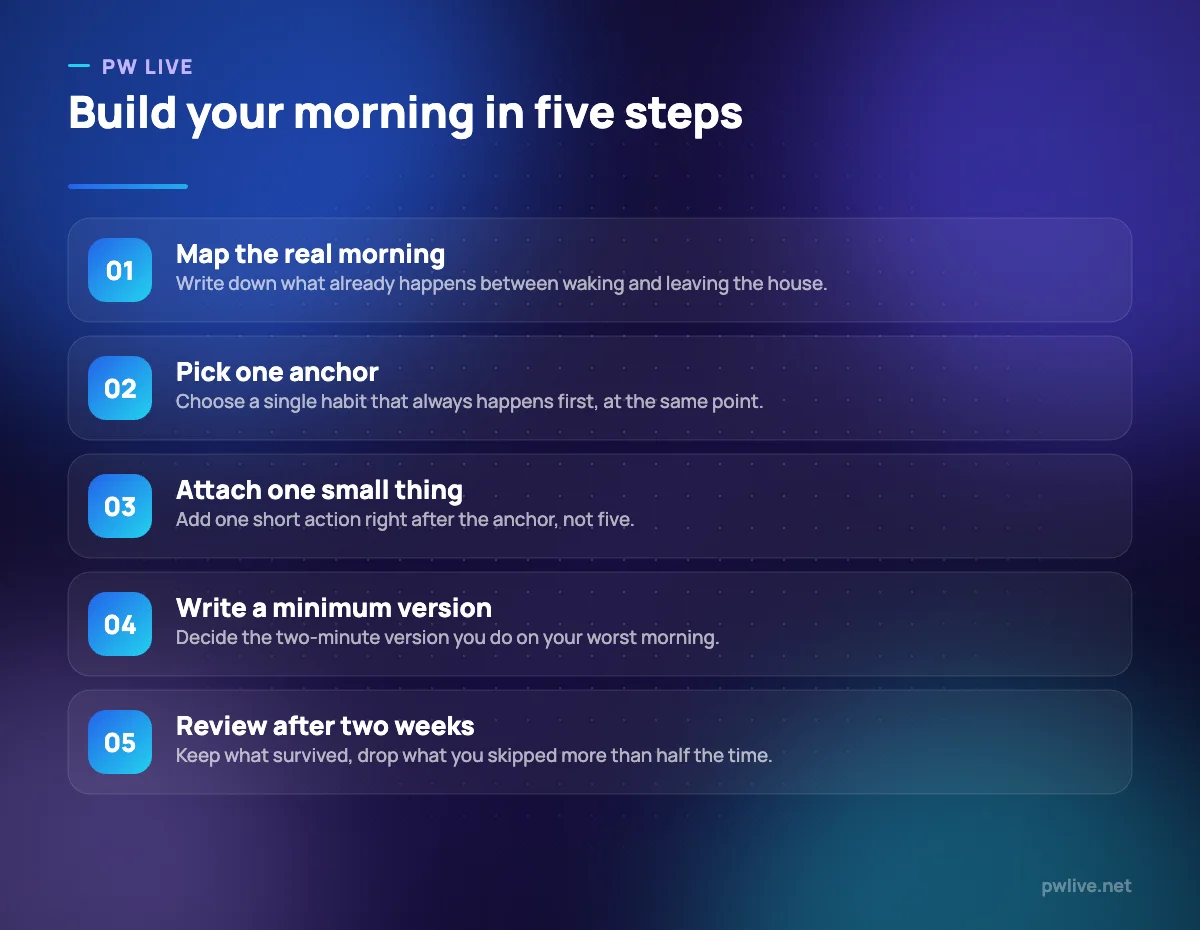
Start with the morning you already have
Before you add anything, write down what currently happens. Not what you wish happened. What actually did, on the last three ordinary weekdays.
Note the fixed points: the alarm, when the bathroom is free, when breakfast happens, when you have to leave. Those are the walls of the room. Your routine has to fit inside them.
Then find the gaps. Most people discover one usable pocket of ten to twenty-five minutes that is currently spent scrolling. That pocket is your routine. You do not need to create time, only to claim a piece that already exists.
Pick one anchor, not ten habits
An anchor is the one thing that always happens first, in the same place, at roughly the same point. Filling a bottle of water. Making the bed. Opening the curtain. Putting your phone on the far side of the room.
The anchor matters more than its content, because everything else hangs off it. When you have a reliable anchor, you can attach a second habit to it later without thinking about timing at all.
Choose an anchor that is:
- Physical, so you notice whether you did it
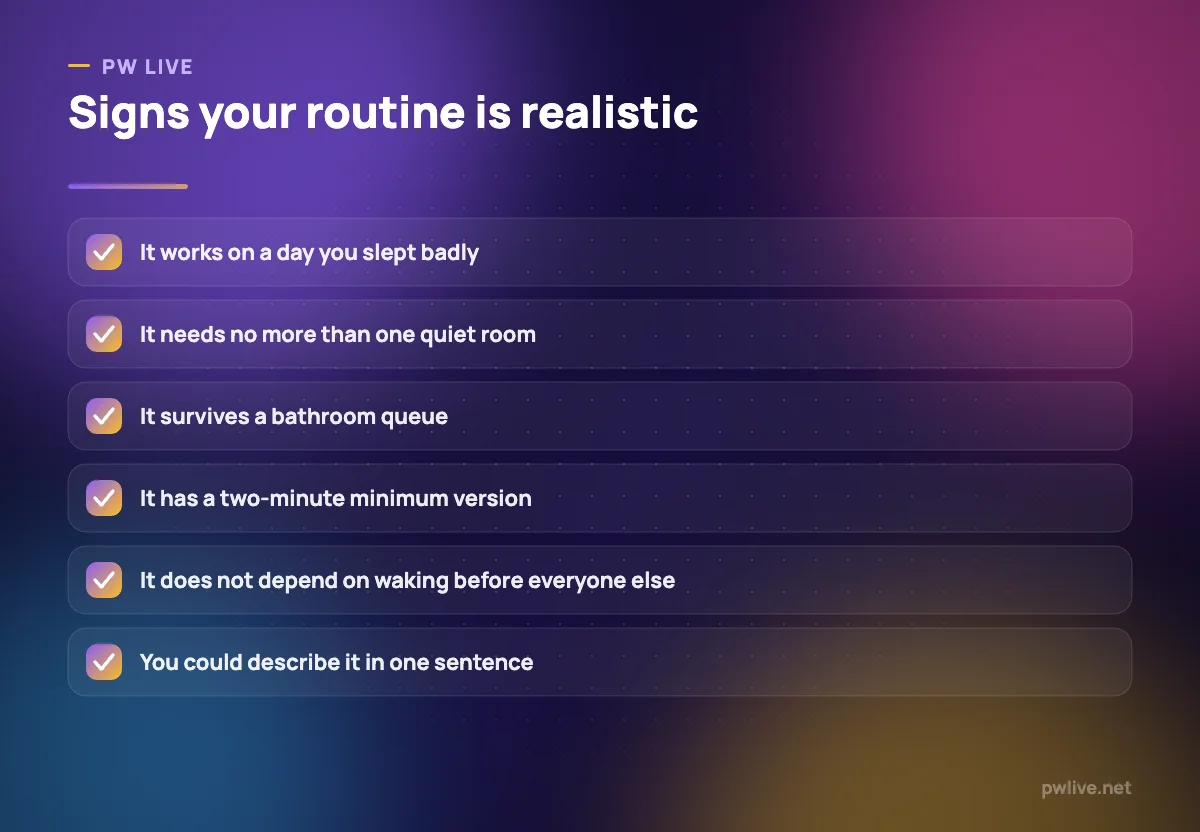
- Under thirty seconds
- Possible in a shared room without disturbing anyone
- Not dependent on a device
Add one small thing, then stop
The common mistake is stacking a whole imagined life onto a new routine: exercise, journalling, revision, meditation, cold water, reading. Six new habits at once means six chances to fail on the same morning, and one failure usually takes the rest down with it.
Add one thing after your anchor and run it for two weeks. Ten minutes of revision from a formula and revision notebook, five minutes of tidying your desk, one page of reading, or a short walk. Only when that feels automatic should you add the next.
If you want the habit-formation mechanics behind this, our guide to making a new routine stick covers cues, friction and recovery in detail.
Build three versions: full, short and minimum
This single idea rescues more routines than any other. Write your morning three times.
- Full version. The morning you get on a good day, perhaps 30 to 45 minutes. Everything you want in it.
- Short version. Half of that, for a normal day with a queue for the bathroom and a bus to catch.
- Minimum version. Two minutes. The anchor plus one token action, like opening your books and reading a single page.
The minimum version is not a failure state. It is how the streak survives illness, guests, a late night of study or a shift that ran over. A routine you can do badly is a routine you keep.
What actually belongs in the first hour
Put things in your morning that are better done fresh and worse done tired. That usually means:
- One hard thing. The subject you avoid, the problem set, the task you have been carrying for days. Twenty focused minutes here is worth an hour at night.
- Light movement. Stretching, stairs, a walk to the shop. Enough to wake the body, not a full workout you will skip. Our simple exercise routine for busy students fits comfortably into a morning.
- A quick look at the plan. Two minutes with your calendar or timetable so the day has a shape.
Leave out anything that opens a feed. Messages, news and social apps hand your attention to other people before you have used any of it yourself. If your phone is the first thing you touch, our digital detox guide has practical ways to change that without going offline entirely.
Make the night before do the work
Most good mornings are built the previous evening. This is the cheapest improvement available to you.
- Decide the first task and leave it open on the desk or table
- Put the bag, clothes and bottle in one place
- Charge the phone outside the room where you sleep
- Set a realistic wake time based on when you actually fell asleep, not when you meant to
Sleep is the ceiling on everything else. Cutting rest to buy morning hours trades a good hour for two poor ones, which is why sleep and study performance are so tightly linked. Protect the sleep first, then design the morning around whatever is left.
When the morning is not yours to control
Some mornings genuinely belong to other people. You may cook, drop a sibling to school, open a shop, or share one room with three people and a television.
In that case, stop trying to own the first hour and move the routine to the first gap that is reliably yours. That might be the commute, a free period, or twenty minutes after the house empties. A routine is a fixed sequence in a fixed slot, and the slot does not have to be at 6am.
If your days vary week to week, anchor the routine to an event rather than a clock time: after I lock the shop, after the bus, after the second class. Event-based routines survive irregular schedules far better than time-based ones. Our guide to building a weekly study timetable that survives real life uses the same principle across the whole week.
Keep it alive when it slips
It will slip. Plan for that instead of treating it as evidence about your character.
- Missing one day is noise. Missing three in a row is a signal to simplify.
- When you restart, restart at the minimum version, never at the full one.
- Review every two weeks and cut anything you skipped more than half the time.
- Change the routine when your term, job or family situation changes. A routine that fitted last semester is not obliged to fit this one.
For more on protecting focused time once the morning is working, read our routine for deep work as a student, and browse the rest of the lifestyle and productivity archive or the productivity skill track for related habits.
Key takeaways
- Map the morning you actually have before designing the one you want.
- Choose a single anchor habit and attach one small action to it.
- Write full, short and minimum versions so the routine survives bad days.
- Front-load one hard task and keep feeds out of the first hour.
- Prepare the night before, and never buy morning time with sleep.
- If the morning belongs to your family or job, move the routine to your first reliable gap.
Frequently asked questions
How long should a morning routine be?
Long enough to be useful and short enough to repeat, which for most people is 15 to 40 minutes. What matters far more than length is that it happens in the same order every day.
Do I need to wake up early for it to work?
No. A routine at 8:30 that you keep beats a routine at 5:00 that you abandon after ten days. Set your wake time from the sleep you need, then build the routine into whatever follows.
What if I share a room and cannot move around in the morning?
Choose quiet, low-space actions: reading a page, reviewing notes, planning the day, stretching beside the bed. Save anything noisy for after the room empties, and use the same sequence each day so it still feels like a routine.
How do I restart after weeks of not doing it?
Go straight to the two-minute minimum version for a week and do not attempt the full routine. Restarting small rebuilds the pattern, and the pattern is what carries the rest.
Keep learning with PW Live
Browse every guide in Lifestyle & Productivity, or pick a skill track and follow the roadmap step by step.





Leave a Reply