
If your chest tightens the week before a paper, your mind goes blank in the hall, or you cannot sleep the night before, you are dealing with exam anxiety, and you are in very ordinary company. Almost everyone who has sat something that mattered has felt some version of it.
Anxiety is not evidence that you are weak, unprepared or unsuited to what you are studying. It is what a mind does when something feels important and uncertain at the same time.
This guide covers what actually helps, what quietly makes things worse, and how to tell the difference between normal nerves and something worth getting support for. There is no shame anywhere in that spectrum.
What exam anxiety is, in plain terms
Nerves are a physical event before they are a mental one. Your heart speeds up, your breathing goes shallow, your stomach turns and your attention narrows.
That narrowing is useful in small doses. It is why a little pressure sharpens performance. Past a point it stops helping, and you get the blank-mind experience where you read a question three times and none of it registers.
Understanding that sequence matters, because it tells you where to intervene. You cannot argue yourself out of a racing heart, but you can slow your breathing, and the rest tends to follow.
What genuinely helps in the weeks before
Most of the useful work happens well before exam day, and it is less dramatic than people expect.
- Reduce uncertainty where you can. Know the paper’s structure, the timing, the marking scheme and what the hall will be like. Anxiety feeds on unknowns.
- Do timed practice, on purpose. Sitting full papers under real conditions makes the actual exam feel familiar rather than new.
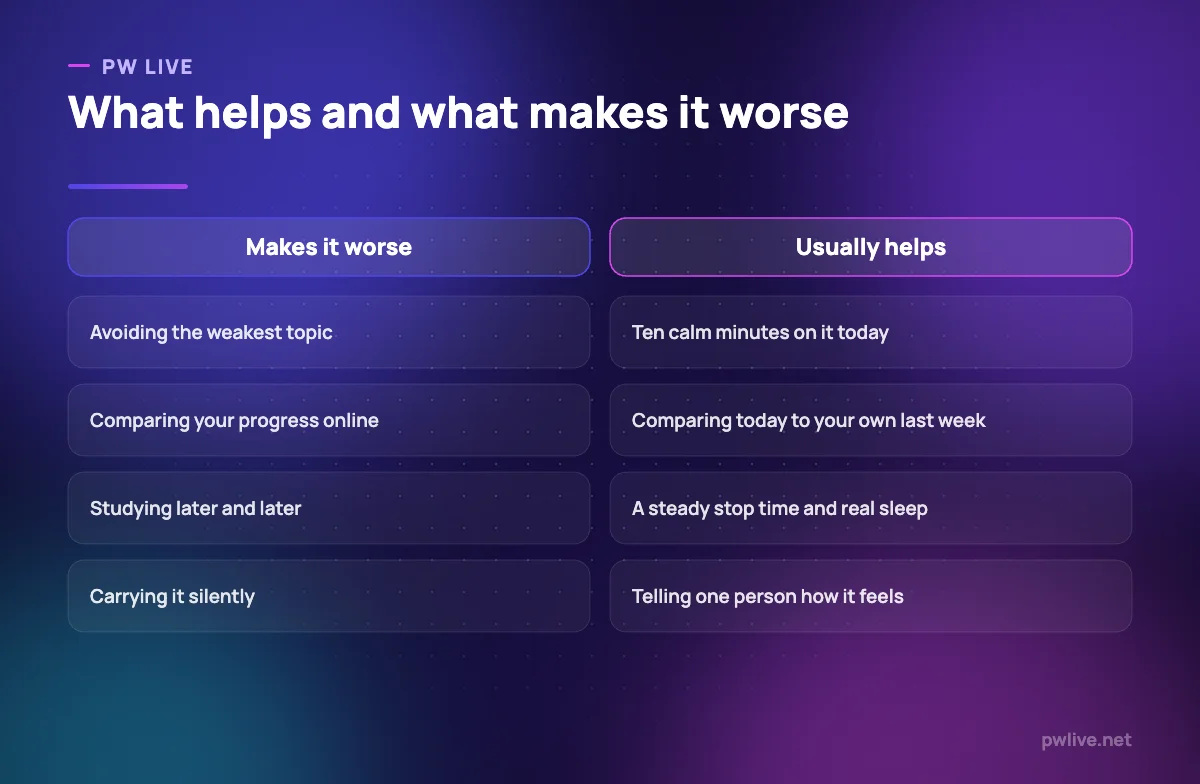
- Go towards weak topics in small doses. Ten calm minutes on the thing you have been avoiding does more for anxiety than three hours on a topic you already know.
- Keep the boring foundations. Sleep, food, daylight and some movement are not optional extras during a demanding stretch.
- Tell one person how you are feeling. Saying it out loud reliably shrinks it.
Timed practice is especially worth the discomfort. Our guide to analysing a mock test properly turns those sessions into useful information rather than another source of dread.
What quietly makes it worse
None of these are moral failings. They are just things that feel protective in the moment and cost you later.
- Avoidance. Skipping the topic, the mock test or the timetable removes the discomfort now and grows it steadily.
- Endless comparison. Study-hour posts and rank talk in group chats tell you nothing useful about your own preparation.
- Sleep sacrifice. Cutting sleep to revise more is the most common and most costly trade students make, as our sleep and study guide explains.
- All-or-nothing thinking. Treating one exam as the sole determinant of your life makes every question feel unsurvivable.
- Waiting until it is unbearable to speak to anyone. Support works far better early than late.
Notice that four of the five are about how you are relating to the exam, not how much you know. That is usually where the anxiety lives.
A calmer routine for the final week
The week before a paper is not the time for new material or heroic all-nighters. It is the time to make everything predictable.
Keep your wake time steady. Study in shorter blocks with real breaks. Revise from condensed notes rather than full textbooks, using something like a formula and revision notebook. Do at least one full timed paper early in the week, not the night before.
Decide in advance what the last evening looks like: what you will pack, when you will stop, what you will do instead of revising. Our exam day checklist covers the practical side so your mind has fewer open loops to hold.
If panic rises during the exam
This is the moment students fear most, and it is more manageable than it feels.
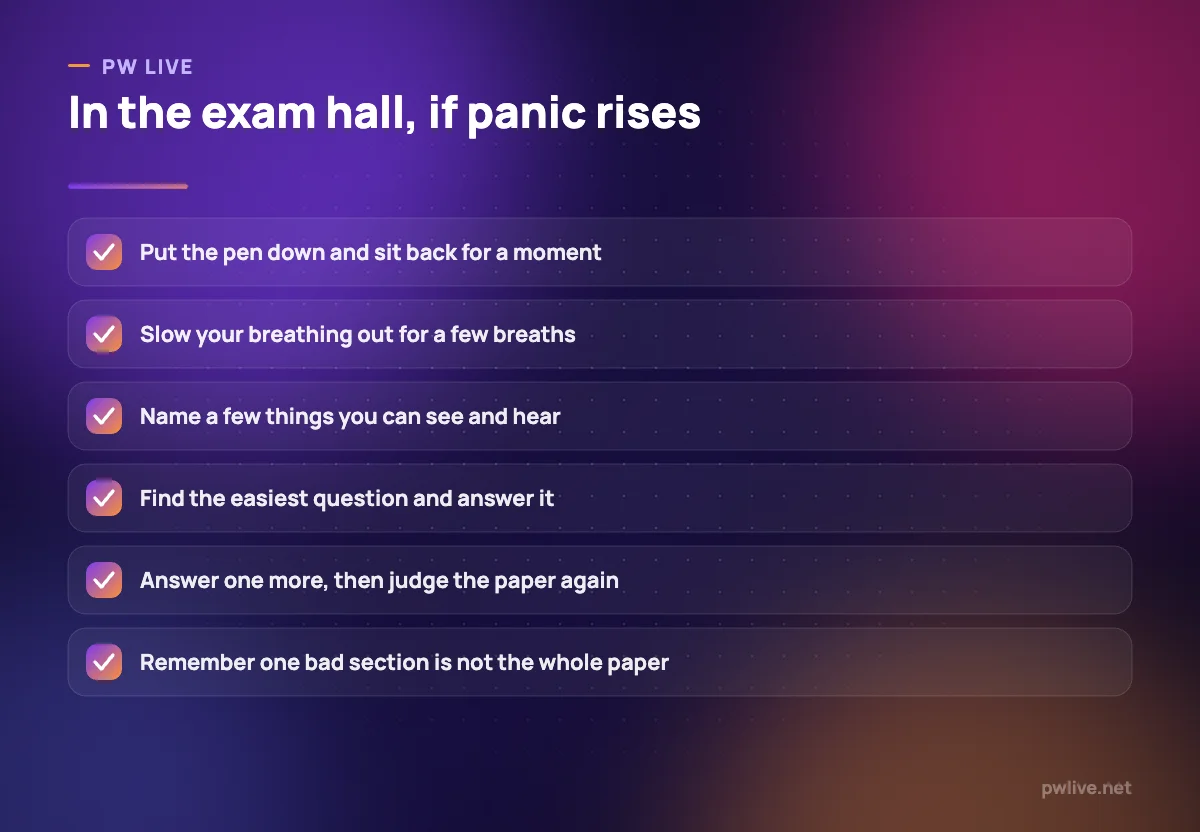
First, stop writing. A short pause costs you far less time than fifteen minutes of unreadable panic.
Slow your breathing, making the out-breath longer than the in-breath, for several breaths. Then bring your attention outward: notice a few things you can see and hear in the room. This is not a trick, it is a way of widening attention that has narrowed too far.
Then find the easiest question on the paper and answer it. Momentum restores confidence faster than reassurance does. Once you have two answers down, reassess the paper properly and make sensible decisions about what to attempt, which our guide to negative marking strategy can help with.
Avoid anything that relies on hurting or shocking yourself to snap out of it. Those methods are unnecessary and they teach your body to associate exams with harm.
Talking about it is not a last resort
There is a persistent idea that you should only ask for help once you are in crisis. It is wrong, and it costs students months of unnecessary difficulty.
Tell a parent, a teacher, a friend, a warden or a counsellor early. You do not need a diagnosis or a dramatic story to justify the conversation. “I have been finding this really hard and I wanted to say it out loud” is a complete sentence.
If saying it in person is difficult, write it down first. If the first person does not respond well, that is about them, not about whether your feelings are legitimate. Try someone else. Our guide to building a support system when studying gets hard covers how to do this in practice, and how parents can support a student without adding pressure is worth sharing with the adults around you.
Please speak to a doctor or a counsellor if anxiety is persistent rather than occasional, if it is affecting your sleep, appetite, health or daily life, if you are avoiding school or classes, or if you have thoughts of harming yourself. That is a medical matter like any other, help genuinely exists, and reaching out early is one of the most sensible things you can do.
Keeping perspective on results
An exam measures a slice of your preparation on one particular day. It does not measure your intelligence, your character or your future.
Plenty of people have taken a longer or different route to the same place, and almost nobody’s life turned out to be decided by a single paper. If a result does not go the way you hoped, that situation is recoverable, and our guide to recovering after a result that did not go your way walks through the next steps.
For the wider picture on sustained pressure, our exam stress and burnout guide sits alongside this, and the exam strategy skill track covers the preparation side.
Key takeaways
- Exam anxiety is common and manageable, and feeling it says nothing about your ability.
- Reduce uncertainty: know the paper, do timed practice, and approach weak topics in small doses.
- Avoidance, comparison and cutting sleep feel protective and reliably make anxiety worse.
- If panic rises in the hall, pause, slow your out-breath, look around the room, then answer the easiest question.
- Never use methods that rely on pain or shock. They are unnecessary and they make exams feel more threatening.
- Talk to someone early, and speak to a doctor or counsellor if anxiety persists or affects your daily life.
Frequently asked questions
Is some anxiety before an exam normal?
Yes. A degree of nervousness is a normal response to something that matters, and mild pressure can even sharpen focus. It becomes worth addressing when it stops you preparing or stays with you outside exam periods.
Why does my mind go blank in the exam hall?
Under high stress, attention narrows and recall becomes harder, which feels like the knowledge has vanished. It has not. Pausing, slowing your breathing and answering an easy question usually brings it back.
Should I tell my teachers or parents that I am struggling?
Yes, and earlier than feels necessary. Most people respond better than students expect, and even one supportive person makes a measurable difference to how a difficult term feels.
When should I speak to a doctor or counsellor about anxiety?
When it is persistent rather than occasional, when it affects your sleep, eating, health or daily activities, or when it is stopping you attending or functioning. Asking for help early is ordinary and sensible, not an overreaction.
Keep learning with PW Live
Browse every guide in Health & Wellness, or pick a skill track and follow the roadmap step by step.





Leave a Reply