

Most people quit a skill somewhere between week four and week eight, and the reason is almost never that they cannot do it. It is that they cannot see that they are doing it. Improvement in the middle of a skill is real but invisible from the inside.
Tracking your skill progress fixes that. It replaces “I feel like I am going nowhere” with a record you can check, which is a much more reliable source of motivation than enthusiasm.
The system below takes about two minutes a day and thirty minutes a month.
Why progress feels invisible
Skills improve unevenly. You spend weeks with no visible change, then jump, then plateau again. Meanwhile your standards rise faster than your ability, so work that would have thrilled you in month one now looks mediocre.
That rising standard is a sign of progress, but it feels like failure. Without a record, you compare today’s work against today’s taste and conclude you are stuck.
The cure is comparison against your past self, using evidence rather than memory. Memory is a poor witness here, because it smooths away how hard things used to be.
Measure inputs, outputs and outcomes
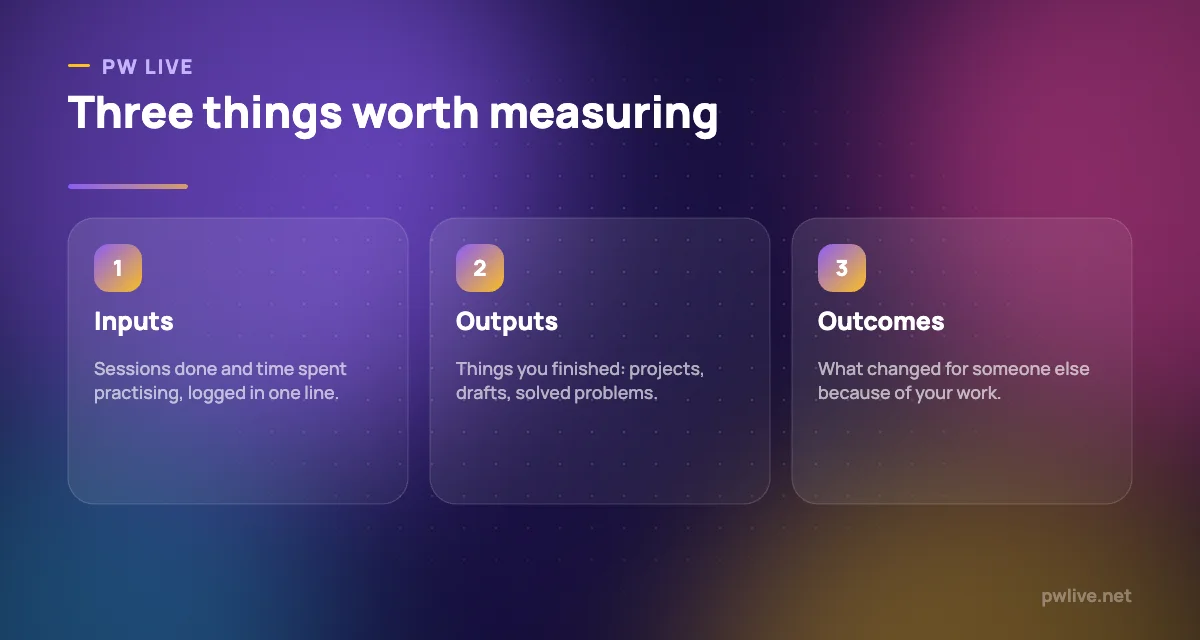
Three levels are worth tracking, and each answers a different question.
Inputs are what you put in: sessions completed, hours practised, problems attempted. They are easy to record and they keep you honest, but they can mislead if hours become the goal.
Outputs are what you finished: a project, a chapter, twenty solved problems, a recorded talk. These are the real evidence of a skill.
Outcomes are what changed for someone else: a user who found the tool useful, a mark that improved, a client who paid, a colleague who used your document. Outcomes are the slowest to appear and the most convincing when they do.
Beginners should weight inputs and outputs. Once you are past the first quarter, shift attention to outputs and outcomes, because hours alone stop correlating with improvement.
Build a skill log you will actually keep
Complexity is the enemy here. A tracking system that takes ten minutes a day gets abandoned in a fortnight.
Use one table, five columns, one row per session:
- Date
- What I worked on (a few words)
- What I produced (a link, a file name, a count)
- What was hard (one sentence)
- Next time (one sentence)
Columns four and five are the valuable ones. They turn the log from a diary into a plan, and the “what was hard” column becomes your practice agenda, which is exactly what deliberate practice needs as an input.
A spreadsheet is more than adequate, and it lets you sort and count later. If you have never set one up for this kind of thing, our guide on using spreadsheets for study planning covers the basics.
Rate your sub-skills, then re-rate them monthly
Overall self-assessment is useless. “How good am I at design?” has no stable answer.
Break the skill into six to eight sub-skills, exactly as you would when planning a 90-day learning block, and rate each from zero to five. Write one line describing what a five would look like in your context, so the scale means something.
Re-rate monthly, without looking at your previous ratings until you are done. Then compare. Two things usually happen: one or two ratings jump, and one drops because you now understand the sub-skill well enough to see how much you did not know. Both are progress.
Keep evidence, not impressions
Save your work with dates. This is the single most motivating habit in the whole system, and it costs nothing.
- Keep every draft, not just the final version
- Record yourself once a month if the skill is spoken or performed
- Screenshot your interface, dashboard or design at the end of each project
- Keep the first thing you ever made and never delete it
Six weeks later, open the earliest item. The gap between it and your current work is the argument against quitting, and it is far more persuasive than any pep talk.
Set a review rhythm
Tracking without review is just data collection. Two rhythms are enough.
Weekly, 15 minutes. Read your log. Count sessions completed against sessions planned. Pick one weakness from the “what was hard” column as next week’s focus. This slots naturally into a broader weekly review habit.
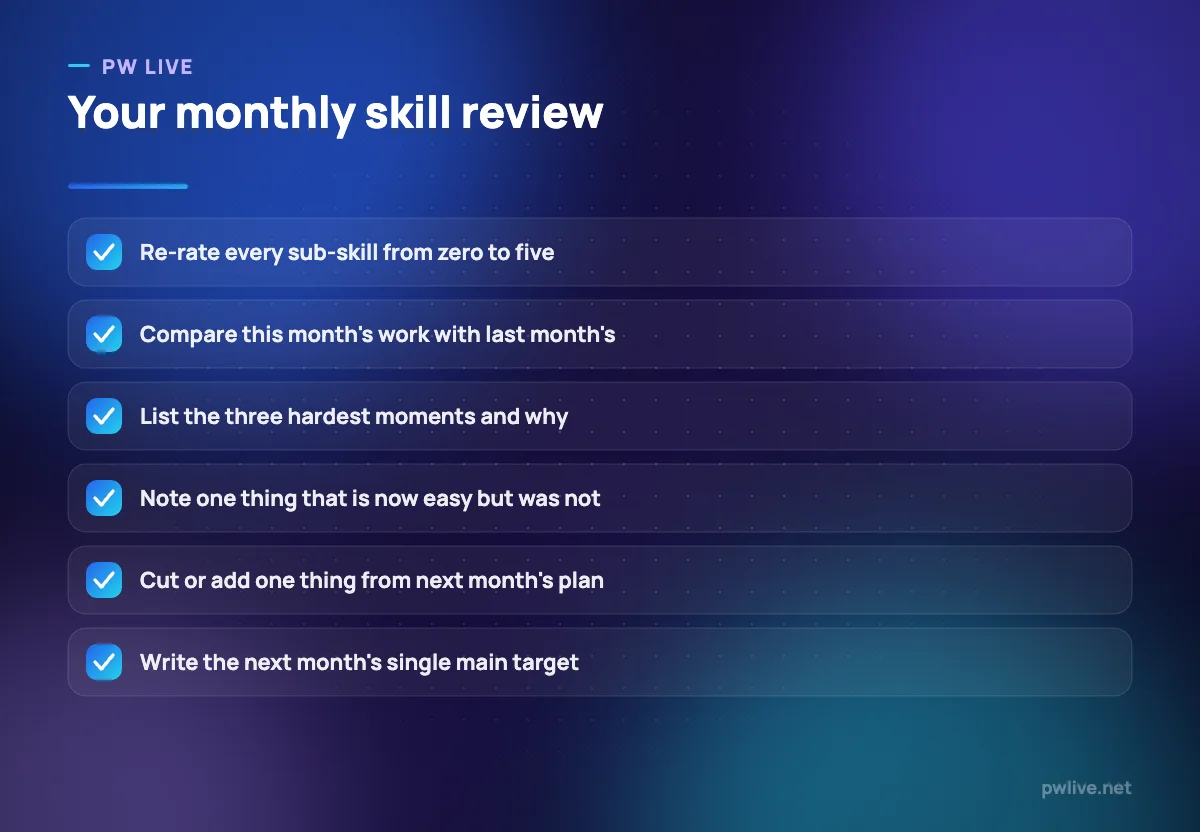
Monthly, 30 minutes. Re-rate sub-skills, compare current work with last month’s, and adjust the plan. Cut one thing that is not working and add one thing that is missing.
Keep the review at a fixed time. A review that depends on remembering to do it will not survive a busy month, which is why attaching it to an existing routine, as our guide to habits that stick suggests, works better than relying on intention.
Reading a plateau correctly
Plateaus are normal and they mean different things depending on what your log says.
- Sessions dropped, work unchanged. This is not a plateau, it is a schedule problem. Fix the calendar, not the method.
- Sessions steady, difficulty falling. You have drifted into comfortable practice. Raise the difficulty.
- Sessions steady, difficulty high, no visible gain. This is a genuine consolidation phase. Hold the course for another three to four weeks before changing anything.
- Everything is hard and nothing is finishing. The scope is wrong. Shrink the task until you can complete something.
Being able to tell these apart is the practical payoff of tracking. Without a log, all four feel identical and you guess.
Do not turn tracking into the hobby
There is a failure mode where the tracking system becomes the project: colour-coded dashboards, elaborate templates, streak counters that make a missed day feel catastrophic.
Guard against it with three rules. Keep the log to under two minutes a day. Never let a broken streak be a reason to stop, because the record is a tool and not a judgement. And review the system itself once a quarter, dropping anything you have not looked at.
For the wider habit architecture around this, the productivity track and the lifestyle and productivity category are the natural next stops, while the career readiness track covers how to turn a year of logged work into something an employer can read.
Key takeaways
- Progress in the middle of a skill is real but invisible, so record it rather than feel for it.
- Track inputs, outputs and outcomes, shifting weight to outputs as you improve.
- Keep a five-column log with “what was hard” and “next time” as the key columns.
- Rate six to eight sub-skills monthly and compare against your past ratings, not your current taste.
- Save dated evidence, including your very first attempt.
- Review weekly for 15 minutes and monthly for 30, at a fixed time.
Frequently asked questions
How often should I track my skill progress?
One line per practice session, a short weekly read of the log, and a monthly re-rating of your sub-skills. Anything more detailed tends to get dropped.
What if my ratings go down after a month?
That usually means your judgement improved faster than your ability, which is a good sign. Note it, keep the old rating visible, and check again in a month.
Are streaks helpful for motivation?
They help while they are unbroken and hurt afterwards, because one missed day can feel like failure. Count sessions per week instead, which tolerates real life.
Should I share my progress publicly?
Public updates add accountability and often bring feedback, but only if you can post a bad week honestly. If public posting would push you to exaggerate, keep the log private and share finished work instead.
Keep learning with PW Live
Browse every guide in Skills Development, or pick a skill track and follow the roadmap step by step.





Leave a Reply