
Online education reaching smaller cities is one of the more genuine shifts in Indian learning, because it changes something that used to be settled by geography. A student in a district town can now watch the same lecture, attempt the same test series and take the same course as a student in a metro.
That does not make the playing field level. Access to teaching is one input among several, and the students who benefit most are the ones who pair online material with structure they build themselves.
This guide covers what has actually opened up, what has not, and how to use online education well when the nearest good coaching centre or library is far away.
What has genuinely opened up
The clearest change is access to instruction. Recorded lectures, live classes, question banks and test series are no longer limited to whoever lives near a particular institute.
A few knock-on effects matter more than the headline.
Choice of teacher. If a particular explanation does not work for you, you can find another. That was rarely possible when there was one teacher for a subject in your town.
Repetition on demand. A recorded lecture can be replayed until an idea lands, which is a real advantage over a single classroom pass.
Exposure to standards. Test series and peer discussion show you what the competition actually looks like, which is hard to gauge locally.
Adult and mid-career learning. Skills courses have become available to people who cannot relocate or leave a job, which quietly matters as much as the student market.
What has not changed, and what to do about it
Access to lectures does not solve the harder parts of studying. Being honest about this is what separates students who benefit from those who accumulate unwatched content.
Four gaps remain:
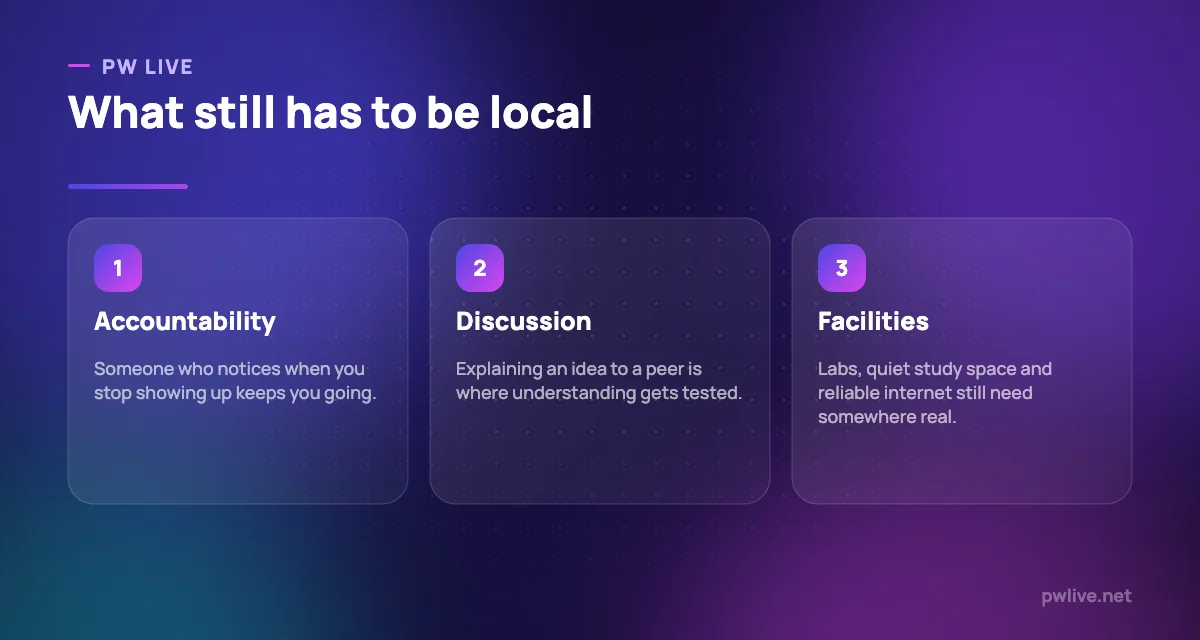
- Accountability. Nobody notices when you stop attending an online class.
- Doubt resolution. A quick question that would take thirty seconds in person can take days online, or never get asked.
- Discussion. Understanding gets tested when you explain something to a peer, and a chat window is a weak substitute.
- Practical facilities. Laboratory work, quiet study space and reliable connectivity are still physical problems.
The workable response is not to abandon online learning but to build local structures around it. A study group of three people who meet twice a week does more for consistency than any platform feature.
Choosing a course without wasting money
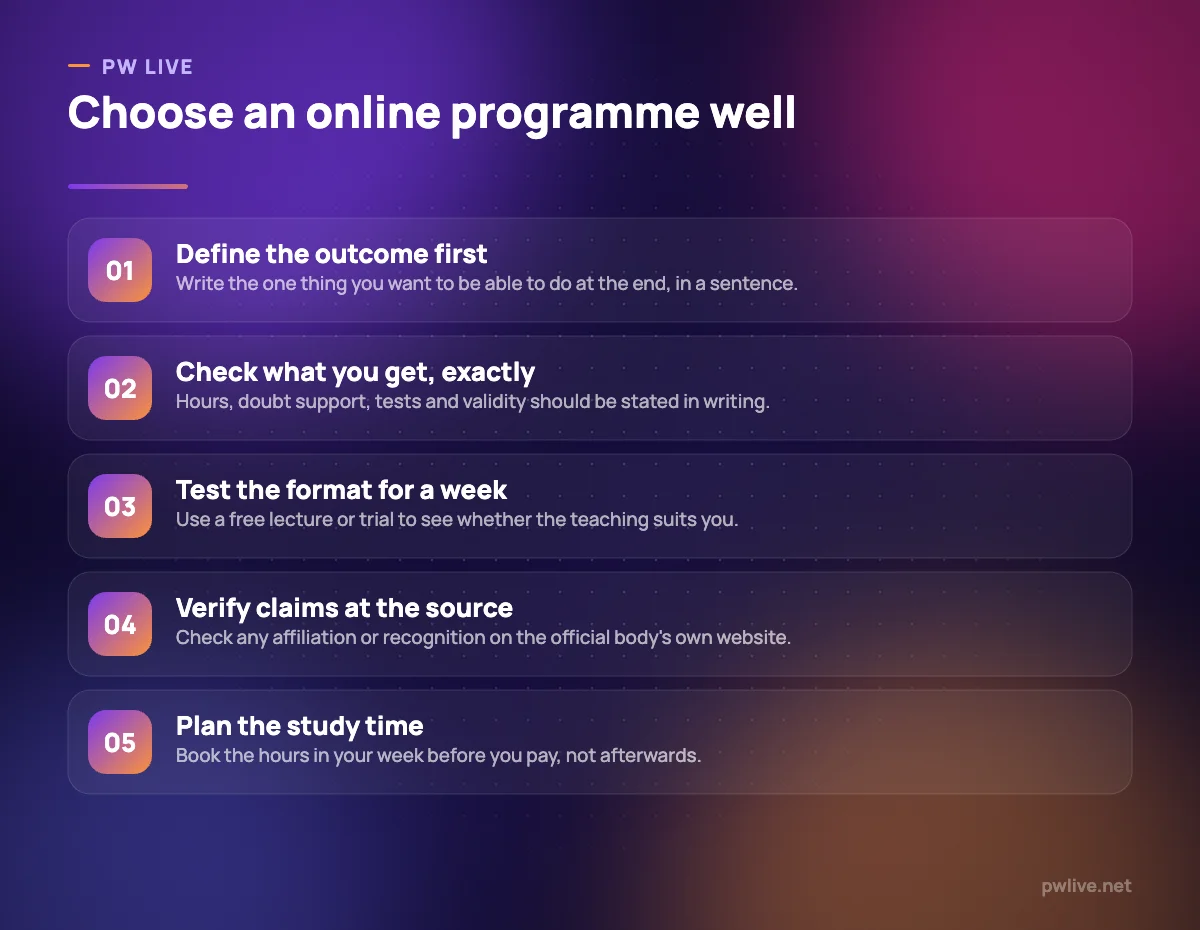
The abundance of options is itself a problem. Most enrolment regret comes from choosing quickly and studying slowly.
Before paying anything, write down the outcome you want in one sentence. Then check what is actually included: number of hours, whether doubt support exists and how it works, whether tests are included, how long access lasts, and what happens if you fall behind.
Verify any claim about recognition, affiliation or accreditation on the official body’s own website rather than on the provider’s marketing page. This applies to degree programmes, professional certifications and government-linked schemes alike.
Our guide to choosing an online course you will actually finish covers the evaluation in more detail, including the warning signs worth taking seriously.
Making video lectures actually work
Watching is not studying. This is the single biggest cause of wasted months in online preparation, and it is entirely fixable.
- Watch with a pen and a notebook, not with a highlighter.
- Pause and attempt the problem before the teacher solves it.
- Stop after each concept and write, from memory, what it said.
- Use playback speed to review, not to consume new material.
- Solve questions the same day, not at some future point.
Our guide to studying from video lectures without wasting hours sets out a workflow, and active recall explains why testing yourself beats rewatching every time.
Building the local half yourself
If the teaching is online, the structure has to be local. Three things do most of the work.
A fixed place and time. The same corner, the same hours. This matters more in a shared home where study space is contested, and our guide to setting up a study space in a small or shared home has practical arrangements for tight spaces.
Two or three study partners. They can be online, but meeting in person is better. Agree what you will each have covered by the next meeting, and spend part of the session explaining topics to each other.
One adult who checks in. A parent, teacher or older sibling who asks what you covered this week, without judgement, is remarkably effective.
Handling the practical constraints
Connectivity, devices and electricity are genuine constraints in many places, and planning around them beats being defeated by them.
- Download lectures in advance whenever the platform allows it, so a bad connection costs you nothing.
- Keep a paper backup of your schedule and your revision notes.
- Do question practice offline, since that is where most of your time should go anyway.
- Identify one reliable place with better connectivity for live sessions and tests.
- Keep your notes backed up, so a lost or damaged phone does not cost you months.
Free resources can cover a surprising amount if you use them systematically rather than randomly. Our guide to learning from free resources without getting lost explains how to sequence them.
Deciding between online, local coaching and self-study
There is no universally correct answer, and the honest comparison depends on you rather than on the format.
Online suits students who can hold a routine without supervision and who need access to teaching that is not available locally. Local coaching suits students who need the pressure of showing up and the ease of asking a question face to face. Self-study suits disciplined students with good material and a clear plan.
Most students end up with a mix, and that is sensible. Our comparison of self-study and coaching walks through how to decide, and building a study system that actually works covers the structure that makes any of these options productive. For more, browse the education category or explore the skills development hub if you are learning outside a formal syllabus.
Key takeaways
- Online education has widened access to teaching, choice of teacher and repeatable explanation, especially outside metros.
- It does not solve accountability, doubt resolution, discussion or facilities, which you must build locally.
- Verify any claim about recognition or affiliation on the official body’s own website before paying.
- Watching lectures is not studying: pause, attempt, write from memory and solve questions the same day.
- Plan around connectivity by downloading in advance and keeping your practice offline.
Frequently asked questions
Is an online course as good as attending coaching in person?
It depends on you rather than on the format. Online gives you better access to teaching and worse accountability, so it works well for students who can hold a routine and less well for those who need external structure.
How do I check whether an online programme is legitimate?
Look up the institution or certification on the official regulator’s or awarding body’s own website. Never rely on claims made in advertisements, forwarded messages or the provider’s own marketing pages.
What if my internet connection is unreliable?
Prioritise platforms that let you download lectures, keep your question practice offline, and identify one place with a better connection for live tests. Most study time should not need a live connection anyway.
Can I prepare for competitive exams entirely online?
Many students do, but they succeed by adding local structure: a fixed schedule, a small study group and regular full-length tests taken under proper conditions.
Keep learning with PW Live
Browse every guide in News & Updates, or pick a skill track and follow the roadmap step by step.





Leave a Reply