
AI chat tools for studying can genuinely accelerate learning, and they can also quietly hollow it out, because both feel identical while you are sitting at your desk.
The difference is not the tool. It is whether the thinking happened in your head or in the chat window. One of those shows up in the exam hall; the other does not.
This guide sets out where these tools help, where they harm, the prompts that build understanding rather than replace it, and the integrity line you should not cross. Rules vary by institution, so check yours first and treat this as guidance, not permission.
Start with your institution’s rules
Before anything else, find your college, school or exam board’s policy on AI use. It usually sits in the academic integrity or assessment section of the handbook.
Policies differ sharply. Some courses ban AI entirely for assessed work, some allow it with a declaration, some permit it for brainstorming but not drafting. A rule you did not read still applies to you.
Two things are true almost everywhere: submitting text you did not write as your own work is misconduct, and misconduct findings follow you further than a poor grade would. If the policy is unclear, ask the module leader in writing and keep the reply.
What these tools are good at, and what they are not
Understanding the mechanism prevents most misuse. A language model predicts plausible text from patterns in what it has seen; it is not looking anything up unless it has been given a source. Our explainer on how large language models work covers this without jargon.
That makes them strong at:
- Explaining a concept again in different words, at a level you choose.
- Generating practice questions and worked variations of a problem type.
- Playing examiner: quizzing you, then challenging your answer.
- Critiquing structure, clarity and logic in something you wrote.
- Translating dense textbook language into plain English.
And unreliable at:
- Precise facts, dates and figures, which it can state confidently and wrongly.
- Citations and references, which it may invent entirely.
- Long multi-step calculations, where a single silent slip changes everything.
- Anything about your specific syllabus, marking scheme or exam pattern.
Treat every factual claim as a lead to verify, never as a source. Verify against your textbook, NCERT, the official syllabus or the exam body’s own notice.
The rule that keeps you honest: attempt first
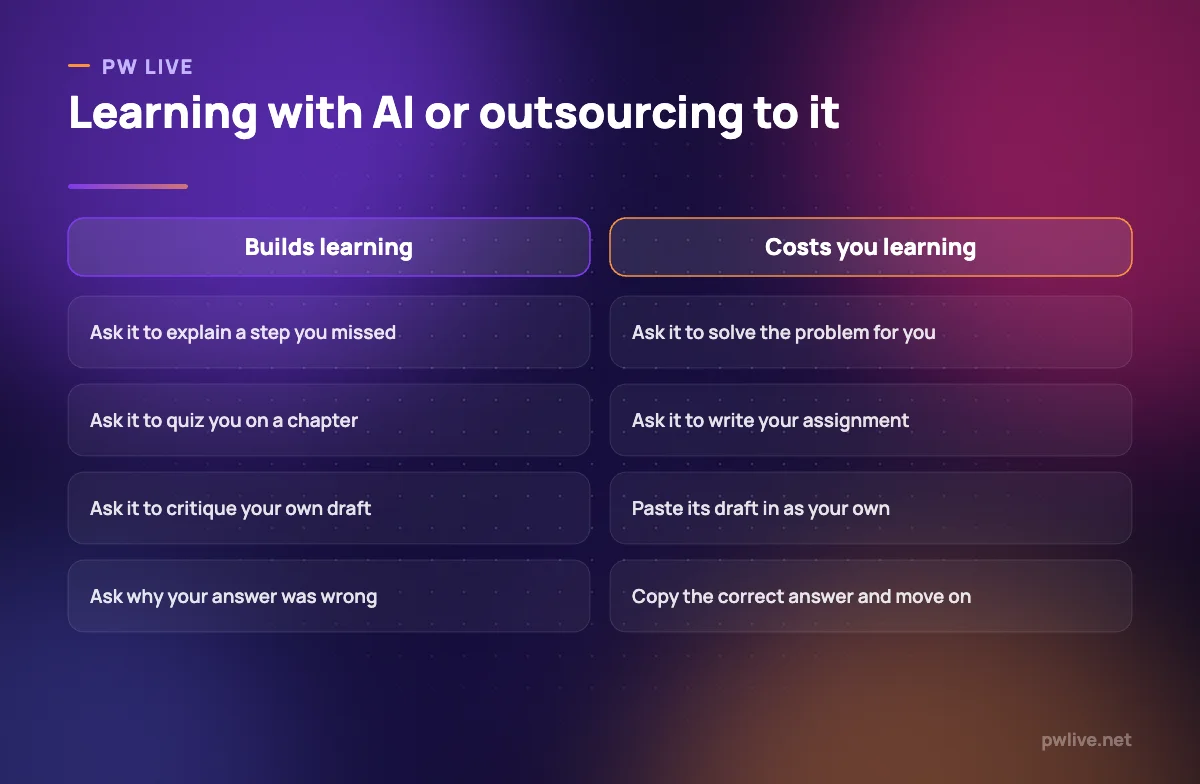
One habit separates useful AI study from self-sabotage. Attempt the work yourself before you open the chat.
Write the paragraph. Try the problem. Get it wrong. Then bring your attempt to the tool and ask what is wrong with it.
This works because retrieval is what builds memory. Reading a fluent explanation of something you never struggled with produces a strong feeling of understanding and almost no retention, which is exactly the trap described in active recall.
A simple test: after any AI conversation, close the window and explain the idea aloud from memory. If you cannot, you have read, not learned.
Prompts that build understanding
The way you ask changes what you get. These patterns work well.
- Explain and escalate. “Explain this concept as if I am starting from scratch, then again at exam level, and tell me what students most often get wrong.”
- Quiz me. “Ask me ten questions on this chapter one at a time. Do not give me the answer until I respond, then tell me what my answer missed.”
- Find my error. “Here is my working. Do not solve it. Tell me the first line where I went wrong and why.”
- Socratic mode. “Do not give me the answer. Ask me questions that lead me to it.”
- Critique my draft. “Here is my essay. Comment on the argument, structure and evidence. Do not rewrite it.”
- Make variations. “Give me five problems of the same type with different numbers, and check my answers afterwards.”
Notice what these have in common: the tool responds to your work rather than producing work for you. The instruction “do not give me the answer” is the most valuable sentence in this article.
Where the line actually is
There is a clean way to think about this. Ask whether the graded output represents your thinking.
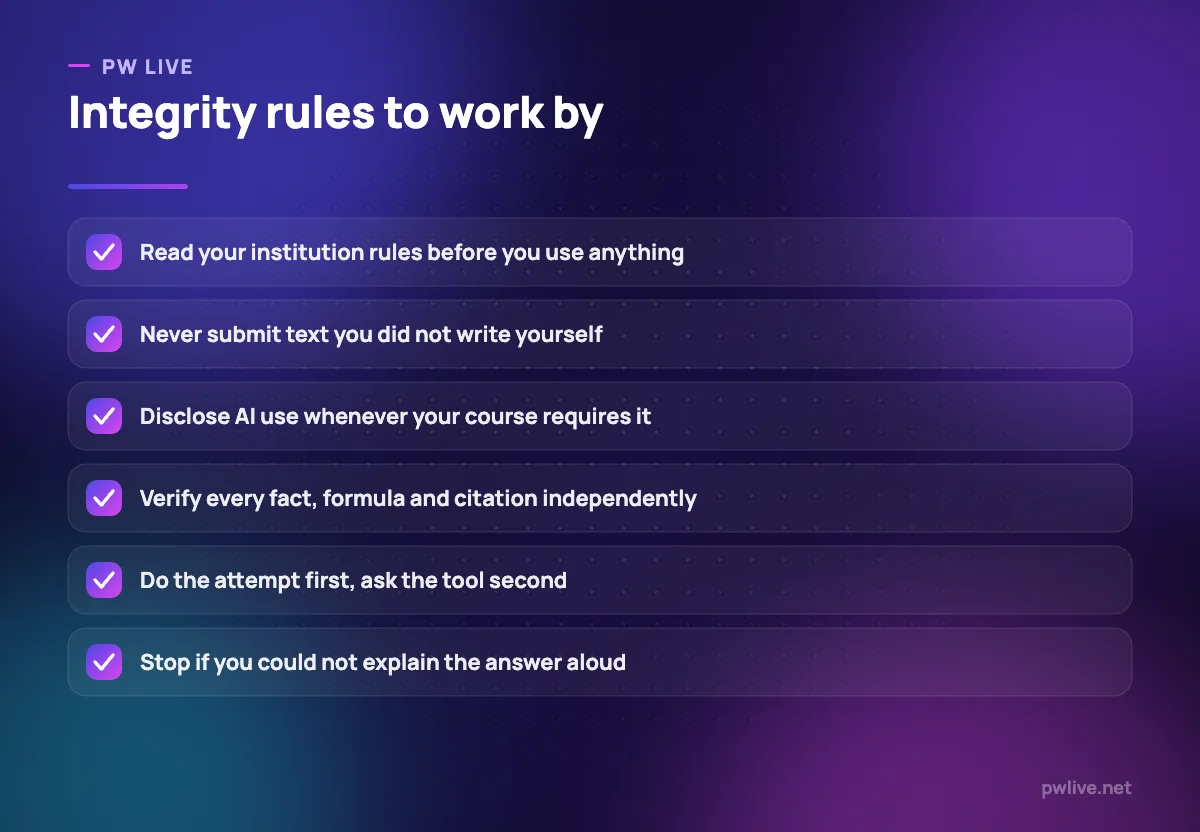
Generally acceptable in most courses, subject to your own rules:
- Asking for an explanation of a concept you then use in your own words.
- Generating practice questions to test yourself with.
- Asking for feedback on your own completed draft.
- Asking it to explain unfamiliar vocabulary in a paper.
Not acceptable anywhere:
- Submitting generated text, code or solutions as your own.
- Using it during an exam, test or any closed assessment.
- Generating references you have not read and cannot verify.
- Paraphrasing generated work to disguise its origin. That is the same act with extra steps.
Where your course requires disclosure, disclose plainly: what you used it for, and where. A short honest note protects you far better than silence.
Build AI into a study routine that already works
These tools are an accelerator on a system, not a replacement for one.
- Before a topic: ask for a plain-language overview to orient yourself, then read the actual textbook chapter.
- During: ask it to explain the single step you got stuck on, not the whole problem.
- After: have it quiz you, then move the questions you failed into your spaced repetition queue.
- After a mock: paste your error log and ask what pattern it sees, then confirm the pattern yourself using how to analyse a mock test.
Be careful with what you paste. Do not upload confidential material, other people’s work, identity documents or anything your institution has restricted, and assume conversations may be stored.
For the wider view, see our guide to AI study tools and how to use them wisely, the technology category, and the exam strategy skill track. The judgment involved here is itself one of the skills that stay valuable as AI changes work.
Key takeaways
- Read your institution’s AI policy first; rules differ and ignorance is not a defence.
- Attempt the work yourself, then bring your attempt to the tool for feedback.
- Use it to explain, quiz and critique, never to produce work you submit.
- Verify every fact, formula and citation against a real source, because it can invent them.
- Ask it to withhold answers and question you instead.
- If you cannot explain the answer aloud from memory, you have not learned it.
Frequently asked questions
Is using an AI chat tool for homework cheating?
It depends on your institution’s rules and what you use it for. Using it to understand a concept is usually fine; submitting its output as your own work is misconduct almost everywhere.
Can teachers tell if I used AI to write something?
Detection tools are unreliable in both directions, which is a poor reason to risk it. The stronger argument is that outsourced writing leaves you unable to defend your work in a viva or an exam.
Can I trust AI answers for exam facts and formulas?
No. Check every fact, formula, date and citation against your textbook, syllabus or the exam body’s official notice, because these tools can be confidently wrong.
What is the single best way to use AI while studying?
Ask it to quiz you without giving answers, then explain your reasoning back to it. That forces retrieval, which is what actually builds memory.
Keep learning with PW Live
Browse every guide in Apps & Tools, or pick a skill track and follow the roadmap step by step.





Leave a Reply