

The self-study vs coaching question is usually asked as if one is better. It is not. The right answer depends on how you handle unstructured time, how quickly you get unstuck on your own, and what your family can comfortably spend.
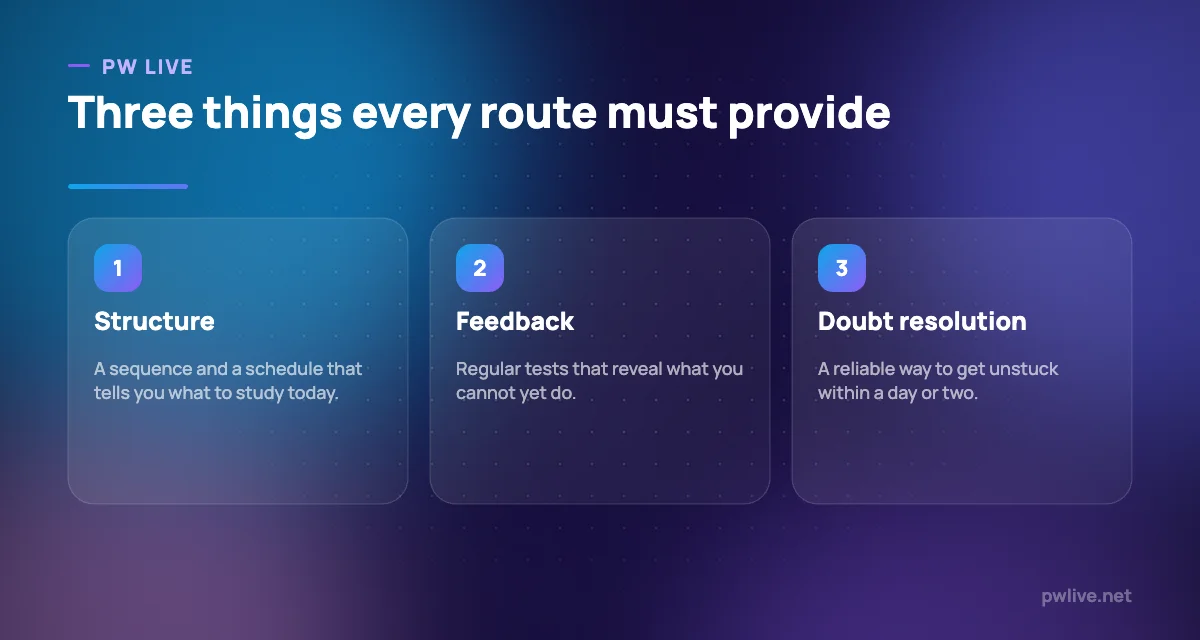
Plenty of students clear hard exams through pure self-study. Plenty of others waste two years in a coaching batch that moved faster than they could absorb. The route matters less than whether you actually get three things: structure, feedback and doubt resolution.
This guide gives you a way to decide honestly, including the hybrid option most people end up needing.
What each route is actually selling
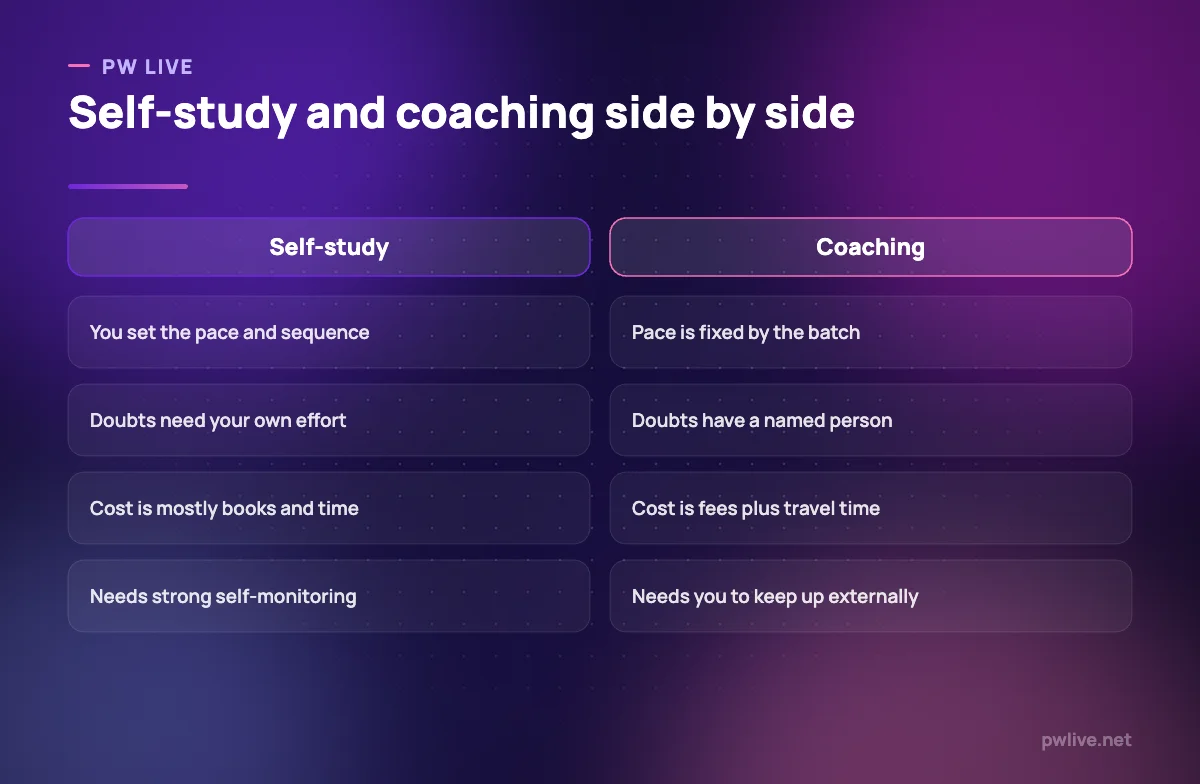
Coaching sells structure and pace. You get a syllabus broken into a calendar, a teacher who has taught the topic hundreds of times, regular tests, and a room full of people doing the same thing. The pace is the product, and it is also the risk.
Self-study sells control. You choose the sequence, the depth, the speed and the resources. You can spend three days on one weak chapter without falling behind anyone. The control is the product, and it is also the risk.
Neither sells the thing that actually determines your result: hours of focused, active work on problems you cannot yet solve. That has to come from you in both cases.
Six questions that decide it for you
Answer these honestly rather than aspirationally.
- When you do not understand something, what do you do? If you search, read two other explanations and usually get there within an hour, self-study is viable. If you close the book and switch subjects, you need a person.
- What happened last time you had unstructured months? Study holidays and long breaks are good evidence. Look at what you actually did, not what you planned.
- Can you build and follow a schedule? Structure is the first thing self-study removes and the last thing most students can supply themselves.
- Do you have access to good material and a way to judge it? Not having a curated resource list is the single most common self-study failure.
- What does the money cost your family? Fees that create pressure at home can hurt your performance more than they help it.
- How far is the travel? Two hours a day in transport is roughly a full extra study session lost, five days a week.
If four or more answers point to needing external structure, coaching or a structured online programme is the safer bet, whatever your pride says.
When self-study genuinely works better
Self-study wins in specific situations, and they are more common than the coaching industry suggests.
- You are strong in most of the syllabus and weak in a few chapters. A batch will make you sit through what you already know.
- You are a repeat aspirant. You have already seen the full syllabus once, so you need targeted revision and tests, not fresh lectures.
- You are preparing while working or attending college. Fixed class timings are simply incompatible with a job, and self-study lets you use the hours you actually have. Our guide to preparing for government exams while working full time goes deeper on this.
- You already have a working study system. If you can build a timetable, run mock tests and analyse them, you are supplying most of what coaching provides.
The thing self-study cannot skip is testing. If you are self-studying, you must buy or join a test series, take papers under real time limits, and analyse them properly. Reading our guide to analysing a mock test matters more for self-study students than for anyone else, because there is nobody else to tell you where you stand.
When coaching earns its fee
Coaching is worth the money when it supplies something you genuinely cannot build yourself.
- You do not know what to study or in what order. A tested sequence is real value, especially for a syllabus you have never seen.
- You stall on doubts. A teacher who resolves a conceptual block in five minutes can save you a week.
- You need peer pressure. Some people work hard only in the presence of others working hard. That is a legitimate fact about yourself, not a weakness.
- You have no study environment at home. A classroom or library slot may be the only place you can concentrate. If space is the issue, our guide to setting up a study space in a small or shared home may solve it more cheaply.
What coaching does not do is study for you. Attending every lecture and doing no independent problem-solving produces the familiar pattern of a student who understands everything in class and freezes in the test.
The hybrid route most students actually need
In practice the strongest setup is rarely pure. A common and sensible combination looks like this:
- Self-study for the subjects you are already comfortable in, using standard textbooks and your own schedule.
- Structured help for your weakest subject only, whether that is a class, an online course or a tutor.
- A paid test series taken by everyone, self-study or not.
- Recorded lectures for specific chapters rather than a full course, watched with the discipline described in our guide to studying from video lectures.
This keeps costs down, protects your time, and puts external structure exactly where your self-discipline is weakest.
Run a four-week trial before committing a year
You do not have to guess. Test the question with a short experiment.
Pick one chapter you have not studied. Learn it entirely by self-study over one week: read, make notes, do the problem set, then test yourself. Record how many hours it took and how you scored.
Then take a demo class or a trial module for a comparable chapter and repeat the measurement. Compare three things: the hours spent, the score, and how many times you gave up mid-way.
Most students discover something surprising. Some find they were far more capable alone than they assumed. Others find that one hour with a teacher replaced six hours of confused reading. Either answer is useful, and both are cheaper than discovering it in month seven.
Warning signs you chose wrong
Whichever route you pick, review it after six to eight weeks. Switch or adjust if you see these signals.
In coaching: you are attending regularly but your test scores are flat, you are more than a chapter behind the class, you have stopped asking questions, or homework is going undone every week because class hours consume your whole day.
In self-study: you have not taken a timed full-length test, you keep re-reading the same comfortable chapters, you have a growing list of unresolved doubts, or you cannot say what you will study tomorrow morning.
Both failure modes are fixable, and neither requires abandoning the route. Adding a test series fixes most self-study drift. Cutting attendance to your weak subjects and reclaiming the hours fixes most coaching overload.
For more on planning the year around whichever route you choose, see our six-month exam preparation timeline, the exam strategy skill track, and the wider education and learning archive.
Key takeaways
- The route matters less than whether you get structure, feedback and doubt resolution
- Decide using past evidence of how you handle unstructured time, not intentions
- Self-study suits repeat aspirants, working candidates and students with few weak areas
- Coaching earns its fee when you stall on doubts or cannot build a sequence yourself
- A hybrid setup, with paid help only where you are weakest, is usually the best value
- Review the decision after six to eight weeks against clear warning signs
Frequently asked questions
Can I clear a competitive exam through self-study alone?
Yes, and many students do. The non-negotiable additions are a proper test series, a fixed schedule and a reliable way to resolve doubts within a day or two.
Is online coaching a real middle ground?
It can be, because it supplies structure without travel time. Judge it on whether doubts get answered and whether you actually watch lectures on schedule rather than stockpiling them.
Should I join coaching if all my friends have?
No. Their weak subjects, home environment and self-discipline are different from yours. Use the six questions above and decide on your own evidence.
How do I know if I should switch mid-year?
Switch when test scores have been flat for two months despite consistent effort, and when you can name the specific thing the other route would fix. Do not switch out of general frustration.
Keep learning with PW Live
Browse every guide in Education & Learning, or pick a skill track and follow the roadmap step by step.





Leave a Reply