

A negative marking strategy is the difference between two students who know exactly the same amount and score fifteen marks apart. One of them decided in advance when to guess. The other decided in the hall, while the clock ran.
Negative marking exists to punish blind guessing, and it does that job well. What it does not punish, and what most students misunderstand, is informed guessing after eliminating options.
This guide shows you how the arithmetic actually works, how to find your own attempting threshold from your mock data, and how to make the decision in three seconds rather than three minutes.
First, know your exact marking scheme
Marking schemes differ between exams, between sections of the same exam, and sometimes between question types within a section. Some sections carry no penalty at all, and some exams have changed their scheme between cycles.
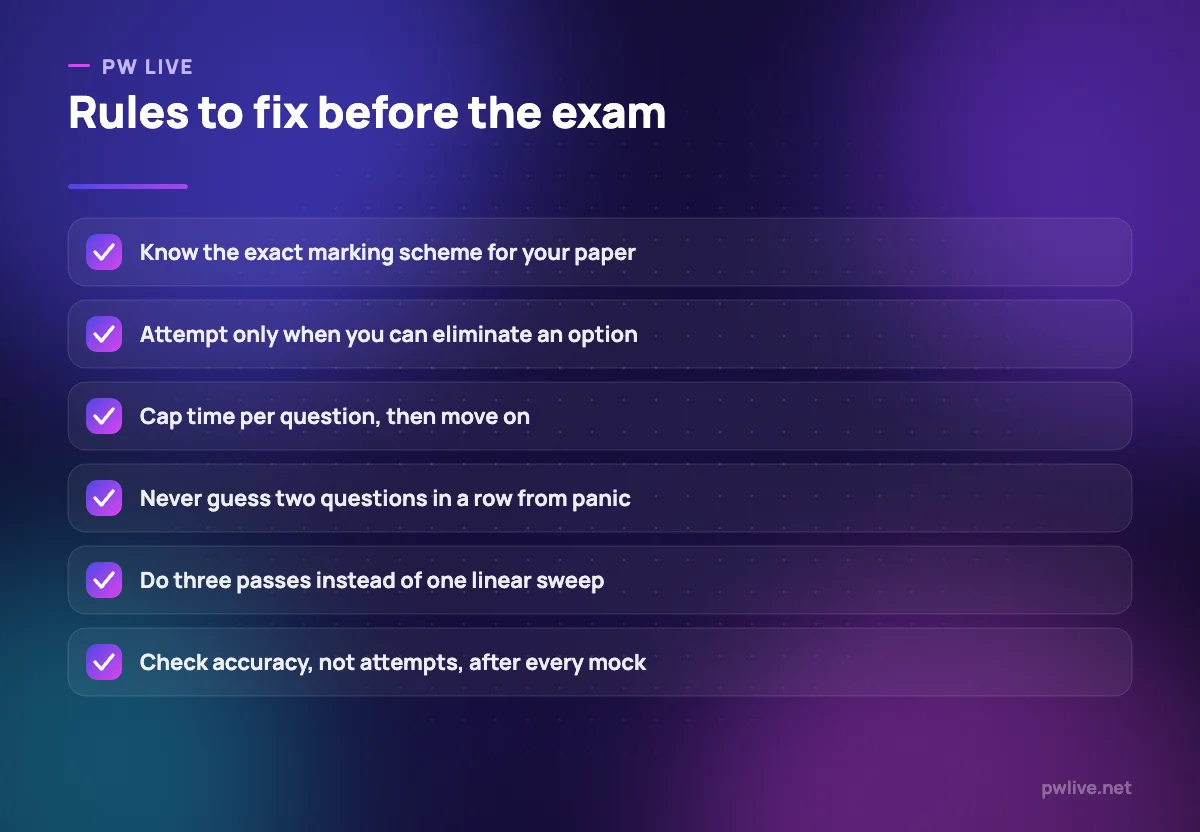
So before you build any strategy, read the official information bulletin for your exam and the instructions printed on the paper itself. Do not carry over a rule you learnt for a different exam.
What you need to know for each question type:
- Marks awarded for a correct answer.
- Marks deducted for a wrong answer.
- Whether unattempted questions are neutral.
- Whether numerical-entry or multiple-correct questions are penalised differently.
The strategy below assumes a penalty exists. Where a section has no negative marking, the rule is simple: attempt everything, leaving nothing blank.
The arithmetic, in plain terms
Take a common style of scheme as an illustration: say a correct answer gives four marks and a wrong one costs you one.
Over many questions, guessing is worth it whenever you would be right often enough for the gains to outweigh the losses. With that four-to-one ratio, you break even at roughly one correct answer in five.
Now compare that to what elimination gives you. With four options and no idea at all, your chance is one in four, which is already slightly above the break-even point. Rule out one option and you are at one in three. Rule out two and you are at one in two, comfortably profitable.
Two honest caveats. First, on a real paper you attempt a limited number of such questions, so the averages are noisy and a run of bad luck is entirely possible. Second, you are usually not guessing randomly, because papers are designed with attractive wrong options that pull you towards a specific mistake, which can push your real accuracy below the theoretical number.
The practical conclusion is the one that matters: eliminate before you guess, and never guess from a blank.
Find your own threshold from your mocks
Theory gives you a starting point. Your own data gives you the real rule, and you already have it sitting in your mock tests.
For each of your last three or four papers, split your attempts into three groups and calculate accuracy for each:
- Sure attempts. You knew it and solved it.
- Eliminated attempts. You were unsure but ruled out at least one option.
- Pure guesses. You had nothing.
Most students find their sure attempts land somewhere high, their eliminated attempts land in a middle band, and their pure guesses land close to random or worse.
Now check the middle group against the break-even accuracy for your scheme. If your eliminated attempts sit clearly above it, guessing after elimination is earning you marks, so do more of it. If they sit below it, you are eliminating badly rather than guessing badly, and the fix is practice on those topics, not more caution.
The third group almost always loses marks. That is the group to cut to zero. Our guide to analysing a mock test properly explains how to log these categories after every paper so the numbers exist when you need them.
Make the decision in three seconds
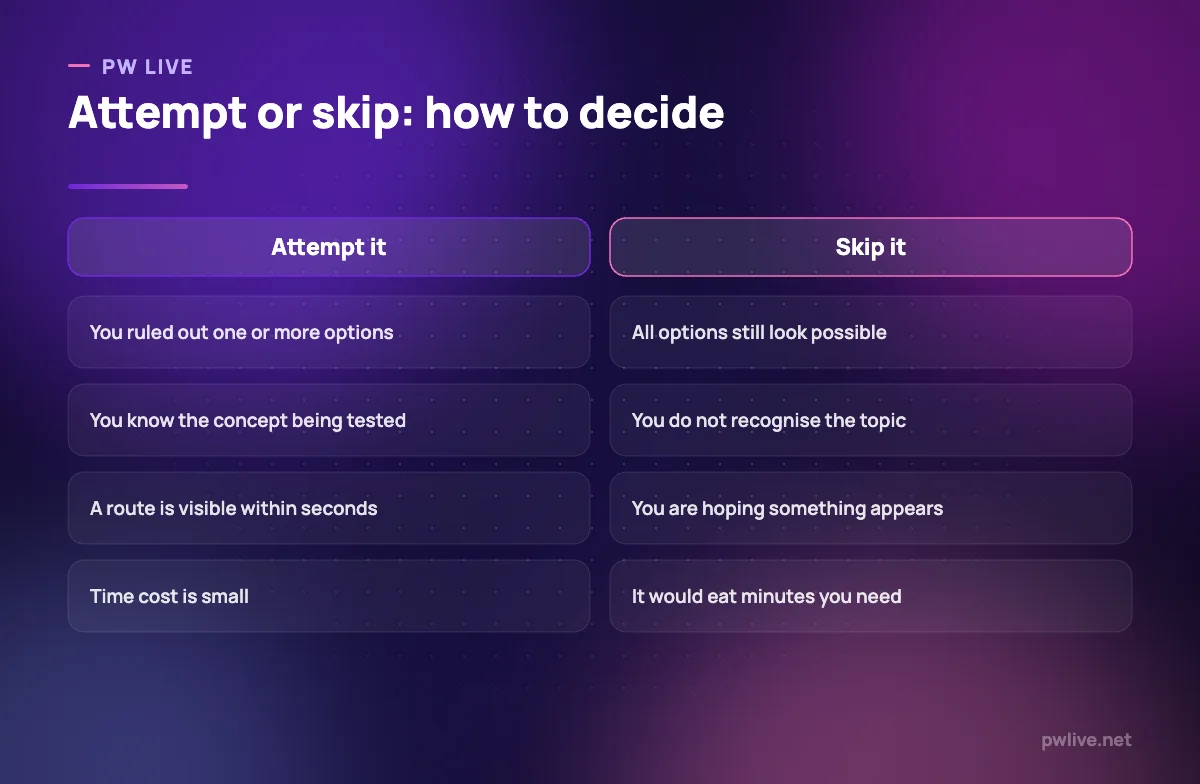
In the hall you do not have time for arithmetic. You need a reflex, so reduce it to one question asked in order:
- Do I recognise what is being tested? If no, mark it and move on immediately.
- Can I rule out any option? If yes, you are already above break-even for most schemes. Answer and move on.
- Do I have a route within my time cap? If yes, solve it. If no, mark and move on.
The trap to avoid is the middle state: half a route, growing investment, and a refusal to abandon a question because of the time already spent. Sunk time is gone whether you stay or leave.
Set a hard cap per question before the exam, based on the paper’s total time divided by its questions, and roughly double that as your absolute ceiling for anything.
Use three passes, not one sweep
A linear sweep through the paper guarantees that a hard question early on steals time from easy questions later. Three passes solve this.
- Pass one. Answer everything you know quickly and confidently. No struggling, no guessing. This banks your certain marks.
- Pass two. Return to questions where you saw a route but needed working. Solve these with your time cap enforced.
- Pass three. Handle the remainder. Eliminate where you can and attempt those; leave the genuine blanks blank.
This also improves your guessing quality, because by pass three you have seen the whole paper, your mind has warmed up, and questions that looked opaque at the start sometimes read differently.
Where negative marking really costs you: careless errors
Here is the uncomfortable part. For most students, the biggest source of negative marks is not risky guessing. It is questions they knew, answered confidently, and got wrong.
A misread word, a sign error, the right answer marked in the wrong row, using the wrong unit. Each of these costs you the full penalty plus the marks you should have earned.
Three habits reduce them:
- Re-read the question stem after solving, checking specifically for “not”, “except”, “incorrect” and units.
- Do the final arithmetic step slowly, since it is where fatigue shows.
- If you change an answer, be sure you have a reason. Second-guessing without new information usually makes things worse.
Track these separately in your error log. If careless slips outnumber guessing losses, your strategy is fine and your process needs work.
Manage the psychology, not just the maths
Two emotional states break good strategies. The first is panic guessing, usually in the final ten minutes, when students fill in a block of answers to avoid leaving blanks. This reliably loses marks.
The second is over-caution, where a student leaves twenty questions they could have eliminated their way through, because a previous paper punished them for guessing. That is a decision made from memory of pain rather than from data.
The remedy for both is the same: fix the rules in advance, when you are calm, and follow them mechanically on the day. Our exam day checklist covers the routine that keeps you in that state, and our guide to what helps with exam anxiety deals with the nerves that push people into panic attempts.
Build the reflex through practice, not intention. Every sectional and full mock is a rehearsal for these decisions, which is why sound preparation planning puts mocks in early rather than saving them for the end. More material on paper technique sits in our exam strategy track and the exams and admissions section.
Key takeaways
- Confirm the exact marking scheme for every section from official instructions.
- Eliminate at least one option before attempting anything you are unsure of.
- Never answer from a complete blank when a penalty applies.
- Calculate your accuracy separately for sure attempts, eliminated attempts and pure guesses.
- Use three passes through the paper with a hard time cap per question.
- Careless errors on known questions usually cost more than guessing does.
Frequently asked questions
Is it ever worth guessing completely randomly?
Rarely, and only when the scheme’s penalty is small relative to the reward. With a blank paper and no elimination, the expected gain is close to zero at best and the variance is high, so the time is better spent elsewhere.
How many questions should I attempt overall?
There is no fixed number. Attempt everything you know or can narrow down, and judge yourself on accuracy in each category rather than on a target attempt count.
Should I change an answer if I have second thoughts?
Only if you have found an actual reason, such as a misread condition or an arithmetic error. Changing an answer on a vague feeling more often turns a right answer into a wrong one.
Do all competitive exams have negative marking?
No, and schemes vary by exam, by section and sometimes by question type, and have been revised between cycles. Always check the official information bulletin for your exam year rather than assuming.
Keep learning with PW Live
Browse every guide in Exams & Admissions, or pick a skill track and follow the roadmap step by step.





Leave a Reply