

Exam misinformation is a seasonal industry. Every application window and result date brings a wave of fake notices, edited screenshots, panic-inducing forwards and outright scams, all aimed at students who are already anxious and short of time.
Some of it is careless rather than malicious: an old notice reshared, a headline misread, a rumour that grew in retelling. Some of it is deliberate and expensive, aimed at extracting money or documents from families making a decision under pressure.
You do not need to be an investigator to protect yourself. You need one habit, applied consistently: before you believe it, act on it or forward it, find the original document on the official site.
The five claims that are almost always wrong
Certain claims recur every cycle, in every state, for every kind of exam. Recognising the type saves you time.
- “The exam has been postponed.” Circulated constantly, occasionally true, almost never true when it first appears as a forward.
- “The syllabus has been reduced.” Extremely popular and extremely damaging, because acting on it means studying less.
- “The paper has leaked.” Often accompanied by an offer to sell you something. Treat any such offer as both false and dangerous.
- “Seats are still available through a direct route.” The classic admission scam, usually with an urgent payment attached.
- “The last date has been extended.” Sometimes true, but relying on it without confirmation risks missing the deadline entirely.
The last one is worth a rule of its own: never miss a deadline because you believed it had moved. Complete your application by the original date regardless.
Verify at the source, not in the group
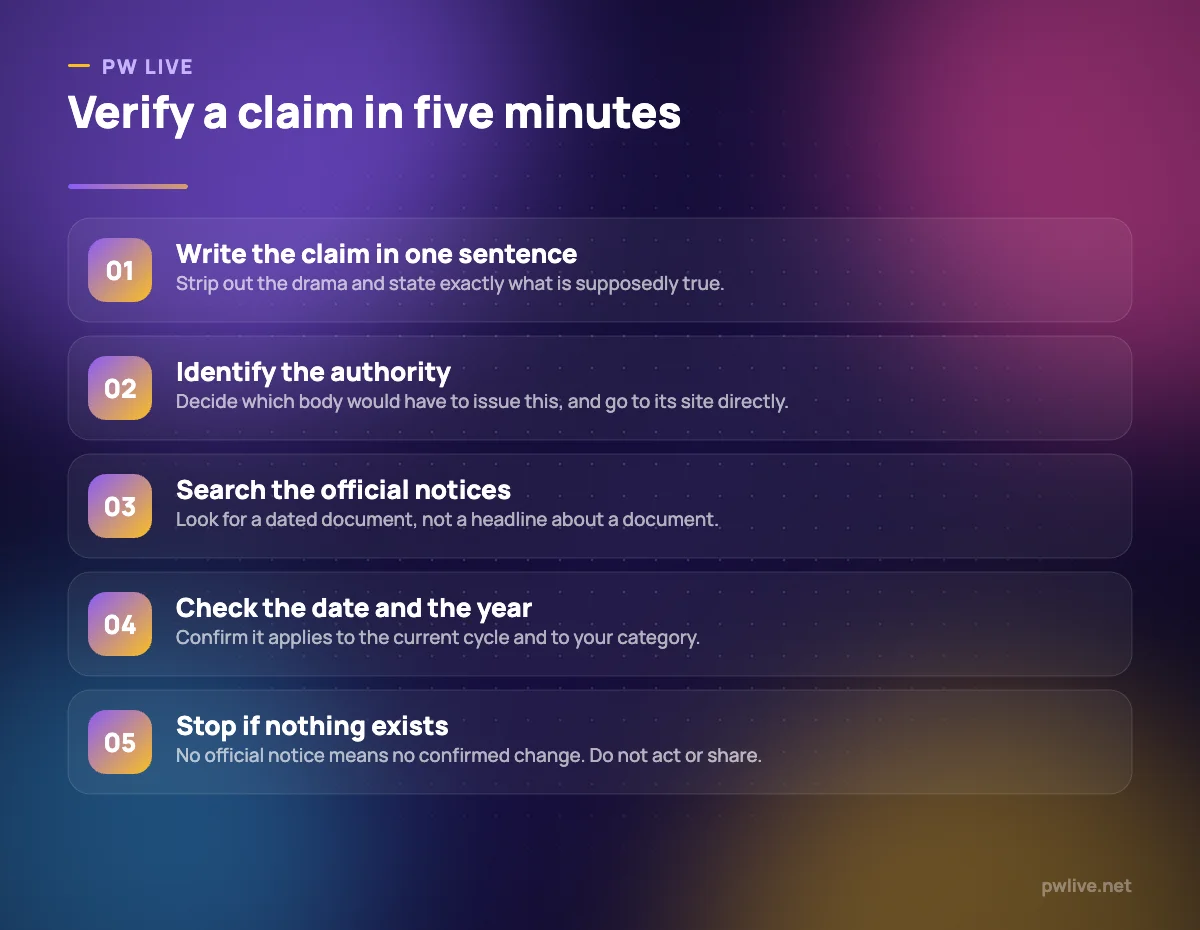
The core method is simple and it works for every claim above.
Identify which body would actually have to issue the notice: the exam conducting authority, the university, the board, the counselling body or the relevant government department. Then go to that body’s website directly by typing the address you already know, not by tapping a link in the message.
Look for a notice with a date. If a claim is real and consequential, the authority publishes it, because they have to. If half an hour of looking turns up nothing, the claim is unconfirmed. Unconfirmed is not the same as false, but it is never a reason to act.
Our guide to reading education news without falling for rumours covers the general version of this routine for news reports rather than direct claims.
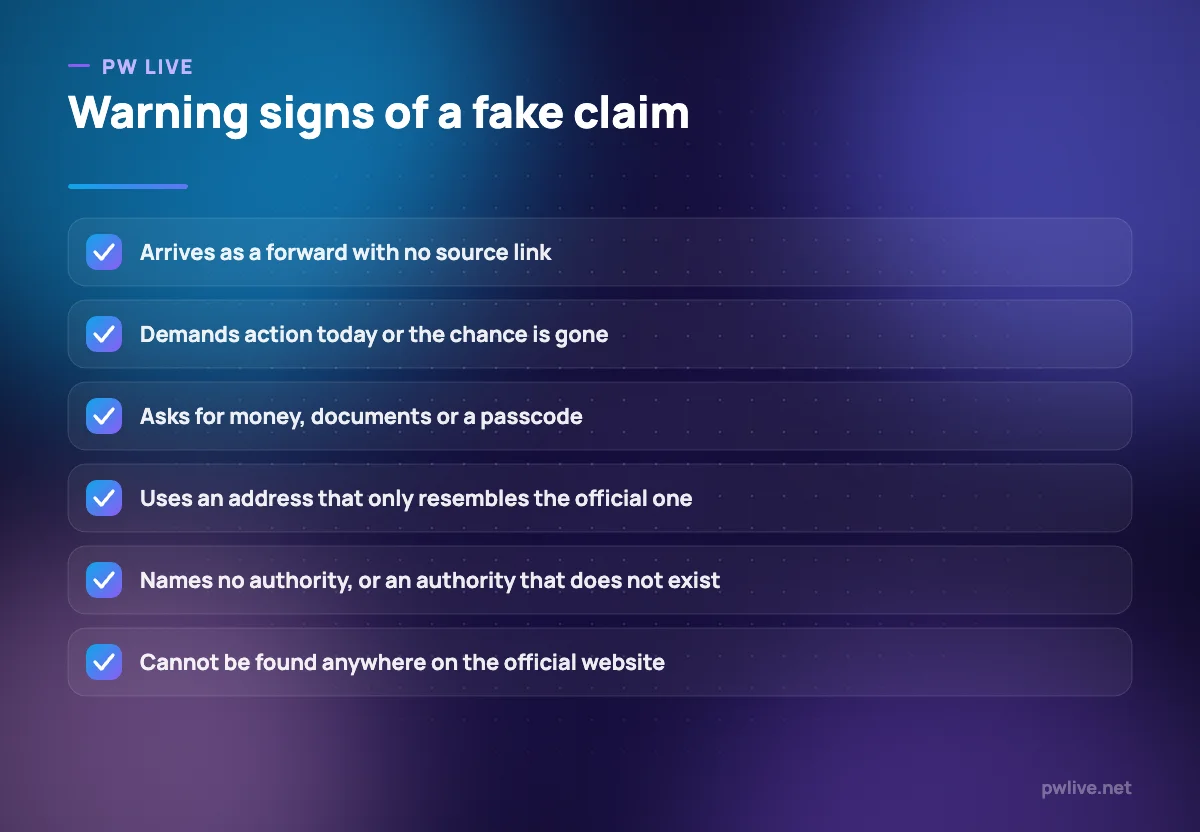
Check the address before you trust the page
Fake admission and result sites work by looking almost right. They copy the design, the logo and the layout, and change the web address by a character or two.
Before entering anything on a page:
- Compare the address character by character with the one printed in the official information brochure.
- Be suspicious of extra words, hyphens or unusual endings added to a familiar name.
- Remember that many official Indian bodies use addresses ending in gov.in or nic.in, but confirm the exact one rather than assuming.
- Never reach a payment or login page through a link in a message; navigate there yourself.
- Look at what the page asks for. An official result page does not need your bank details.
Our guide to keeping your accounts safe covers the wider set of defences, and digital privacy explains why handing over documents casually creates problems long after the application is over.
Money is the loudest warning sign
Legitimate exam and admission processes have published fees, paid through official channels, with a receipt. Anything outside that shape deserves suspicion.
Be firm about these rules:
- No genuine authority asks for payment through a personal account or a payment request in a chat.
- Nobody can sell you a guaranteed seat, a rank, a paper or a favourable evaluation.
- An offer that requires secrecy is not an opportunity, it is a warning.
- Do not send certificates, identity documents or mark sheets to anyone who contacted you first.
- Never share a one-time passcode with anyone for any reason.
If someone claiming to be from an institution phones you, hang up and call the number published on the institution’s official website. A caller who objects to that is telling you what you need to know.
Screenshots, voice notes and coaching groups
Screenshots are the currency of exam rumours, and they are the weakest form of evidence there is. They can be cropped, edited, taken from a previous year or lifted from a satirical account.
Treat a screenshot as a lead. If what it shows is real, you will find the underlying notice in a few minutes. If you cannot, do not forward it, because forwarding is how a rumour acquires credibility it never earned.
Voice notes are worse, because they carry emotional urgency and no verifiable content at all. Coaching and student groups are useful for hearing about something early and useless for confirming it.
What to do when you cannot verify
Sometimes a story is genuinely developing and there is no official word yet. Handle it with a process rather than a reaction.
- Note the claim, in writing, in one sentence.
- Note which authority would confirm it.
- Continue your preparation exactly as planned.
- Check the official page again in a few days.
- Act only when a dated notice exists.
This matters most for syllabus and pattern claims, where acting early on a false report means studying the wrong things for weeks. Our guide to what changing exam patterns mean for students covers how to respond once a change is actually confirmed.
Build a habit that protects you all cycle
A few small habits remove most of your exposure to misinformation for an entire admission season.
- Bookmark the official pages for every exam and institution you are applying to.
- Keep one document listing every confirmed date with a link to its source.
- Do your application on the original deadline, never on a rumoured extension.
- Decide on one person, such as a teacher or a parent, to check alarming claims with before acting.
- Leave or mute groups that generate panic without sources.
If you are still deciding between options, our guides to choosing between JEE, NEET and other paths after Class 12 and CUET preparation are useful starting points, but always confirm eligibility, dates and fees on the official portal. Browse the exams and admissions category for more, and the exam strategy skill track to keep your planning steady while the noise continues.
Key takeaways
- Every consequential exam or admission change is published by the issuing authority; if it is not there, it is not confirmed.
- Postponement, syllabus reduction, leaked papers, direct seats and extended deadlines are the recurring false claims.
- Check web addresses character by character and never reach a payment or login page through a message link.
- No legitimate process sells a seat, a rank or a paper, and none asks for a one-time passcode.
- Apply by the original deadline and keep your own record of confirmed dates with source links.
Frequently asked questions
Someone is offering a guaranteed admission for a fee. Could it ever be genuine?
No. Admissions run through published processes with published fees paid to official accounts. Any offer of a guaranteed seat outside that process is a scam, regardless of how convincing the paperwork looks.
How can I check whether a website is the official one?
Compare the address with the one printed in the official information brochure or notice, character by character, and type it yourself rather than following a link. Design and logos can be copied easily; the address is harder to fake exactly.
What should I do if I have already shared my documents with a suspicious site?
Stop any further communication, change the passwords on any accounts involved, inform your bank if payment details were shared, and report the matter to the institution and the relevant cybercrime authorities through their official channels.
Should I trust news reports about exam changes?
Use them as a signal, then verify. Reliable reporting links to the official notice, so open that document and read the part that applies to your year, exam and category before acting on anything.
Keep learning with PW Live
Browse every guide in News & Updates, or pick a skill track and follow the roadmap step by step.





Leave a Reply