

Falling behind in a subject creates a specific kind of paralysis. The backlog feels too large to start, every new class makes it worse, and avoidance feels safer than opening the book. If you want to catch up in a subject, the first task is not studying harder. It is stopping the gap from growing.
Almost everyone is behind in something. What separates students who recover from those who quietly drop the subject is a plan with a defined scope, rather than a vague intention to “do everything in the holidays”.
This is that plan. It takes about an hour to set up and a few weeks to execute.
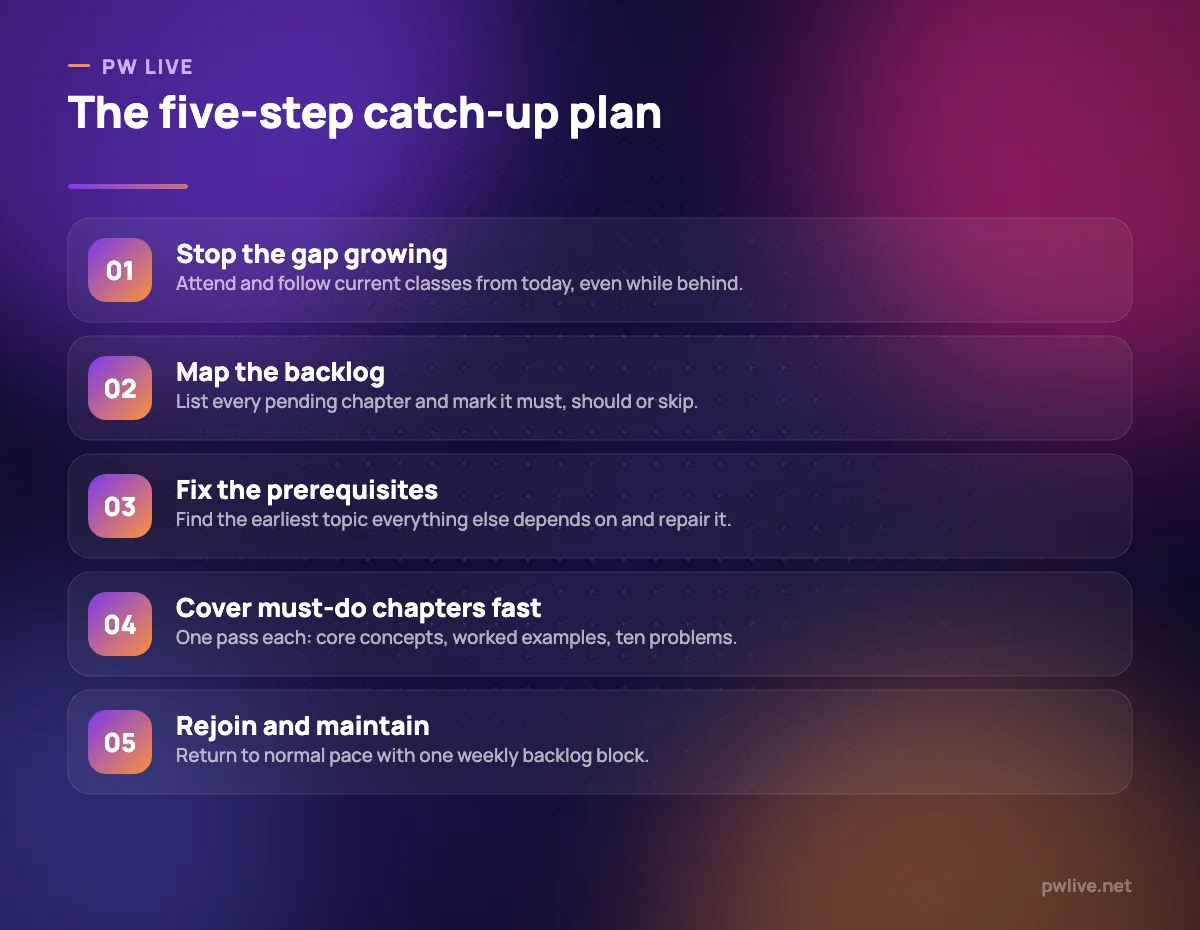
Stop the bleeding before you clear the backlog
The instinct is to abandon current classes and go back to where you lost the thread. This is almost always wrong. It leaves you permanently one step behind and adds new pending chapters at exactly the rate you clear old ones.
Instead, split your effort from today:
- Keep up with current material, even if you only follow half of it. Attend, take structural notes, mark what you cannot follow.
- Give the backlog a separate, fixed block each day or on alternate days.
Following a class you are underprepared for is not wasted. You still absorb vocabulary, structure and question types, which makes the eventual proper study of that chapter much faster.
Set the split roughly at one third current material to two thirds backlog until you have caught up, then invert it.
Map the backlog honestly
Vagueness is what makes a backlog frightening. A list makes it finite.
Open the syllabus and write down every pending chapter. For each one, note three things: how heavily it is weighted in your exam, whether later chapters depend on it, and how confident you are on a simple three-point scale.
Then mark each chapter as must do, minimum coverage or skip.
- Must do: heavily weighted, or a foundation for other chapters, or a known weak area
- Minimum coverage: worth marks but self-contained, and you have partial knowledge
- Skip: low weighting, self-contained, and time is short
Skipping is a legitimate decision, not a moral failure. A student who covers 80 percent of the syllabus properly outscores one who covers 100 percent superficially. What you must not do is skip by accident, which is what happens when there is no list.
For subjects with a standard core text, this triage is much easier. Our guide to NCERT versus reference books explains which source to use for a fast first pass and which to leave until later.
Repair the prerequisite chain first
Subjects like mathematics, physics and accountancy are chains. If you lost the thread at chapter four, chapters five through nine are not nine separate problems; they are one problem repeated.
Find the earliest point where you genuinely stopped understanding. Ask yourself, chapter by chapter going backwards, “can I solve a basic question from this?” until you reach a yes. The chapter after that yes is where you start.
Repairing that one foundational chapter properly often makes three or four later chapters collapse into something manageable in days rather than weeks. Students who skip this step spend the whole recovery confused about why nothing is sticking.
For theory-heavy subjects the chain is looser, and you can usually take chapters in any order. Start with the highest-weighted ones instead.
Run a fast first pass on must-do chapters
Speed here comes from cutting depth on the first pass, not from reading faster.
For each must-do chapter, do this in one focused sitting:
- Read the summary or the chapter opening to get the structure, five minutes
- Learn the core concepts and formulas properly, without trying to memorise details
- Work through two or three solved examples, attempting each before reading the solution
- Attempt ten problems of the standard types, notes closed
- Write a one-page compressed sheet: formulas, question types, your errors
That last page is what you will actually revise later. The approach is described more fully in our guides to taking notes you will actually revise and building a formula and revision notebook.
Resist perfectionism aggressively. A chapter at 70 percent understanding today is worth far more than a chapter at 95 percent in three weeks while five others stay at zero. You can deepen later; you cannot recover the weeks.
Recorded lectures are useful at this stage precisely because you can control the pace, provided you watch them with discipline. Our guide to studying from video lectures without wasting hours covers how to use them for fast coverage rather than passive viewing.

Give the recovery a deadline and a schedule
A catch-up plan without an end date becomes a permanent background worry. Pick a target date, ideally three to six weeks out, and count backwards.
Divide the must-do chapters across the available blocks and write them into your week as specific tasks. Two chapters a week is a realistic pace alongside current classes for most students; three is possible for a short burst but not sustainable.
Protect the plan the same way you protect anything else in a week that goes wrong: leave unassigned catch-up slots rather than filling every hour. Our weekly study timetable guide sets out how to build that slack in without losing the deadline.
Track it visibly. A simple sheet with one row per chapter and a tick when the ten problems are done gives you the one thing a backlog destroys, which is a sense of progress.
Make sure it stays learned
Catching up fast creates fragile knowledge. Chapters covered in one sitting fade quickly unless you deliberately return to them.
Two habits prevent that.
Test rather than review. When you come back to a chapter, close the book and write what you remember or attempt fresh problems. Rereading a chapter you rushed feels reassuring and teaches you almost nothing, which is the point of our guide to active recall.
Space the returns. Revisit each recovered chapter the next day, after about a week, and again after three weeks, using the intervals described in our practical guide to spaced repetition.
Ten minutes of self-testing per recovered chapter, spaced out, is enough to convert a rushed pass into something durable.
Deal with the reason you fell behind
Clearing the backlog without fixing the cause means being in the same position next term. Look at which of these applies.
- A gap in prerequisites made the subject impossible to follow. Fixed by the repair step above.
- Time was allocated elsewhere. Your timetable gave this subject the leftover hours. Fix the allocation, not your attitude.
- Avoidance. You dislike the subject, so you postponed it, which made it worse. Our practical toolkit for beating procrastination deals with this loop directly, and starting with the easiest pending chapter usually breaks it.
- Something outside studies. Illness, family circumstances or a stretch of poor sleep. Rebuild the routine before rebuilding the syllabus, and be honest about the load you can carry.
If the exam is very close and the backlog is large, the calculation changes again, and coverage strategy replaces recovery. Our guide to revising an entire syllabus in the last 30 days covers that scenario. More study-system material is collected in the education and learning archive and the exam strategy skill track.
Key takeaways
- Keep following current classes while you clear the backlog, or the gap keeps growing
- List every pending chapter and mark it must do, minimum coverage or skip
- Repair the earliest prerequisite chapter first in chained subjects
- Run fast one-sitting passes with ten problems and a one-page summary each
- Set a deadline three to six weeks out and track chapters visibly
- Return to recovered chapters by self-testing at spaced intervals
Frequently asked questions
Should I skip current classes to clear my backlog?
No. Keep attending, even if you follow only part of it, and give the backlog a separate fixed block. Dropping current classes guarantees you stay behind permanently.
How many chapters can I realistically cover in a week?
Two per week alongside normal classes is a sustainable pace for most students. Three is possible for a short burst, but planning for more usually produces coverage too shallow to be useful.
Is it acceptable to skip chapters completely?
Yes, when they are low weighted, self-contained and time is genuinely short. Make it a recorded decision on your list rather than something that happens by drift.
What if I have fallen behind in every subject?
Rank subjects by weighting and by how far behind you are, then recover them one at a time rather than in parallel. Fixing one subject fully restores confidence faster than making slight progress in four.
Keep learning with PW Live
Browse every guide in Education & Learning, or pick a skill track and follow the roadmap step by step.





Leave a Reply