

Learning to read education news without falling for rumours is a skill, and for a student it matters as much as any chapter in the syllabus. One forwarded message can convince an entire batch that a paper has been postponed, a syllabus has been trimmed or an application window has quietly closed.
Most of what circulates is not a deliberate lie. It is a half-remembered detail, an old notice reshared out of season, or a genuine headline stretched into something it never said. By the fourth forward, the caution has been stripped out and only the alarming part survives.
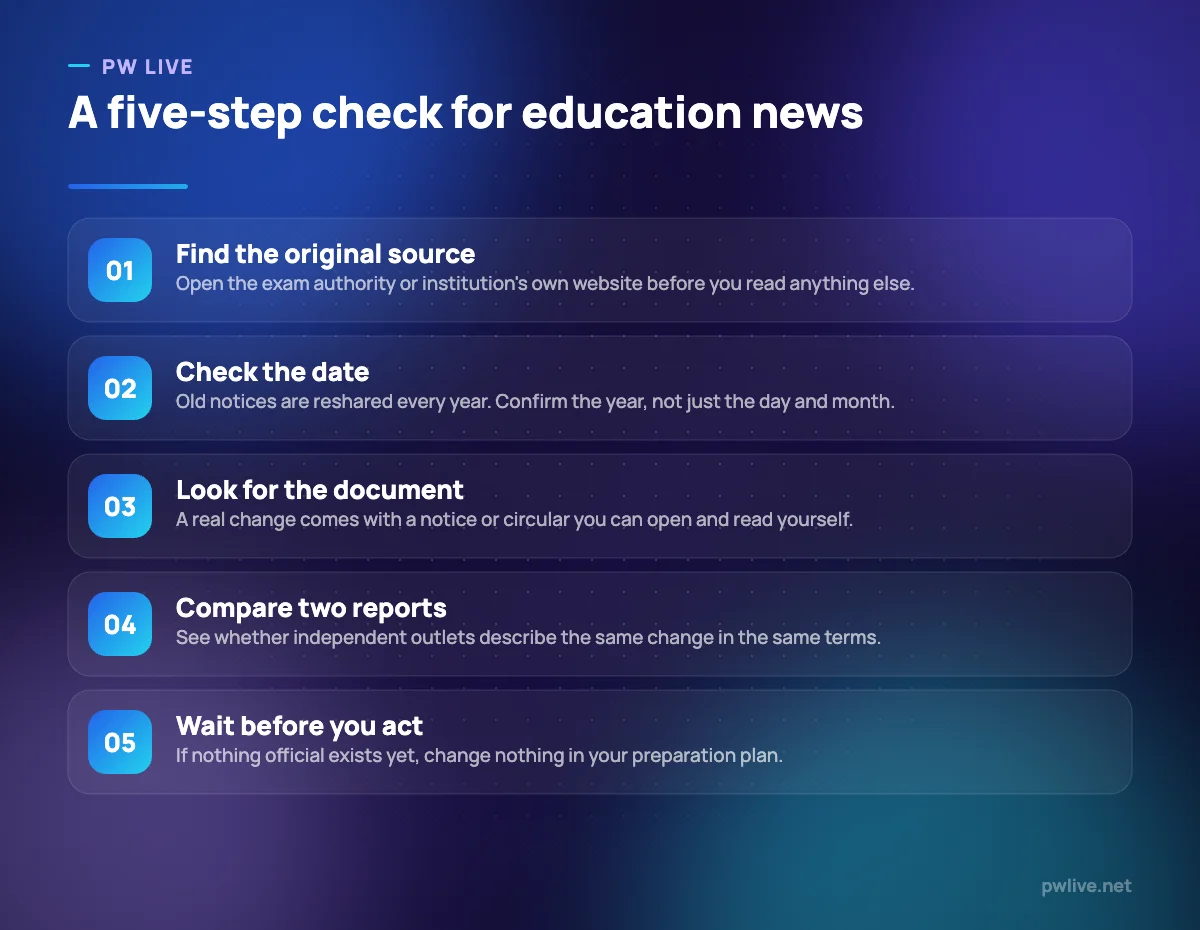
The fix is not to stop reading the news. It is to have a short, repeatable check you run before you believe anything, share anything or change anything about how you are preparing.
Why education rumours spread faster than corrections
Education news sits on top of anxiety. Anything involving an exam date, a syllabus or an admission cut-off touches a decision the reader is already worried about, so it gets shared before it gets read.
Three things make it worse. Notices genuinely do change from year to year, so a false claim sounds plausible. Official language is dense, so simplified versions travel further. And corrections are boring, so nobody forwards them.
Understanding this is useful because it tells you where to be suspicious: the more strongly a message makes you feel, the more slowly you should treat it.
Start with the source, not with the message
The single most useful habit is to stop evaluating the message and go looking for its origin instead. A claim about an exam has an issuing body. A claim about a university has a university behind it. A claim about a scheme has a government portal.
Go there directly. Type the official site into your browser rather than tapping a link inside the message, because links in forwards are the easiest part to fake.
If the claim is real and significant, it will normally appear on that official page in some form. If half an hour of looking turns up nothing there, you have learnt something important: this is not yet a fact, it is a report about a possible fact.
Check the date before you check anything else
Dates are where most honest confusion begins. Screenshots have no timestamp. Article pages get republished. A notice from a previous cycle looks identical to a fresh one because the format never changes.
Before you read the content, find three dates:
- The date on the original document or notice
- The date the article or post was published
- The date the article was last updated, if it shows one
If a screenshot is your only evidence and none of those dates is visible, treat it as undated, which means unusable. Old-notice recycling is the most common form of exam misinformation, and it is also the easiest to defeat.
Look for the primary document
A primary document is the thing itself: the notice, the circular, the information brochure, the updated syllabus PDF, the official press release. Everything else is somebody’s description of it.
Good reporting links to the primary document or quotes it directly. Weak reporting summarises “sources” and moves on. When you find the document, read the part that concerns you rather than the summary, because summaries often drop conditions like which year, which category or which centre a change applies to.
If you are not used to reading formal documents, our guide to PDF tools every student should know covers the practical side of searching inside a long notice for the line that actually affects you.
Read the headline against the body
Headlines are written to be clicked, and the body of the article is often more careful than its title. A headline may say a change is coming when the article says it has been proposed, is under consideration, or applies only to one group.
Watch for these softeners inside the text: proposed, likely, may, expected, under review, sources said. Each one moves a claim from fact towards possibility.
Also notice what is missing. If an article about an exam change never names the authority that made the change, that absence is the story.
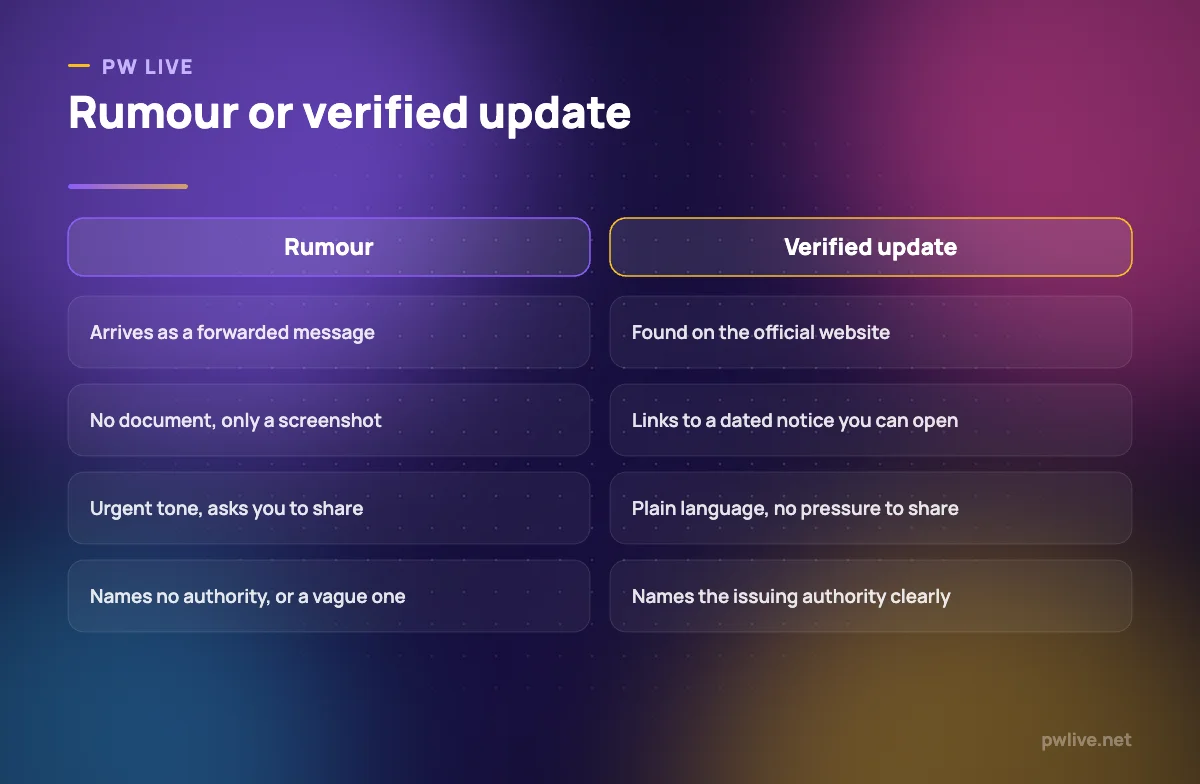
Treat screenshots and forwards as unverified by default
A screenshot is a picture of a claim, not evidence for it. It can be cropped, edited, taken from a parody account or lifted from a completely different year.
Apply one rule: a screenshot is a lead, never a source. If it points to something real, you will be able to find that thing on the official site in a few minutes. If you cannot, do not pass it on.
The same applies to voice notes, coaching-group posts and anonymous channels. They are worth watching for early signals, and worthless as proof. It also helps to understand how search engines work, because the way results are ranked shapes which version of a story you see first.
What to do while a story is still unclear
Sometimes there is a real, unresolved story and no official word yet. The temptation is to redesign your entire schedule around the possibility. Resist it.
- Write down the specific claim in one sentence.
- Note what would confirm it: which authority, which kind of document.
- Set a reminder to check that official page in a few days.
- Carry on with your existing plan until then.
- If it is confirmed, adjust deliberately rather than in a panic.
Uncertainty about a date is not a reason to stop revising. A steady plan such as the one in our six-month exam preparation timeline is designed to absorb small shocks, and constant re-planning costs far more study time than any rescheduled paper.
Build a small news routine you can trust
You do not need to follow education news all day. You need a narrow, reliable channel and a fixed time to check it.
- Bookmark the two or three official pages that genuinely apply to you.
- Enable notifications on those official sources if they offer them.
- Pick one fixed slot a week to check them, not five times a day.
- Mute the groups that generate more heat than information.
- Keep a single notes file with confirmed dates and their source links.
That last habit is quietly powerful. When someone forwards you an alarming claim, you can check it against your own record in seconds. If constant alerts are eating your focus, our digital detox guide has practical ways to cut the noise without disconnecting entirely.
For a deeper look at the specific tricks used in admission and exam rumours, read our companion piece on spotting misinformation about exams and admissions, and browse the exams and admissions category for preparation guidance that does not depend on the news cycle. If you want to build this into a broader habit, the exam strategy skill track puts verification alongside planning and revision.
Key takeaways
- Go to the issuing authority’s own site before you evaluate any claim about exams or admissions.
- Check three dates: the document, the publication and the last update. Undated screenshots are unusable.
- Look for the primary document, and read the part that applies to your year, category and centre.
- Headlines overstate; the body of the article usually contains the qualifiers.
- Never change your study plan on an unconfirmed report. Note it, set a date to recheck, keep working.
Frequently asked questions
How can I tell if a notice circulating online is old?
Look for a year on the document itself, not just a day and month, and search the official site for the current cycle’s notice. If the official page shows a different or newer document, the one you were sent is out of date.
Is it worth following coaching or student groups for exam news?
They are useful for early signals and useless as proof. Treat anything you see there as a prompt to check the official source yourself, and never forward a claim from a group before you have done that.
What should I do if two news outlets report different things?
Find the primary document that both are describing. If neither links to one, assume the story is still unconfirmed and wait for the authority’s own announcement before acting.
Should I stop reading education news altogether while preparing?
No. Narrow it instead. Follow only the official pages that apply to your exam or application, check them on a fixed schedule, and let everything else pass you by.
Keep learning with PW Live
Browse every guide in News & Updates, or pick a skill track and follow the roadmap step by step.





Leave a Reply