

Changing exam patterns are one of the most stressful things a student deals with, mostly because the change arrives as a rumour long before it arrives as a fact. A shift in the number of questions, the marking scheme or the section structure can make months of preparation feel suddenly wrong.
It almost never is. Exam bodies adjust format far more often than they adjust the underlying syllabus, and format is the part you can adapt to in weeks. Understanding is the part that takes months, and understanding transfers.
This guide is about how to think about pattern changes in general: why they happen, which parts of your preparation are genuinely affected, and what to do the day a change is confirmed. For anything specific, always read the notice on the exam authority’s own website rather than a summary of it.
Why exam patterns change at all
Formats are tools, and they get adjusted when the tool stops doing its job. A paper that everyone finishes early stops separating candidates. A paper where guessing pays too well starts rewarding the wrong behaviour.
Delivery changes push format too. Moving a paper from paper-and-pen to a computer screen affects how questions can be presented, how answers are entered and how sections are timed.
There is also a slow, steady direction in most assessment: away from pure recall and towards application. Questions that ask you to use an idea in an unfamiliar setting are harder to prepare for by memorising, which is exactly why they are attractive to the people designing papers.
What actually changes, and what does not
It helps to separate the layers of an exam. The outer layers move; the inner ones rarely do.
- Presentation layer: number of questions, section order, time per section, on-screen versus on-paper. Changes often.
- Scoring layer: marks per question, negative marking, optional questions, normalisation. Changes occasionally.
- Question style layer: more application, more data interpretation, more multi-step reasoning. Drifts slowly.
- Syllabus layer: the actual chapters and concepts. Changes rarely and with notice.
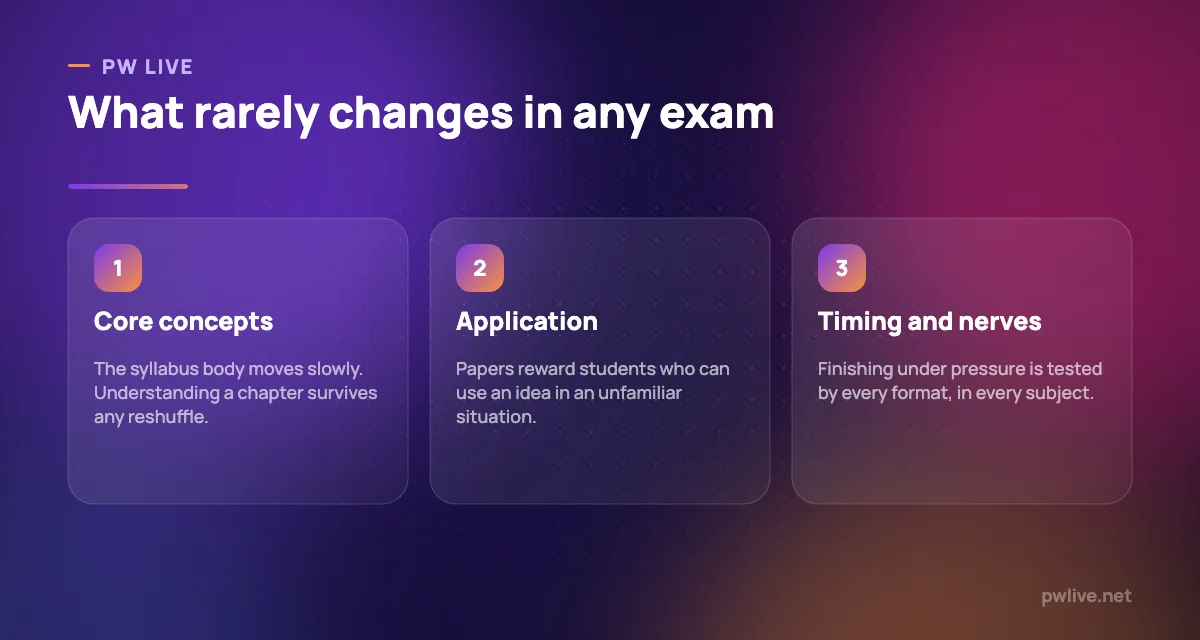
Most panic is about the presentation layer, which is the layer that matters least to how you study. If your concepts are solid, a reordered paper is an inconvenience, not a catastrophe.
Build preparation that does not depend on format
The strongest defence against a pattern change is a preparation method that was never format-specific in the first place.
Study for understanding rather than for a question type. If you have learnt a chapter only as a set of remembered question shapes, any new shape will break you. If you have learnt why the ideas work, a new shape is just a new door into the same room.
Keep your source material stable. Working through your core textbooks properly, as discussed in our comparison of NCERT and reference books, gives you a base that no format tweak can invalidate.
Practise explaining, not just solving. Being able to say out loud why a step follows from the previous one is the clearest evidence that your knowledge is portable.
Where a format change genuinely hits: strategy, not syllabus
The real impact of a pattern change lands on your exam-day strategy. That is worth taking seriously, because strategy is where marks quietly leak.
Three things usually need rework:
- Attempt order. If sections are rearranged or timed separately, your habit of starting with a favourite section may no longer be available.
- Time per question. A different question count changes your pacing arithmetic completely.
- Risk appetite. If marking changes, the maths of guessing changes with it. Our guide to negative marking strategy explains how to work out when an attempt is worth it.
None of this requires relearning content. It requires two or three full-length practice papers in the new shape, reviewed properly.
How to respond in the first week after a change
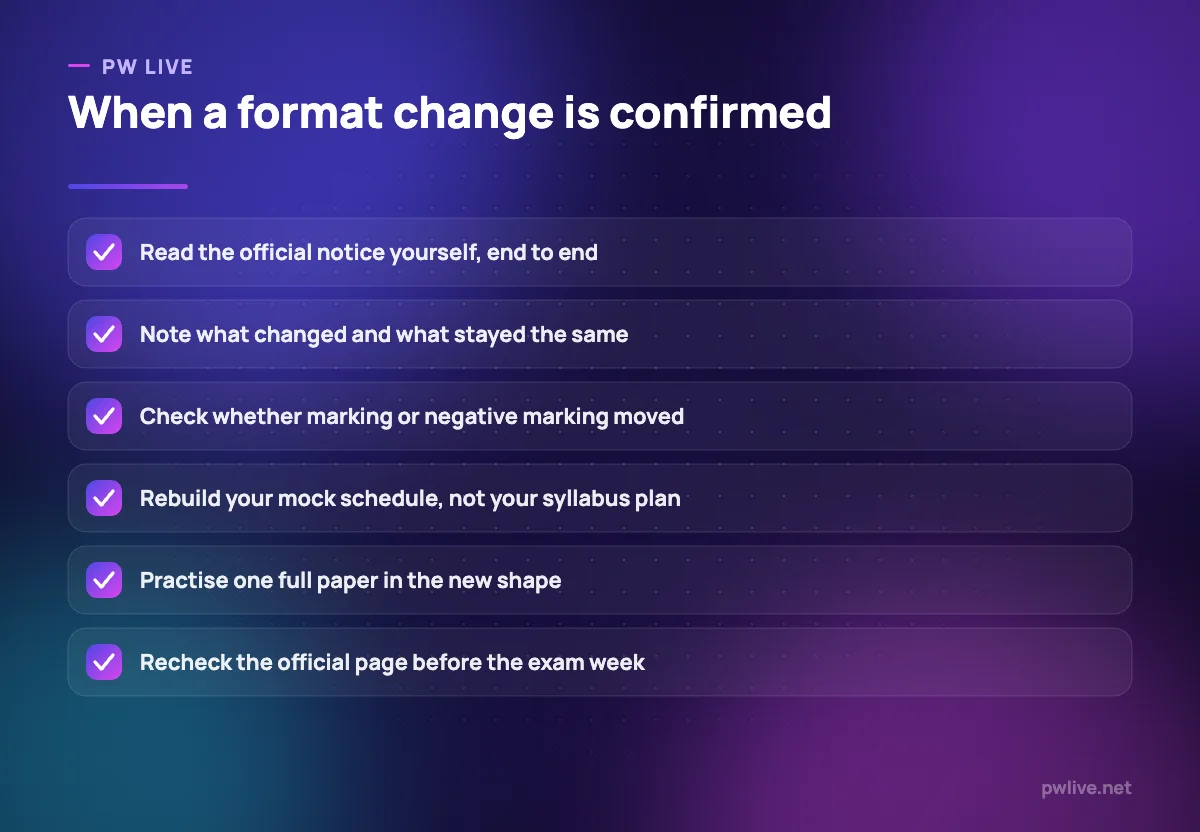
Resist the urge to redesign everything on day one. Work through a short, fixed sequence instead.
- Read the official notice yourself, in full, rather than a screenshot of one line from it.
- Write two lists: what changed, and what explicitly did not.
- Decide whether anything in your syllabus plan is genuinely affected. Usually very little is.
- Rebuild only your mock-test and revision schedule around the new format.
- Sit one full paper in the new shape before you draw any conclusions about your readiness.
That fifth step matters most. A change feels enormous until you have actually written a paper in the new format once, after which it usually feels ordinary.
Read the reporting carefully
Pattern changes generate more coverage than almost any other education story, and coverage compresses detail. A change that applies to one paper, one year or one category gets reported as a change to everything.
Before you act on any report, confirm three things from the official document: which exam it applies to, which cycle or year, and which candidates. Our guide to reading education news without falling for rumours sets out a quick verification routine you can run in a few minutes.
Be especially careful with claims about syllabus reduction. Those are the most forwarded and the most frequently distorted, and studying less on the strength of an unverified message is the most expensive mistake in this whole area.
Keep your revision system change-proof
A good revision system is one you could carry into a differently shaped paper without editing it.
- Keep condensed notes organised by concept, not by question format.
- Maintain a running error log so you fix causes rather than symptoms.
- Use a formula and revision notebook that you actually reread, so recall stays fast under any timing structure.
- Review every mock properly using the method in our guide to analysing a mock test.
- Keep one late-stage plan ready, like our approach to revising a syllabus in the last 30 days, so a compressed timeline does not catch you out.
If format news is genuinely affecting your sleep or concentration, that is worth addressing directly rather than pushing through. Our exam stress and burnout guide covers what helps. You can also browse the exams and admissions category for preparation guidance, and the exam strategy skill track for the planning side.
Key takeaways
- Format changes affect exam-day strategy far more than they affect what you need to learn.
- The stable core of any exam is concepts, application and performing under time pressure.
- Confirm every reported change against the authority’s own notice, including which year and which candidates it covers.
- After a confirmed change, rebuild your mock schedule rather than your syllabus plan.
- Sitting one full paper in the new shape resolves most of the anxiety a change creates.
Frequently asked questions
Should I change what I study when the exam pattern changes?
Usually not. Unless the syllabus itself has been revised in an official notice, keep studying the same content and change only your practice format, pacing and attempt strategy.
How much practice do I need in a new format?
Two or three full-length papers under real timing conditions is normally enough to settle pacing and attempt order, provided you review each one properly instead of just checking the score.
What if a pattern change is announced very close to the exam?
Focus entirely on strategy: pacing, section order and marking maths. Late-stage content changes rarely help, while a calm plan for how you will move through the paper always does.
Where should I check for reliable information about my exam’s pattern?
Only on the exam authority’s official website and its published information brochure. Coaching posts and forwarded messages can point you towards a story, but the notice is the only thing worth acting on.
Keep learning with PW Live
Browse every guide in News & Updates, or pick a skill track and follow the roadmap step by step.





Leave a Reply