
Most business ideas do not fail because the product was badly built. They fail because nobody wanted it enough to pay, and the founder found out only after months of building.
Validation flips the order. You find out whether demand is real before you build, using conversations, a notebook and free tools rather than a budget.
This guide walks through a six-step process you can run in a few weeks with no spending. By the end you will have real evidence that the idea deserves your time, or you will have saved yourself an expensive lesson.
What validation actually means
Validation is not asking friends whether they like your idea. Friends are kind, and kindness is not data.
It means collecting evidence that a specific group of people has a problem, that it is painful enough to act on, and that they would choose your solution over what they do today. Each is a separate, testable claim. The goal is not to prove yourself right but to find the truth cheaply.
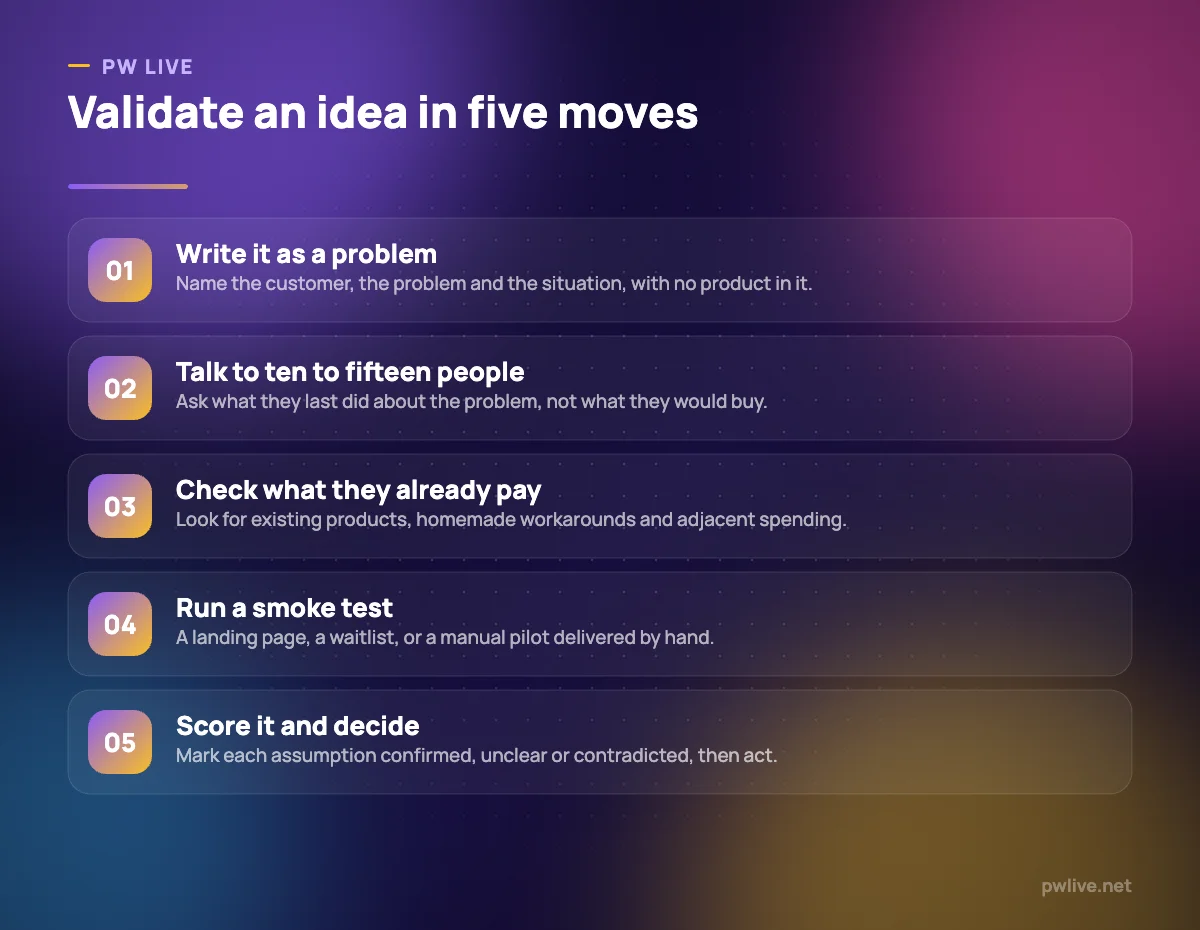
Step 1: Write the idea as a problem statement
Before talking to anyone, rewrite your idea in one sentence that names the customer, the problem and the situation. For example: “Final-year engineering students struggle to find affordable practice interviews in the two months before campus placements.”
Notice there is no product in that sentence. That is deliberate. Start from the solution and every conversation becomes a pitch. Start from the problem and every conversation becomes research.
Write down the three assumptions your idea depends on most. The next steps test them.
Step 2: Talk to people who have the problem
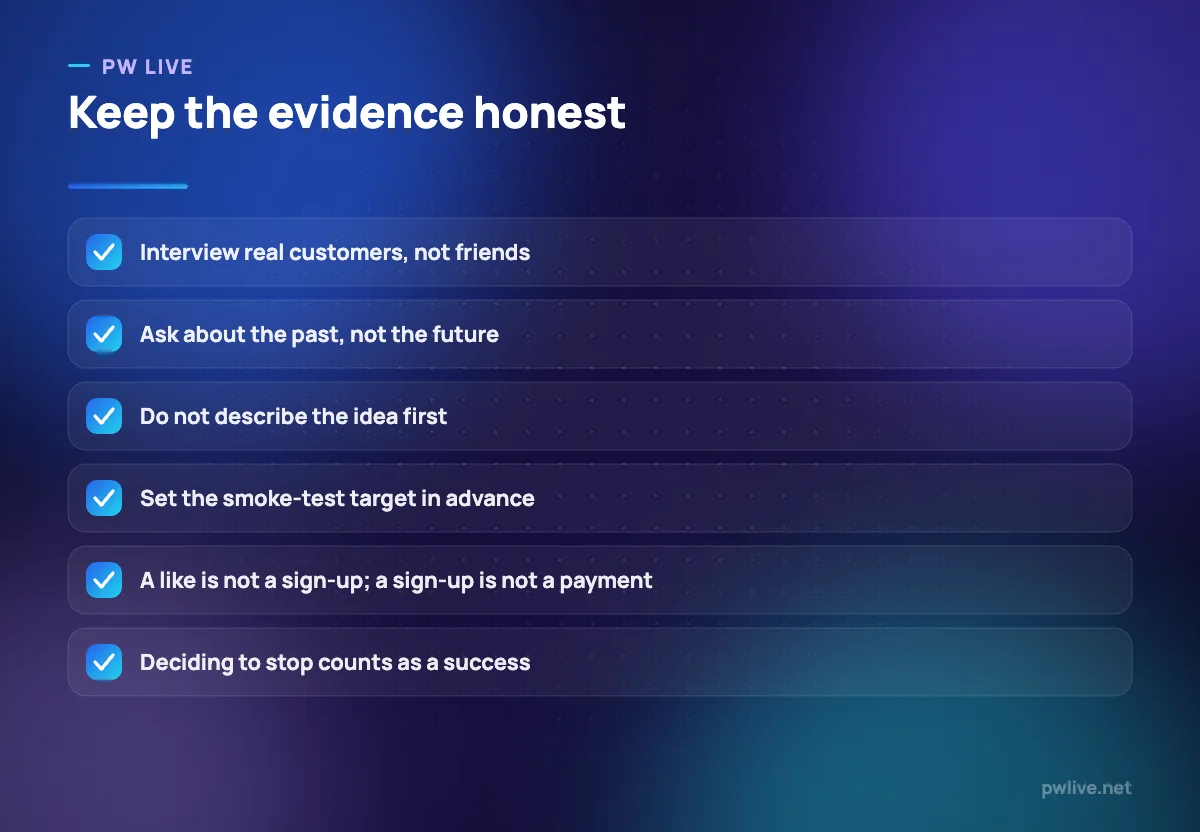
Find ten to fifteen people who match your customer description and ask for twenty minutes each. Classmates, alumni groups and online communities are enough. Ask about the past, not the future:
- When did you last face this problem? Walk me through it.
- What did you do about it? What did that cost in time or money?
- Have you looked for anything better? What happened?
Do not describe your idea until the end, if at all. People are poor at predicting what they would buy but reliable at describing what they have done. Write the answers down immediately; patterns across ten conversations beat any single enthusiastic one.
Step 3: Check whether people already pay to solve it
A problem that nobody currently spends money or effort on is usually not painful enough to build a business around. Look for:
- Existing products that address the same problem, even badly. Competition is evidence of demand.
- Workarounds people have built themselves: spreadsheets, group chats, paid tutors, freelancers.
- Adjacent spending: what these customers already pay for in the same area of their life.
If you find nothing, be honest about why. Sometimes the market is new. More often, the problem is not worth paying for.
Step 4: Run a smoke test
A smoke test measures whether people will take a real action, however small, based on a description of your solution. Free options:
- A simple landing page describing the offer with a sign-up form for early access.
- A waitlist or pre-order form shared where your customers gather.
- A manual pilot: deliver the service yourself, by hand, to five customers before building anything.
The manual pilot is the most powerful. Planning a tutoring platform? Tutor five students first. You will learn what they value and will pay faster than any survey.
Set a target in advance, for example a certain number of sign-ups per hundred visitors, so you cannot rationalise a weak result. Our digital marketing skills page covers reaching an early audience without an ad budget.
Step 5: Do the maths on a napkin
You do not need a financial model yet, only rough answers to four questions:
- What would one customer pay, per month or per purchase?
- What does it cost to serve one customer, including your time?
- How many customers could you realistically reach in the first year?
- How much would you need to earn for this to be worth doing?
If the margin is thin or the reachable market tiny, no amount of execution will fix it. Better to know now.
Step 6: Decide with a scorecard
Score each of your original assumptions as confirmed, unclear or contradicted.
- Mostly confirmed: build the smallest version and get paying customers.
- Mostly unclear: go back to Step 2 with a sharper question and more of the right people.
- Mostly contradicted: stop, or pivot to the adjacent problem that kept coming up.
Deciding to stop is a success. You kept your money and your months.
Mistakes that skew the result
- Validating with the wrong people. Ten conversations with non-customers tell you nothing.
- Asking leading questions. “Would you use an app that does X?” almost always gets a polite yes.
- Confusing interest with commitment. A like is not a sign-up. A sign-up is not a payment.
If the idea passes, our startups category covers building and launching, and our business category covers strategy.
Key takeaways
- Validation tests demand before you build, using conversations and free tools rather than money.
- Frame the idea as a problem statement, not a product, so research stays honest.
- Interview ten to fifteen real customers about past behaviour, not future intentions.
- Run a smoke test with a target set in advance, ideally a manual pilot.
- Check the rough economics, then decide with a scorecard. Stopping is a valid result.
Frequently asked questions
How long should validation take?
A few weeks for a first pass: one to interview customers, one or two for a smoke test, and a few days to decide.
What if my idea is easy to copy once I talk about it?
Ideas are rarely the scarce part; execution and customer understanding are. The insight from conversations is worth far more than the risk of being copied.
Do I need to build a prototype to validate?
Not usually. A clear description, a landing page or a manual pilot tests demand before any code is written.
Keep learning with PW Live
Browse every guide in Business & Entrepreneurship, or pick a skill track and follow the roadmap step by step.





Leave a Reply