

Most small-business disputes are not caused by dishonesty. They are caused by paperwork that never said what would happen. Getting your invoices, quotes and contracts right is the cheapest protection you will ever buy.
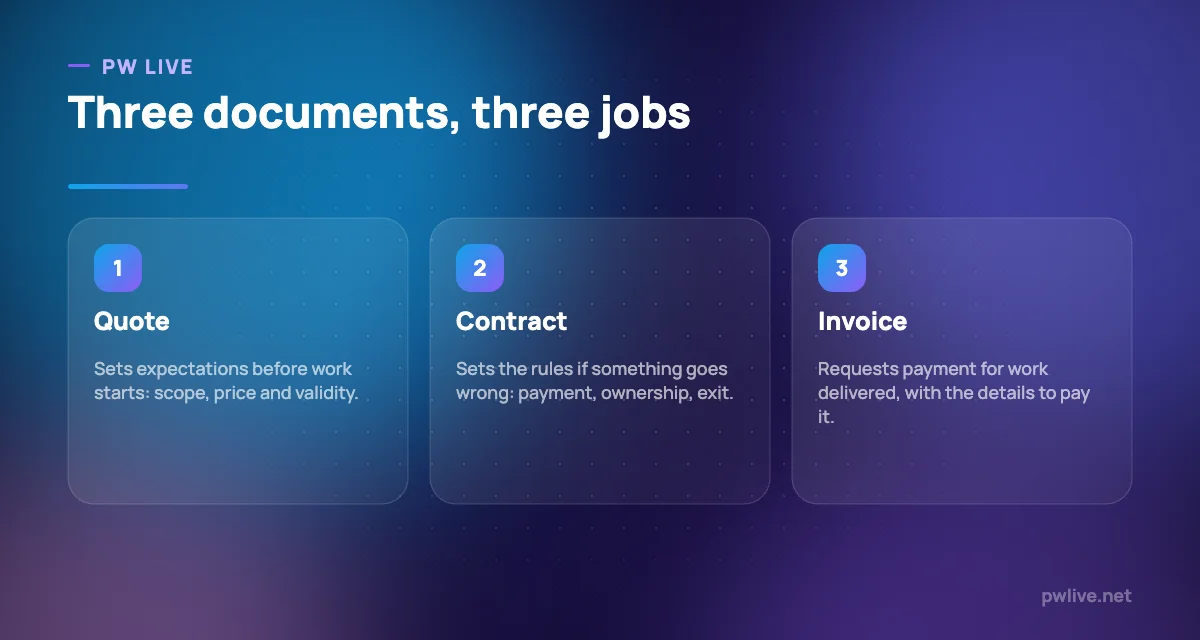
These three documents do different jobs. A quote sets expectations before work begins. A contract sets the rules for when something goes wrong. An invoice requests the money.
This guide explains what belongs in each, the clauses that prevent the most common arguments, and how to build a simple set of templates you reuse.
This article is general information, not legal, tax or accounting advice. Invoice content requirements, tax rules and contract law vary by jurisdiction, sector and registration status, and they change. Have your templates reviewed by a qualified professional and confirm current requirements on the relevant official portal.
The quote: agreeing what you will do
A quote is a proposal. Its job is to make sure both sides are picturing the same thing before any work starts.
A good quote includes:
- Your details and the client’s, with the client’s correct legal name, not a nickname or brand.
- A description of the work, written as deliverables rather than activities. “Three page website with contact form” not “web development”.
- What is explicitly not included. This one line prevents more arguments than everything else combined.
- The price, and whether taxes are additional or included.
- The timeline, and what you need from the client to hit it.
- Revisions, stated as a number with the cost of further rounds.
- Payment terms, including any advance.
- A validity date, after which the quote expires.
The exclusions and the revisions lines are where a quote earns its keep. Scope creep almost always starts with something the client assumed was included.
If your prices are still uncertain, work through pricing your product or service without guessing before you send anything, because a quote is hard to raise once issued.
A quote also sells. It is often the last document a buyer reads before deciding, so write it plainly, lead with the outcome, and keep the jargon out.
The contract: agreeing what happens if things go wrong
A quote covers the good case. A contract covers the bad one.
For small jobs, this can be a short written agreement or accepted terms attached to the quote. For larger or ongoing work, it should be a proper contract reviewed by a professional.
The clauses that matter most in practice:
- Scope and change process. What is included, and how extra work becomes a priced addition rather than a favour.
- Payment terms. Amount, schedule, due dates, and what happens when payment is late.
- Ownership of work. Who owns what is created, and when ownership transfers. Commonly this is on full payment.
- Confidentiality. What each side may not share.
- Client responsibilities. Materials, access, approvals and response times, plus what happens to the timeline when they slip.
- Termination. How either side ends the arrangement, notice required, and what is payable for work already done.
- Liability. A limit on what you can be held responsible for, which is usually the fee paid.
- Dispute resolution and jurisdiction. Where and how disagreements get settled.
You do not need a twenty-page document for a small job. You need those points written down somewhere both parties have agreed to.
Getting acceptance that counts
A document nobody agreed to protects nobody. Make acceptance explicit and keep the evidence.
Practical routes, in rough order of strength: a signed copy, a digital signature, an emailed reply saying the client accepts the quote and terms, or an accepted purchase order referencing your quote.
Two habits are worth building:
- Never start work on a verbal go-ahead, however friendly the relationship. If you must start urgently, get a short email confirming scope and price first.
- Keep the whole trail in one place. Quote, acceptance, change requests and approvals, filed by client and job. When a disagreement arises months later, the person with the records usually resolves it in a single message. Our guide to backing up your files properly applies here.
The invoice: asking to be paid
An invoice is a request for payment and, in many cases, a document with specific content requirements depending on your tax registration status and jurisdiction.
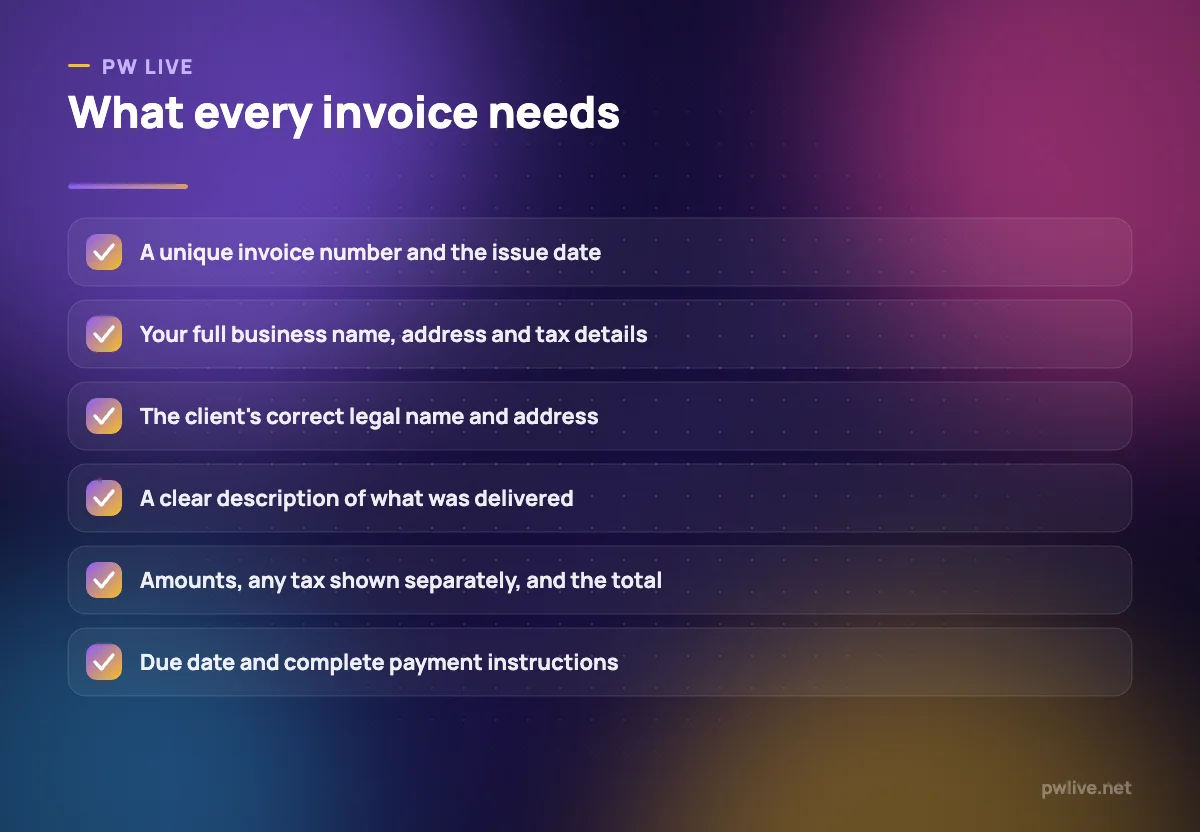
At minimum it should carry:
- A unique invoice number and the date of issue
- Your business name, address and any tax registration details that apply to you
- The client’s legal name, address and reference or purchase order number
- A clear line-item description of what was delivered, with quantities and rates
- Any taxes shown separately, with the total payable
- The due date, stated as a date rather than a period
- Complete payment instructions: bank details, UPI handle or payment link
Where your business is registered for GST, the specific fields, formats and any tax invoice requirements are set by the rules that apply to you, and they change. Confirm the current requirements on the official portal or with your accountant rather than copying a template from the internet. Online sellers can start with our overview of GST and compliance basics for online sellers, and the wider registration picture is covered in how to register a small business in India.
Two practical points. Number invoices in an unbroken sequence, because gaps raise questions. And send the invoice to the person who processes payments, not only to the person who hired you; in larger organisations these are rarely the same.
Payment terms that actually get you paid
Terms are not decoration. They change behaviour.
- Ask for an advance on new clients and large jobs. It funds the work and filters out clients who were never going to pay.
- Use milestones on longer projects, so you are never carrying months of unpaid work.
- State a specific due date on the invoice. “Net 30” is understood by finance teams but a date is understood by everyone.
- Set out late payment consequences in the contract, whether that is interest, a pause in work, or withheld delivery. Take advice on what is enforceable where you operate.
- Make payment effortless. A payment link or UPI handle on the invoice removes a step, and steps are where invoices go to die.
- Invoice immediately on delivery. The clock only starts when the invoice is issued.
Then chase on a schedule rather than on a mood: a short reminder before the due date, one on the day, a phone call a few days after, and an escalation to a named person who approves payments.
This is also a cash flow question, not just a paperwork one. Read cash flow basics to see why an unpaid invoice is more dangerous than a lost sale.
Build a template set once and reuse it
Do this once, properly, and every future job takes minutes.
Create four files you copy for each job:
- Quote template with placeholder scope, exclusions, revisions and validity.
- Terms of business covering the contract clauses above, attached to every quote.
- Invoice template with your numbering scheme and all required fields.
- Change request template, a short form describing extra work, its price and the effect on the timeline.
Keep a simple log with columns for client, job, quote sent, accepted, invoiced, due and paid. A spreadsheet is enough at this stage, and the discipline of filling it in matters far more than the tool.
Have a professional review the templates once, then use them consistently. Consistency is what makes the paperwork protective: a template you sometimes skip is a template that will be missing on exactly the job that goes wrong.
Freelancers setting all of this up for the first time will find the surrounding client-management advice in freelancing for beginners useful. For more on running the business side, browse the business and entrepreneurship archive or build the client-facing side through the communication skills track.
Key takeaways
- A quote sets expectations, a contract sets the rules for problems, and an invoice requests payment.
- The exclusions line on a quote prevents more disputes than any other sentence you write.
- Scope changes, payment terms, ownership of work and termination are the clauses that matter most.
- Never start on a verbal go-ahead, and keep the acceptance trail filed by job.
- Invoice content requirements depend on your registration status and jurisdiction, so confirm them with a professional.
- Advances, milestones, specific due dates and easy payment routes get you paid faster than politeness does.
Frequently asked questions
Do I need a contract for small jobs?
Some written agreement is worth having for every paid job, though it can be a short set of terms attached to the quote rather than a formal contract. The size of the document should match the size of the risk, not the size of the fee.
Is an email confirmation enough to count as agreement?
An email in which the client clearly accepts a specific quote and terms is commonly used as evidence of agreement, but what is enforceable depends on your jurisdiction and the circumstances. Ask a qualified professional how this applies to your work.
What should I do when a client will not pay?
Start with a documented reminder sequence and a phone call to whoever approves payments, since most late payment is disorganisation. If that fails, follow the escalation route in your contract and take professional advice before doing anything further.
Can I change a quote after the client accepts it?
Not unilaterally. Once accepted, the quote is the agreement, which is why a validity date and a written change process matter. Additional work should be documented as a change request with its own price and timeline effect.
Keep learning with PW Live
Browse every guide in Business & Entrepreneurship, or pick a skill track and follow the roadmap step by step.





Leave a Reply