

The most reliable way to start a business is not a new idea. It is to build a business around a skill you already have, one people have already asked you for, and turn it into something with a name, a price and a repeatable process.
You have a head start most founders would pay for: you can already deliver. What is missing is packaging, a buyer and the confidence to charge.
This guide takes you from a list of things you can do to a small business you can run beside your current work, and shows where the common traps are.
Find the skill people already ask you for
Start with evidence, not ambition. Open a page and write down every task where one of these is true:
- Someone has asked you to do it for them
- Colleagues route this kind of work to you by default
- You have done it repeatedly and it now takes you less time than it takes most people
- People ask you to explain how you did it
That list is your raw material. It will often include things you dismiss because they feel easy to you. Ease is the point. The tasks you find unremarkable are frequently the ones others avoid.
Now filter for three things: is there someone who pays for this, can you deliver it without a large upfront investment, and can you do it repeatedly without resenting it. If a skill fails the third test, it belongs in your job, not your business.
If your list is thin, our guide to choosing the right skill to learn for your career will help you pick one worth building deliberately.
Choose one buyer, not a general audience
A skill is not a business until it is aimed at someone. The same ability can serve five different buyers, and each needs a different offer, price and message.
Take photography. The same camera skill serves wedding families, restaurant owners needing menu shots, e-commerce sellers needing product images, and companies needing staff portraits. Those are four businesses, not one.
Pick the buyer where three conditions meet:
- They feel the problem regularly, not once in a decade.
- They already spend money on solving it, even badly.
- You can reach them, through your existing contacts, a community you belong to, or a place they gather.
The third condition is the one people skip, and it is usually the reason nothing sells.
Write your buyer as a sentence you could test: shop owners in my area who sell products online and take their own photos. Then name five real ones. If you cannot, choose a buyer you can actually reach.
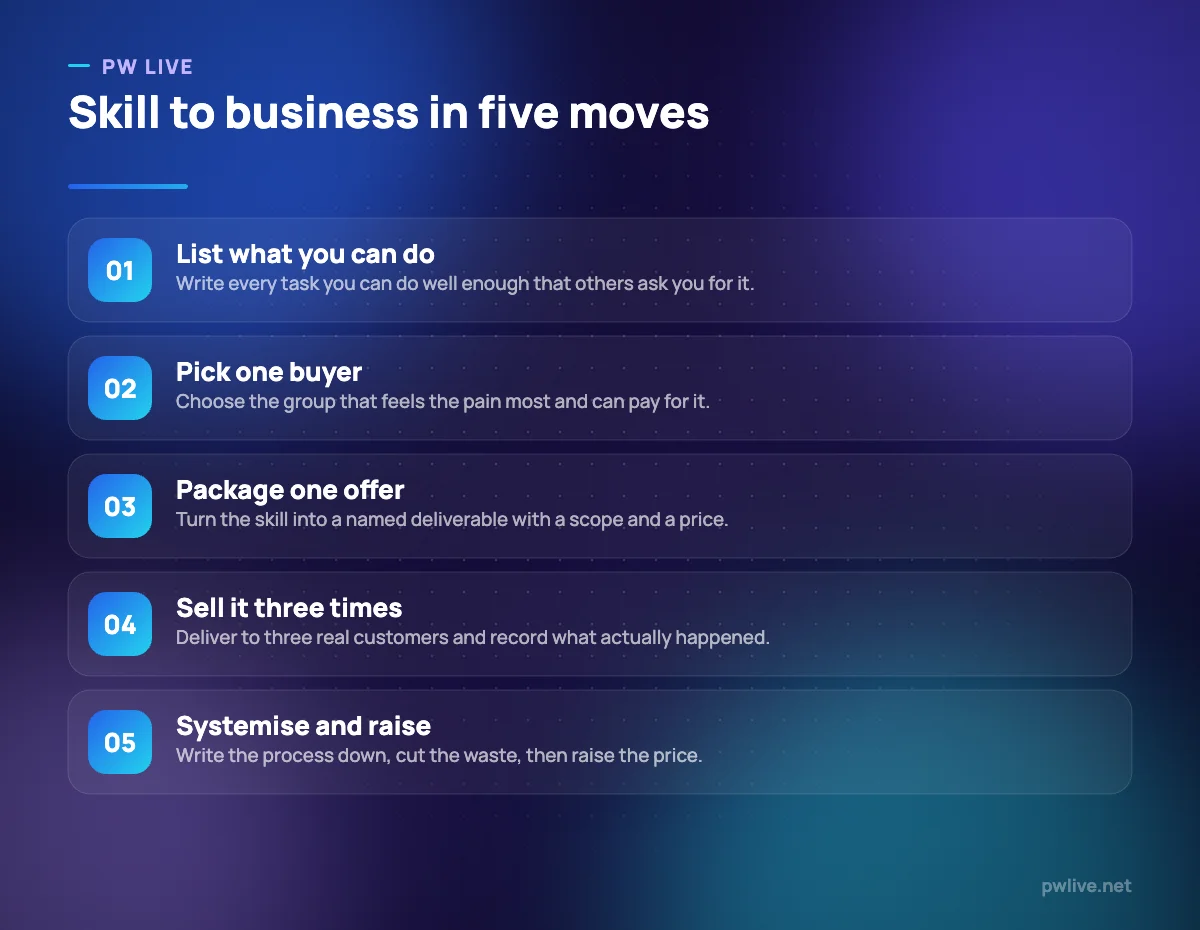
Package the skill into one named offer
Buyers do not purchase skills. They purchase results with a scope and a price attached.
Turn your skill into an offer with four elements:
- A name that says what it does. “Menu photo pack” beats “photography services”.
- A scope. What is included, listed in three or four bullets, plus a line on what is not.
- A timeline. How long delivery takes from the day they say yes.
- A price. One number.
Then build a small ladder around it: a low-commitment entry offer, the main offer, and something larger for customers who want more. Three tiers give buyers a choice between your options rather than between you and someone else.
Two rules save enormous pain later. Define revisions explicitly, and put the payment terms in the same document as the scope. Our guide to invoices, quotes and contracts covers what those documents should contain.
For the number itself, work through how to price your product or service without guessing. Skill-based businesses almost always start too cheap because the work feels easy to the person doing it.
Prove it with three real customers
Do not build a brand, a website and a logo before you have sold anything. Sell three times first.
Getting those three is a direct effort, not a marketing campaign. Our guide to finding your first ten customers sets out the method: build a list, start with people who know you, ask specific questions, make one clear offer.
While you deliver those three jobs, measure things you will need later:
- Actual hours spent, start to finish, including messages and revisions
- Every direct cost, however small
- What the client asked for that was not in the scope
- What confused them, and where the process stalled
- What they said the result was worth
Three delivered jobs will tell you more about your business than three months of planning. They also give you the evidence to charge more.
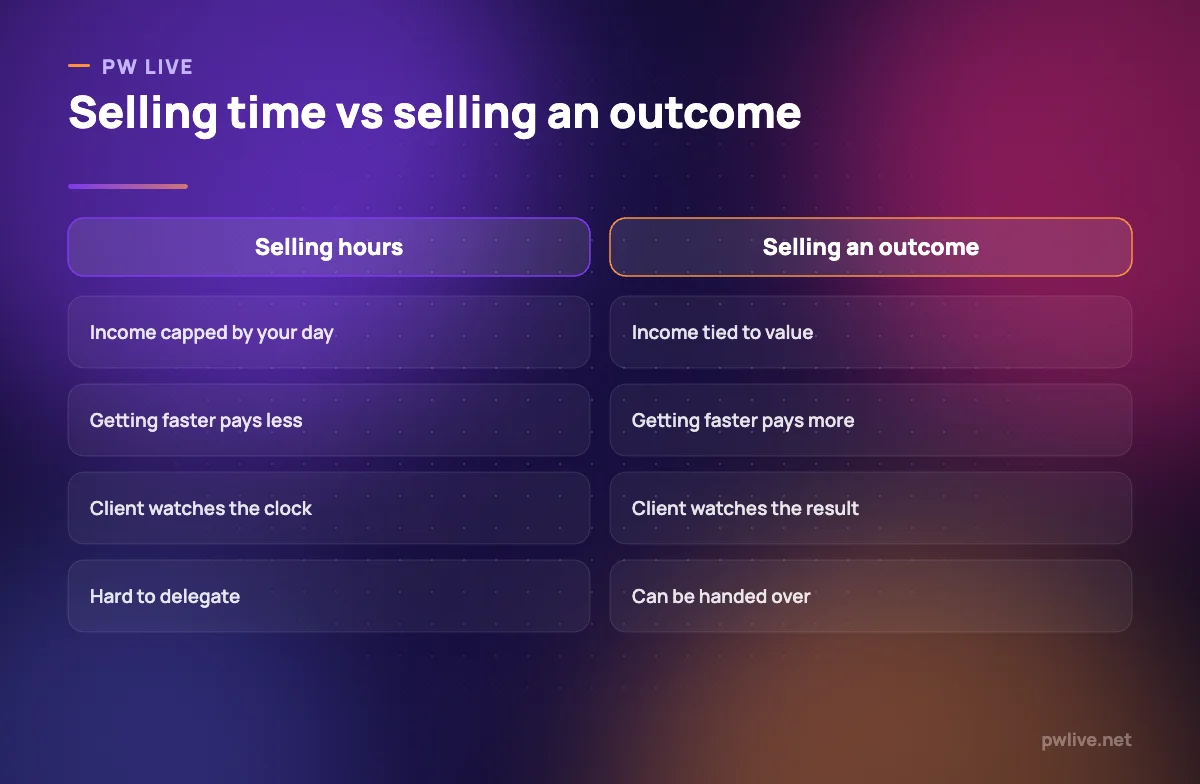
Move from selling hours to selling outcomes
Charging by the hour feels safe and quietly caps your income. Every hour you save through skill reduces what you earn, which is the wrong incentive to build a business on.
Moving to fixed-price outcomes changes that. So does a monthly retainer, where a client pays a set amount for an agreed set of work each month.
To make the shift safely:
- Scope tightly, in writing, with a clear list of what is excluded
- Base your fixed price on your measured hours from the three test jobs, plus a margin for the job that goes wrong
- Define a change process, so extra work becomes a new line item rather than a favour
- Keep one or two retainer clients for predictable income while project work fluctuates
Build proof that does the selling for you
With a handful of jobs behind you, start collecting the assets that make the next sale easier.
- A short case description. The situation, what you did, what changed. Three paragraphs is enough.
- Before and after evidence. Images, numbers or a client’s own line about the result.
- A public trail. Posting what you learn about your craft, where your buyers can see it, is slow but compounding.
If you are early and have little to show, our guide to building a portfolio when you have no work experience explains how to create proof from self-directed projects.
Keep the proof specific. “Delivered thirty product images in four days for a seller launching a new range” says more than any adjective.
Run it beside your job, then decide
You do not need to quit anything to start. Most skill businesses begin in evenings and weekends, which is the right way to test whether demand exists.
A workable structure:
- Two fixed blocks a week for client work, and one for finding clients
- One evening a month for admin, invoicing and reviewing numbers
- A hard limit on how much you take on, so delivery quality holds
Check your employment contract before you begin, particularly for clauses about outside work, conflicts of interest and ownership of what you create. If anything is unclear, ask a qualified professional rather than guessing. This article is general information, not legal or accounting advice.
Decide in advance what would make you go full time: a number of months of steady income, a pipeline of committed work, and savings that cover your fixed costs for a defined period. Deciding the trigger while you are calm is far better than deciding it in a bad week.
To keep the underlying craft improving as the business grows, browse the skills development archive and the career readiness track.
Key takeaways
- Start with the skill people already ask you for, not the one you wish you had.
- One skill can serve several buyers, and each is a different business, so choose one you can actually reach.
- Package the skill as a named offer with a scope, a timeline and a single price.
- Sell three times before you build a brand, and measure hours, costs and scope creep on each job.
- Shift from hourly billing to fixed outcomes or retainers so getting better pays you more.
- Run it alongside your job, check your employment contract, and set the trigger for going full time in advance.
Frequently asked questions
What if my skill is common and lots of people offer it?
Common skills are proof that a market exists. Narrow the buyer, define the offer more clearly than competitors do, and compete on reliability and clarity rather than on being the cheapest.
Do I need any qualification to sell a skill?
For most services, demonstrated results matter more than certificates, though some fields are regulated and require specific licences. Check the rules for your particular trade with a qualified professional before you advertise.
How do I know when to raise my prices?
Raise when you are winning nearly every enquiry, when your calendar is full, or when your measured hours show the current price no longer pays properly. Apply the new price to new clients first and give existing ones notice.
Should I register a business before my first client?
Many people start as a sole proprietor and register as requirements apply to them, but this depends on your trade and location. Our overview of registering a small business in India explains the shape of the process, and an accountant can confirm your specific position.
Keep learning with PW Live
Browse every guide in Business & Entrepreneurship, or pick a skill track and follow the roadmap step by step.





Leave a Reply