
Plenty of student projects work. A hackathon prototype gets demoed, a final-year project impresses the panel, a side project picks up a few hundred users from a hostel group chat. Then the semester ends and it quietly dies.
The gap between a working project and a working startup is not technical. It is a set of decisions about users, scope, team, money and time that most students have never made.
This roadmap walks through those decisions in order. It assumes you are still enrolled, have little money, and want to know whether your project deserves to become a company without risking your degree.
First, is it actually a startup?
Not every good project should become a business. Before committing, answer three honest questions:
- Does it solve a problem someone has repeatedly? A tool people try once is a demo. A tool they return to is a product.
- Would anyone pay for it? Directly through subscriptions or sales, or indirectly through a business that benefits.
- Can it grow beyond your campus? Local ideas can still be businesses, just a different kind.
If the answers are unclear, validate first. Our business category has a guide on testing an idea before spending.
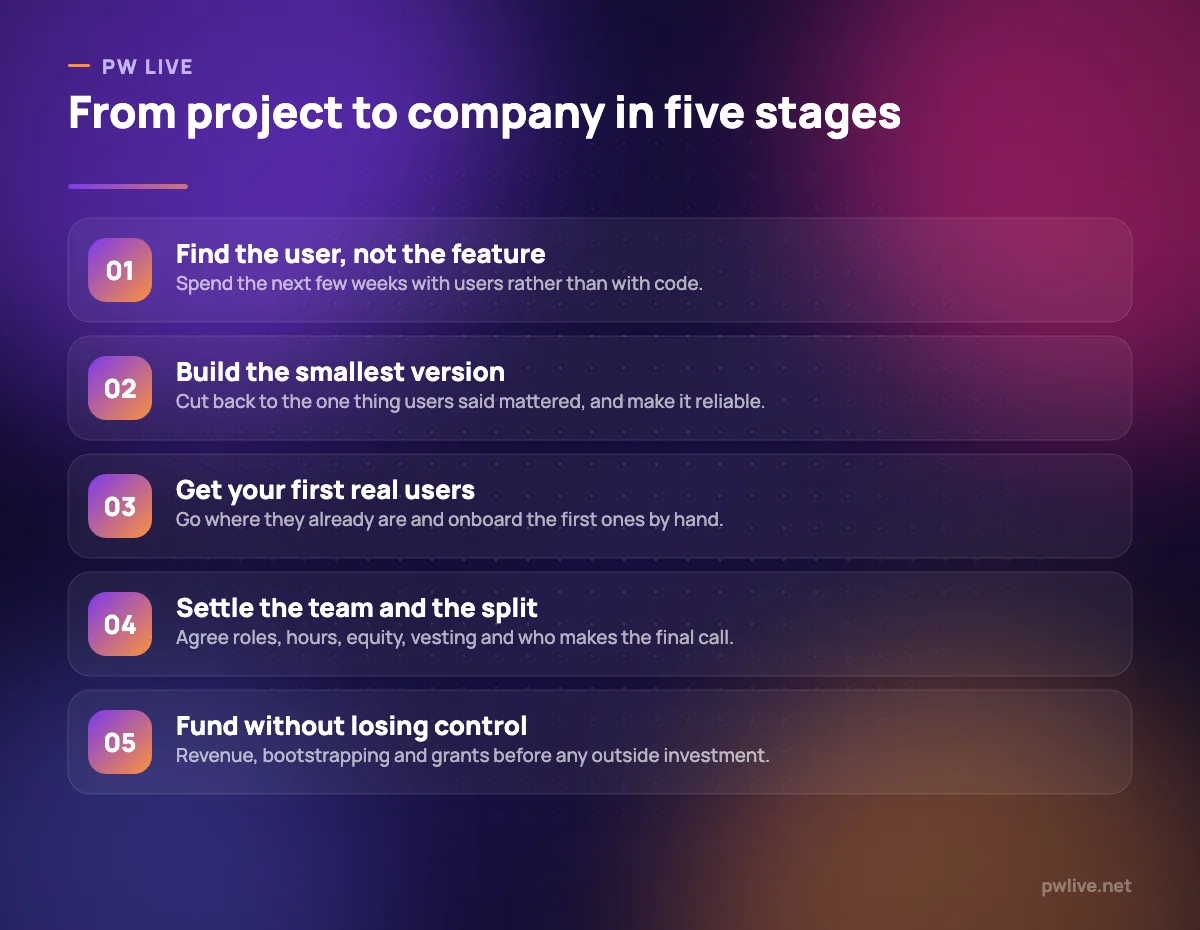
Stage 1: Find the user, not the feature
Student founders tend to keep building: a new feature, a redesign, a rewrite in a better framework. Meanwhile nobody is talking to the people who might use it. Flip that: for the next few weeks, spend more time with users than with code.
- Find the ten people who used your project most. Ask why, what they do without it, and what would make them stop.
- Watch someone use it for the first time without helping. Note every moment of confusion.
- Ask what they would pay, then what they last paid for something similar.
The output is one sentence: “This is for these people, who have this problem, and it helps them do this.” Until you can write it, stop building.
Stage 2: Build the smallest useful version
Strip the project back to the one thing users said mattered.
- Cut, do not add. The first version should do less than the college project, but reliably.
- Choose boring technology. The framework you know beats the one you want to learn. This is a business, not a portfolio.
- Instrument it. Know how many sign up, how many return, and where they drop off.
If the product needs more technical depth than you have, our coding and programming guide covers the fundamentals worth strengthening.
Stage 3: Get your first real users
Real users are people outside your friend circle who chose your product unprompted.
- Go where they already are. Communities, professional groups and forums related to the problem.
- Do things that do not scale. Onboard the first users personally. Fix their issues by hand.
- Ask for one action. A sign-up, a payment, a referral. Measure whether it happens.
A dozen users who would miss the product beat a thousand who signed up and forgot.
Stage 4: Sort out the team and the split
The college project had whoever was around. The startup needs a team that has agreed roles, commitment and ownership. Have the uncomfortable conversation early:
- Who does what, and for how many hours a week? Write it down.
- How is equity divided? Equal splits feel fair but rarely reflect unequal commitment. Consider vesting.
- What happens if someone leaves? Decide now, while everyone is friends.
- Who makes the final call? Pick a decision-maker per area.
Put it in writing. Many student startups die of a co-founder disagreement nobody planned for. Our leadership and management skills page covers running a small team.
Stage 5: Money without losing control
You do not need funding to start. You need enough runway to find out whether the idea works, and most student startups can get that without giving anything away:
- Revenue. Charging from day one is the cleanest money and the best validation.
- Bootstrapping. Part-time freelancing or a small stipend that covers hosting and basic costs.
- Grants and competitions. Many universities, state programmes and foundations run non-dilutive schemes.
- Incubators. Mentors, workspace and sometimes small capital, occasionally for equity.
- Outside investment. Only once you have users, revenue or clear traction. Raising too early costs ownership.
Whatever the source, track money in, money out and how many months you can continue. That number drives every decision.
Balancing the startup with your degree
Dropping out makes a good story and a bad default. Most student founders are better off finishing; the degree is a safety net that lets you take risks.
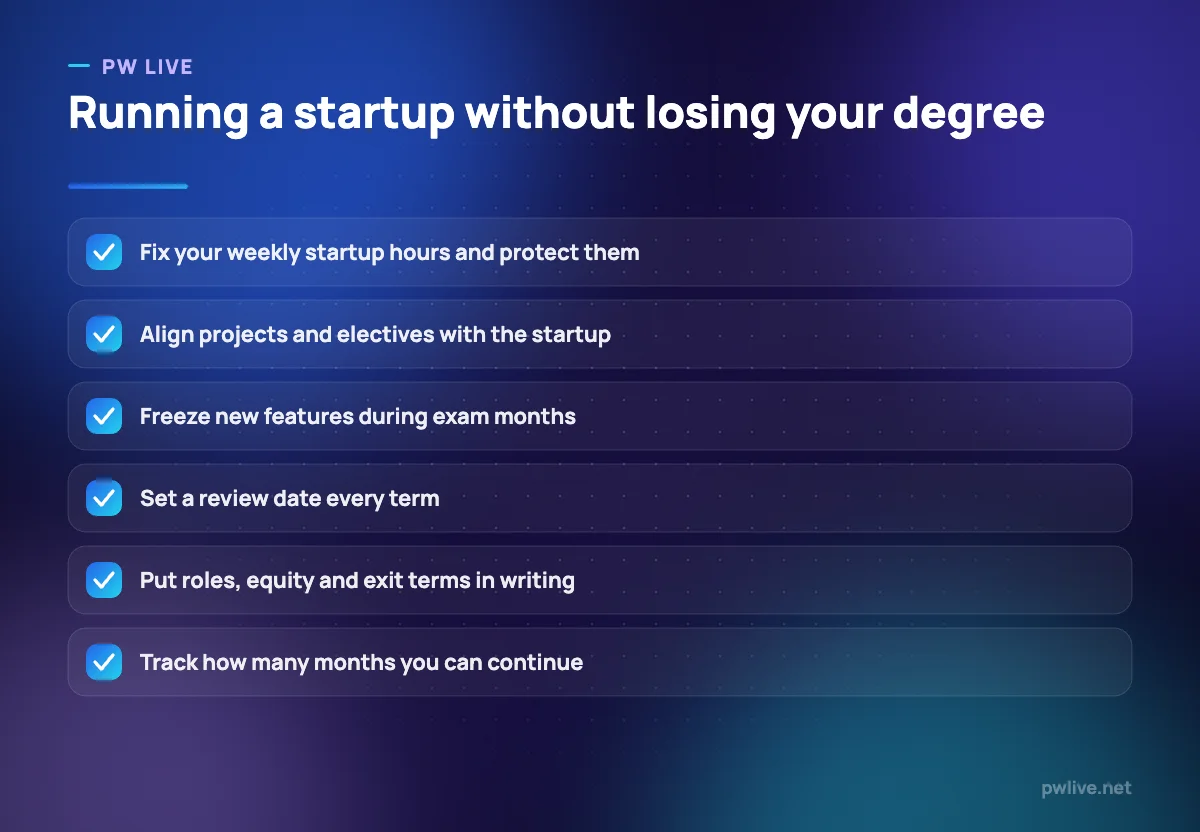
- Fix your weekly hours for the startup and protect them. Twelve focused hours beat forty scattered ones.
- Use the university. Align projects, dissertations and electives with the startup’s needs.
- Plan around exams. Freeze new features during exam months and tell users in advance.
- Set a review date. Every term, look at users, revenue and your energy, and decide: continue, pause or stop.
Stopping is not failure. Learning cheaply and early that it was not a business is the point.
Key takeaways
- Confirm the project solves a repeated problem someone values before calling it a startup.
- Spend the first weeks talking to users, not adding features.
- Strip the product to the one thing that matters and build it reliably.
- Agree roles, equity and exit terms with co-founders in writing, early.
- Fund with revenue, grants and bootstrapping before investment, and keep the degree.
Frequently asked questions
Should I register a company straight away?
Not until you have paying customers, an investor or a programme that requires it. Registration adds cost and compliance work you do not yet need.
Do I need a technical co-founder?
You need someone who can build and someone who can talk to customers. If you are one, find the other. If you can do both for now, wait.
What if my co-founders lose interest?
Agree in advance what happens to their share and their work. If it happens anyway, treat it as information and decide whether to continue.
Keep learning with PW Live
Browse every guide in Startups & Innovation, or pick a skill track and follow the roadmap step by step.





Leave a Reply