

Most people trying to find a startup idea start in the wrong place: a blank page, a brainstorming session, and pressure to be clever. Good ideas rarely arrive that way. They usually come from noticing a problem you have already lived with, then being disciplined enough to check whether anyone else feels it too.
The useful question is not “what could I build?” but “what do I already know is broken?” That shift matters because it moves you from imagination to evidence.
This guide walks through where real ideas come from, how to filter them, and how to test one cheaply before you commit months to it.
Start with problems you already have access to
You do not need an original idea. You need an unfair starting position: a problem you understand better than most people, or a group of people you can reach faster than a stranger could.
Look at three places in your own life.
- Your work or study routine. What takes an hour that should take ten minutes? What do you do manually every week because no tool fits?
- Your community. Your hostel, your family business, your college society, the shop your parents run. Small worlds are easy to observe closely.
- Your skills. If you already write, code, design or teach, you can see where the process breaks for everyone doing that work.
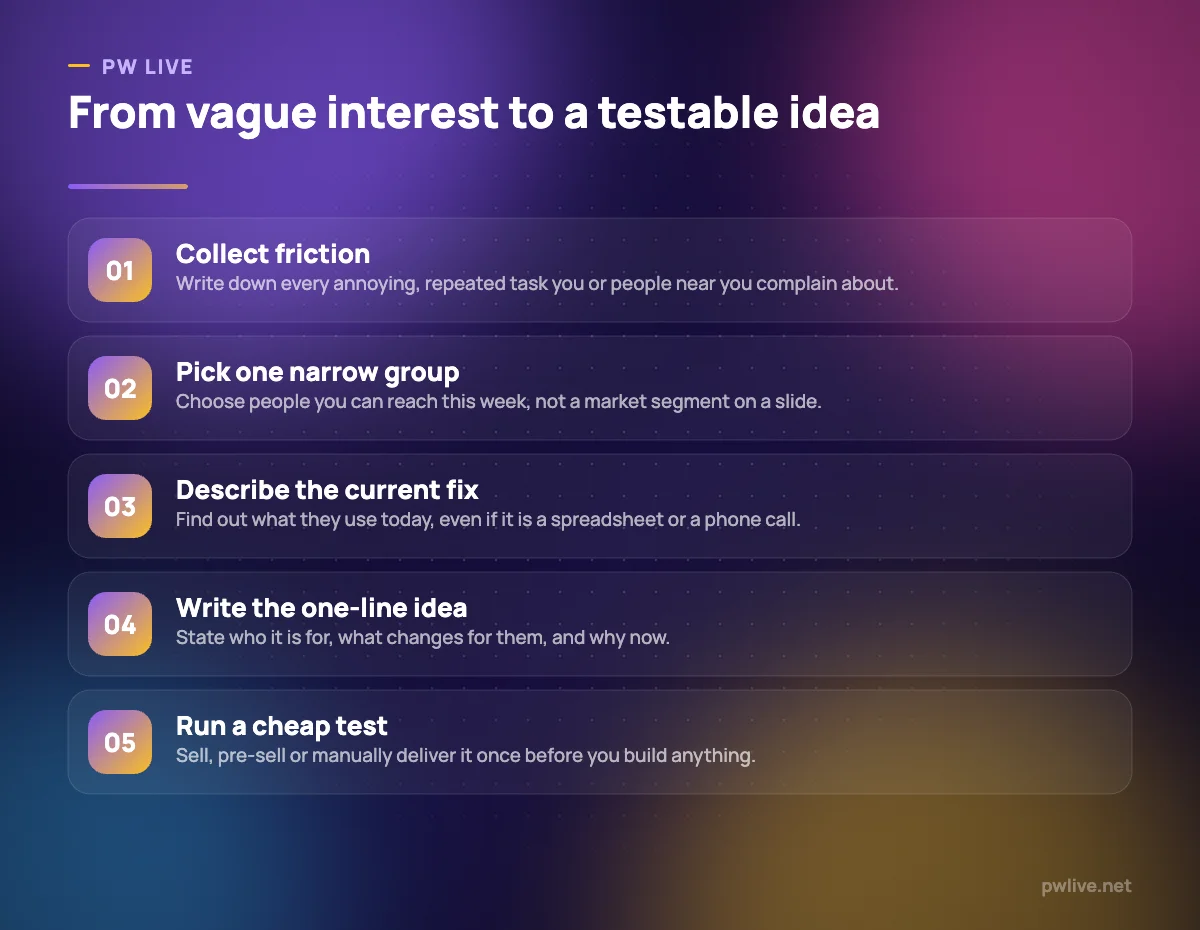
Write these down as complaints, not solutions. “Coaching centres lose track of which students stopped attending” is a complaint. “An app for coaching centres” is a solution wearing a disguise.
Keep a running list for two or three weeks. Most people who say they have no ideas simply have not been writing anything down.
Learn to tell a problem from a preference
Not every annoyance is a business. The ones worth pursuing tend to share a few traits.
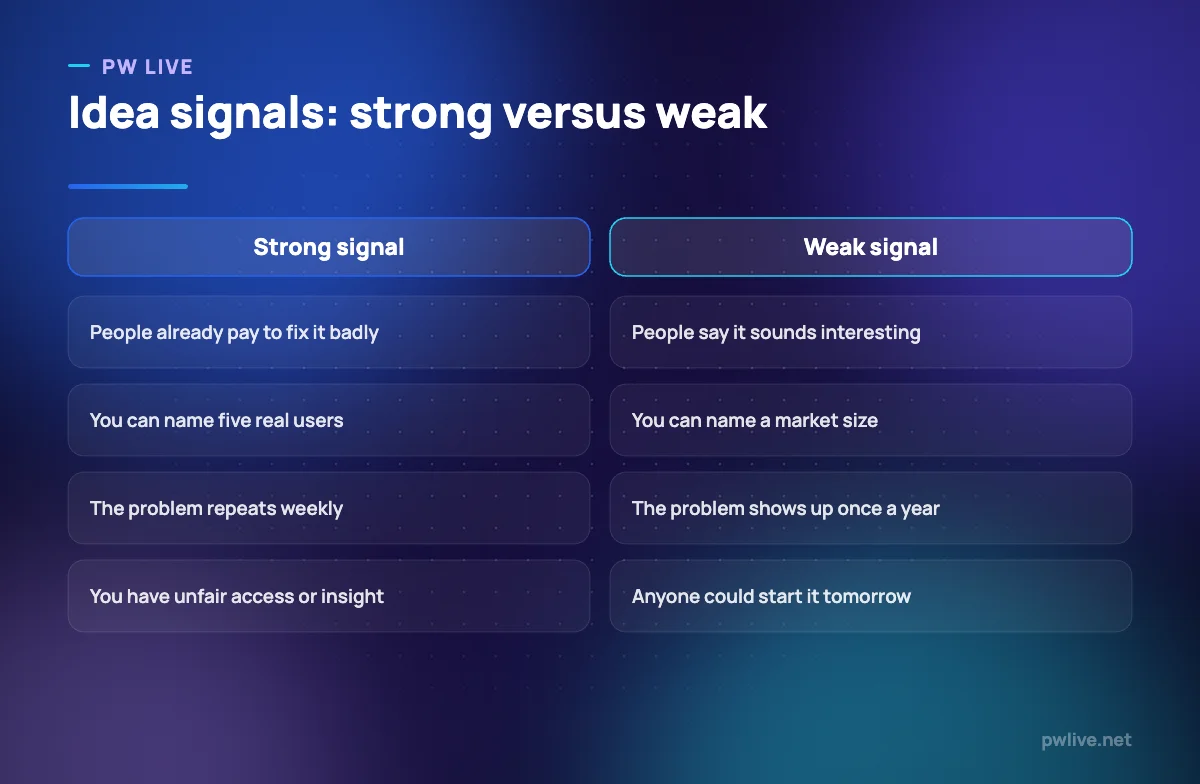
- They repeat. Weekly beats yearly. A problem someone faces every Monday builds a habit around your product.
- They already cost something. Money, time, missed revenue, or anxiety. If nobody is paying anything today, you will have to create the budget from nothing.
- There is an ugly workaround. Spreadsheets, WhatsApp groups, physical registers and copy-paste rituals are gold. They prove the need exists without a product.
- The person feeling it can decide. If solving it requires four approvals, your first ten customers will take a year.
The workaround test is the most useful one. When you find someone maintaining a messy spreadsheet at 11pm, you have found demand that already survives without marketing.
Look where change has just happened
Ideas do not need to be new. They need to be newly possible or newly needed. Something has usually shifted to open the gap.
- A rule changed. New compliance, new exam pattern, new tax process. Whenever the rules move, people need help adjusting.
- A cost fell. Cloud tools, cheap data, payment rails and AI models have made things affordable that were not affordable a few years ago.
- A behaviour changed. More people learning online, more small sellers going digital, more work happening remotely.
- A group got left behind. Software built for large firms often ignores the smallest ones entirely.
If you are exploring the technology side of this, our explanation of how large language models work and the basics of cloud computing for students and small businesses will help you judge what is genuinely possible now versus what only sounds possible.
Choose a narrow first user, not a market
“Students” is not a customer. “Second-year engineering students preparing for campus placements at tier-two colleges” is.
Narrowing feels like shrinking your ambition. It does the opposite. A narrow group is easier to find, easier to interview, easier to sell to, and gives you sharper feedback. You can widen later once something works.
Write your idea in one sentence with this shape: for [specific person], who struggles with [specific repeated problem], we do [specific thing], instead of [current ugly workaround].
If you cannot fill in the last blank, you have not researched enough yet.
Test the idea before you build anything
The fastest way to kill a bad idea is to try to get one person to commit. Not to praise it. To commit.
Cheap tests, roughly in order of strength:
- Manual delivery. Do the job by hand for one person. If you are imagining a matching platform, match two people over the phone.
- Pre-sell. Ask for an advance, a deposit, or a signed intent to buy. Money is the least polite and most honest feedback.
- A single page and a waitlist. Useful only if you also drive real traffic to it and talk to the people who sign up.
- A concierge pilot. Serve five users manually for a month and count how many come back.
Conversations matter more than surveys here. Our guide to talking to users and finding problems worth solving covers the questions that get honest answers, and the deeper checklist in how to validate a business idea before you spend a rupee shows how to run these tests on a student budget.
Judge the idea against your own life
An idea that suits someone else may not suit you. Before committing, ask three practical questions.
- Can I stay interested for years? Most startups take longer than expected. Curiosity outlasts excitement.
- Do I have any edge here? Access to users, domain knowledge, a skill, or simply the patience to do unglamorous work others avoid.
- What does the first version cost me? Time, money, and opportunity cost. If you are studying, be honest about your real free hours. The realities are covered in our guide to building a startup while studying full time.
There is nothing noble about choosing a harder idea than you need to. Choose the one where your unfair advantage is real.
Know when to keep going and when to stop
Set a decision point before you start: a date and a signal. For example, “in six weeks I will have either five paying users or three signed pilots, or I move on.”
Without that, you will keep going out of sunk cost and call it persistence. Many ideas fail for reasons that repeat across companies, and reading about why most startups fail before you begin makes those signals easier to spot in your own work.
Dropping an idea is not the end. The problem list you built stays with you, and the second idea is almost always sharper than the first. More broadly, browsing the business and entrepreneurship archive and building foundations through the skills development tracks gives you more raw material to draw on next time.
Key takeaways
- Ideas come from observed problems, not brainstorming sessions. Keep a written complaints list.
- Repeating problems with an ugly existing workaround are the strongest starting points.
- Narrow your first user until you can name real people you could contact this week.
- Test with commitment, not compliments: manual delivery, pre-sales or a paid pilot.
- Pick an idea where you have some edge and enough curiosity to last years.
- Decide in advance what result would make you stop, then honour it.
Frequently asked questions
Do I need an original idea to start a startup?
No. Most successful companies improve on something that already exists for a specific group of people. Execution, focus and access to users matter far more than novelty.
How long should I spend looking for an idea?
Give yourself a few focused weeks of observing and talking to people rather than an open-ended search. A deadline forces you to test something instead of endlessly comparing options.
Should I start with a problem I have or a market I like?
Start with a problem you can observe closely. Liking a market is useful, but access to real users and a clear pain point will move you faster than interest alone.
What if someone is already solving the problem?
Competition usually proves the problem is real. Look for the users the existing solution serves badly, and decide whether you can serve that slice noticeably better.
Keep learning with PW Live
Browse every guide in Startups & Innovation, or pick a skill track and follow the roadmap step by step.





Leave a Reply