

Unit economics is the practice of asking a simple question: when I sell one more of the thing I sell, am I better or worse off? Businesses that cannot answer it clearly tend to grow their way into trouble.
The idea is not complicated and does not need accounting software. You need a definition of one unit, a handful of costs, and the discipline to include the numbers that make the answer look worse.
This guide explains each figure, how to calculate it from what you already have, and how to read the result.
What a unit is, and why the definition matters
A unit is one repeatable transaction or relationship. It might be one order, one subscriber, one client project, one seat, or one delivery.
Choose the unit that matches how your money actually arrives. If people buy repeatedly, the customer is usually the better unit than the order. If most people buy once, the order is the right unit.
Getting this wrong distorts everything downstream. A tuition business that measures per class rather than per student for a term will misjudge both its costs and its marketing spend.
Write your unit down as a sentence: one unit is one customer on a monthly plan or one unit is one order of printed shirts. Everything below refers to that.
Contribution margin: what one sale actually leaves you
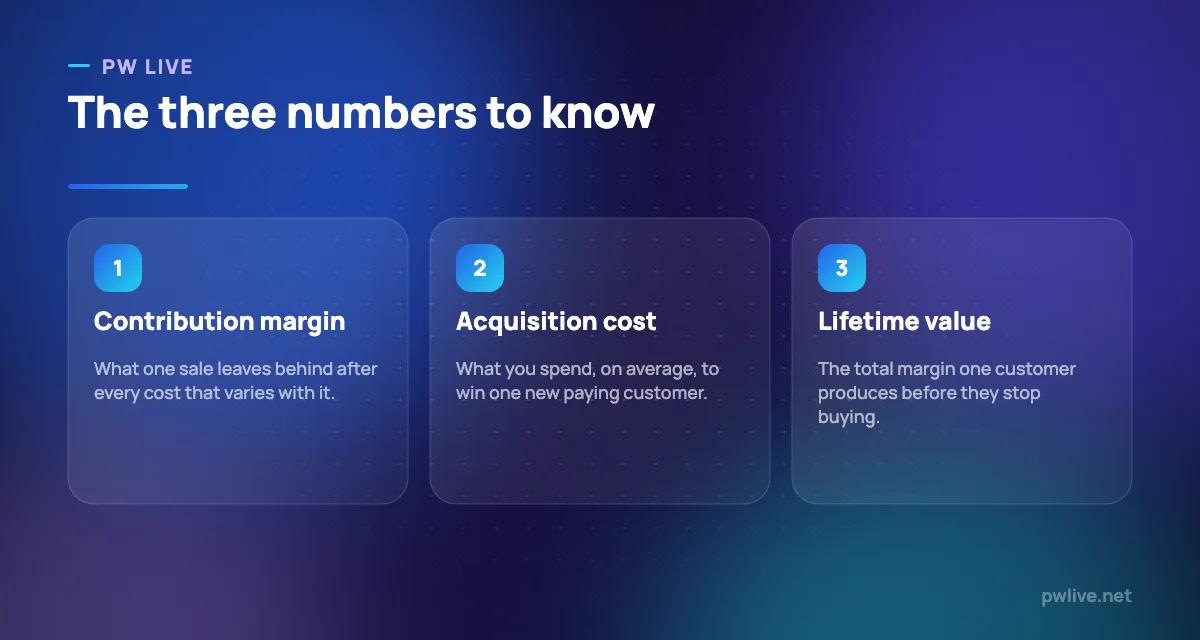
Contribution margin is revenue per unit minus every cost that varies with that unit.
Variable costs are the ones that only exist because the sale happened:
- Materials, stock or ingredients
- Packaging and delivery
- Payment gateway, marketplace or platform commissions
- Any freelancer or subcontractor paid for that specific job
- Support time attributable to that customer
- An allowance for returns, refunds and rework
Rent, salaries of permanent staff and software subscriptions are fixed costs. Keep them out of the per-unit calculation; they belong to the break-even question further down.
A worked example with round numbers. Say a product sells for 1,200 rupees. Stock costs 500, packaging and shipping 120, the platform takes 100, and one in ten orders is returned and cannot be resold, adding roughly 50 per order on average. Variable cost is 770, so contribution margin is 430, about 36 percent. Those figures are invented for illustration, but the method is exactly what you should run on your own numbers.
If contribution margin is negative, every sale makes you poorer and volume makes it worse. That is a pricing or cost problem to fix before anything else. Our guide to pricing your product or service without guessing is the place to start.
Customer acquisition cost: what a customer costs to win
Customer acquisition cost, usually shortened to CAC, is everything you spent to get customers in a period, divided by the number of new customers won in that period.
Include all of it:
- Advertising spend
- Fees paid to agencies, freelancers or affiliates
- The cost of samples, trials and discounts used to win the customer
- A fair share of the time you or your team spend selling
The mistake almost everyone makes is dividing by responses rather than by paying customers. Fifty enquiries that produce five sales means your CAC is the whole spend divided by five, not by fifty.
Calculate CAC per channel where you can. A blended average hides the truth that one channel is profitable and another is quietly draining money. Our guide to marketing metrics that matter explains how to track this without complex tooling, and running your first paid ad campaign without wasting money covers the paid side specifically.
Note also that channels behave differently. Referrals may cost almost nothing but scale slowly. Paid channels scale but get more expensive as you push volume.
Lifetime value: what a customer is worth over time
Lifetime value, or LTV, is the total contribution margin one customer produces before they stop buying.
For a repeat-purchase business, a workable approximation is: contribution margin per purchase, multiplied by the average number of purchases a customer makes.
For a subscription business: monthly contribution margin, divided by your monthly churn rate. If five in a hundred customers cancel each month, the average customer stays around twenty months.
Two cautions:
- Use observed behaviour, not hope. If you have only been trading six months, you do not know your true retention. Use what you have measured and mark it as provisional.
- Use margin, not revenue. Lifetime revenue is a vanity figure. Only the margin is yours.
The practical value of LTV is that it tells you what you can afford to spend to acquire a customer, and how much a retention improvement is worth. Keeping customers longer is usually cheaper than finding new ones.
Reading the ratios
Once you have the three numbers, a few relationships tell you most of what you need.
- Contribution margin per unit. Positive and comfortable, or thin and fragile? Thin margins leave no room for a bad month.
- LTV against CAC. If lifetime value is barely above acquisition cost, growth is not really working. Comfortable businesses have clear headroom between the two, though what counts as comfortable varies by industry.
- Payback period. How many months of contribution margin it takes to recover the acquisition cost. This matters more than the ratio for cash-constrained businesses, because a customer who repays their cost in one month funds the next customer.
- Break-even volume. Fixed monthly costs divided by contribution margin per unit. That is how many units you must sell each month before you earn anything.
Payback period is the number small businesses under-use. A brilliant LTV to CAC ratio over three years is little comfort if you run out of cash in month four. Read cash flow basics for why that gap is so dangerous.

How to improve unit economics
There are only four levers, and it is worth knowing which one you are pulling.
- Raise the price. The fastest and most direct lever, since the whole increase falls into margin. Usually the most under-used.
- Cut variable costs. Better supplier terms, less waste, cheaper delivery, fewer returns, a lower payment fee. Attack the biggest line first, not the easiest.
- Reduce acquisition cost. Improve conversion at each step, switch spend toward channels that convert, and build referral routes that cost nothing per customer.
- Increase lifetime value. Sell more often to the same customers, add a complementary offer, or reduce churn by fixing whatever makes people leave.
Order of attack for most small businesses: price first, then returns and waste, then retention, then acquisition. Acquisition is where people instinctively start and it is often the hardest to move.
Build the calculation once and revisit it
Set this up in a spreadsheet with three tabs: variable costs per unit, acquisition spend by channel, and repeat behaviour. Update it monthly. It takes twenty minutes once it exists.
Three habits keep it honest:
- Recalculate after any change to price, supplier cost, platform fee or channel mix.
- Keep the assumptions visible in a column next to the numbers, so future you knows what was estimated.
- Compare against reality quarterly. If your model says you make 430 rupees a sale and your bank balance disagrees, the model is missing a cost.
Unit economics also sits underneath the plan you show anyone else. Our guide to writing a simple one-page business plan has a money block that these numbers fill directly, and founders raising money will find them central to what investors actually look for. For the broader set of topics, browse the business and entrepreneurship archive or build the underlying numeracy through the personal finance skill track.
Key takeaways
- Define your unit to match how money actually arrives: per order, per customer, or per subscription.
- Contribution margin is revenue minus every cost that varies with the sale, including fees and returns.
- Acquisition cost is total spend divided by paying customers, not by enquiries.
- Lifetime value should use observed repeat behaviour and margin, never revenue.
- Payback period matters more than the LTV to CAC ratio when cash is tight.
- Improve margin by raising price and cutting waste before you try to cut acquisition cost.
Frequently asked questions
Do unit economics apply to a service business?
Yes. Your variable cost is mostly your own or your team’s delivery time, costed at a real rate, plus any subcontractors and tools bought for the job. Once that is included, many service businesses find their most popular offer is their least profitable.
What is a good LTV to CAC ratio?
There is no universal figure, and sensible ranges differ by industry, margin structure and how long customers stay. Rather than chasing a benchmark, track your own ratio over time and make sure the payback period fits the cash you have.
Should I include my own salary in variable costs?
Include the portion of your time that scales with each unit sold, such as delivering a job. Treat the rest, the time you spend running the business regardless of volume, as a fixed cost.
How often should I recalculate these numbers?
Monthly is enough for most small businesses, plus an immediate recalculation whenever a price, supplier cost or platform fee changes. The calculation is quick once the spreadsheet exists.
Keep learning with PW Live
Browse every guide in Business & Entrepreneurship, or pick a skill track and follow the roadmap step by step.





Leave a Reply