

The money you handle as a student is small. The habits you form while handling it are not. Whether you learn to track spending, avoid bad debt and save each month now will shape your finances long after the amounts have grown.
Nobody teaches this. Most students arrive at their first stipend, allowance or part-time wage with no framework, and pick up habits by accident.
This guide gives you the framework: see where your money goes, build a budget you will follow, create a safety net, and think about investing for the first time. It is general information, not personalised financial advice.
Why student money habits matter
Two things make this stage unusually important. First, time: money invested in your early twenties has decades to grow, an advantage no later salary can buy back.
Second, defaults. How you handle your first regular income tends to become how you handle every income after it. Good defaults do not need a large income, only a system that runs on what you have.
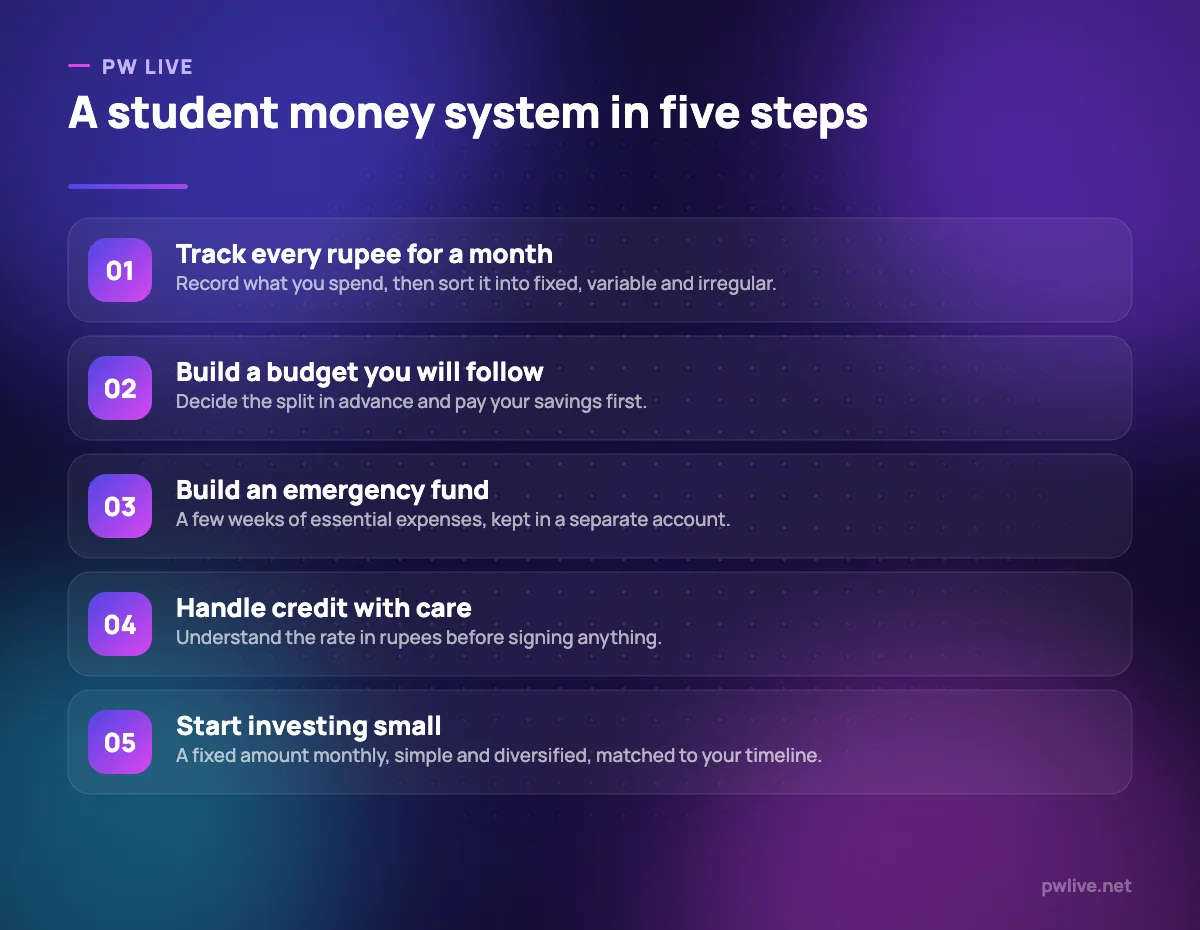
Step 1: Know where your money goes
You cannot budget what you cannot see. For one month, record every rupee you spend, however small, in a notes app, a spreadsheet or a notebook. Then sort the spending into buckets:
- Fixed essentials: rent, hostel fees, phone, transport pass.
- Variable essentials: food, groceries, study materials.
- Discretionary: eating out, subscriptions, outings, shopping.
- Irregular: exam fees, travel home, gifts, repairs.
Most people are surprised by the discretionary total. That surprise is the raw material for a budget.
Step 2: Build a budget you will actually follow
A budget is a plan for spending on what matters and cutting what does not. Start with a simple split. As an illustration only, some people use half for essentials, a smaller share for wants, and a fixed share for savings. The exact split matters less than deciding it in advance.
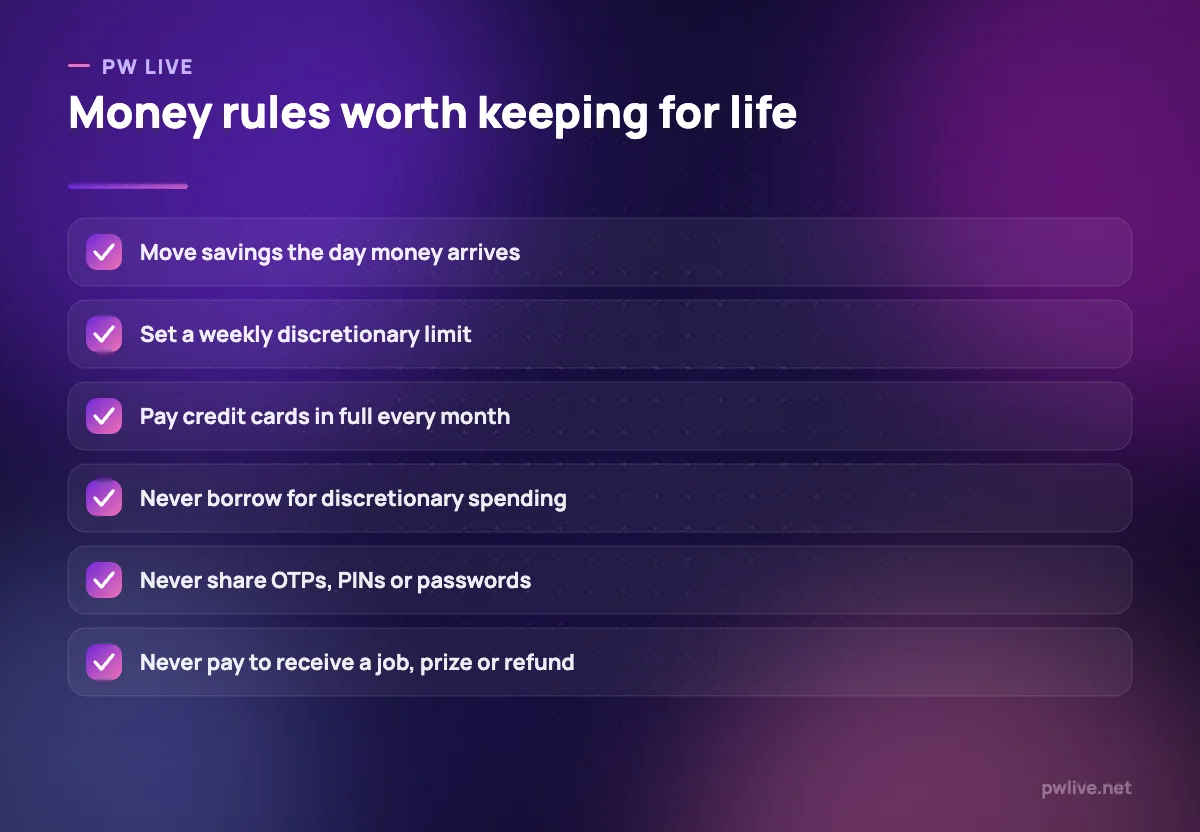
- Pay your savings first. Move the savings share the day money arrives. What is left is what you spend.
- Set a weekly discretionary amount. A month is too long to track in your head; a week is not.
- Plan for irregular costs. Divide known annual expenses by twelve and set that aside monthly.
- Review monthly. Compare plan to reality and adjust one category.
Our personal finance skills page has a worked example of a budget built from scratch.
Step 3: Build an emergency fund
An emergency fund is cash kept apart from spending money and used only for genuine surprises: a medical bill, a laptop repair, an unexpected trip home.
For students, the target can be modest. Even a few weeks of essential expenses stops a surprise becoming a debt.
- Keep it in a separate savings account, out of sight but reachable within a day.
- Fund it before you invest. Investments can lose value at the wrong moment; cash cannot.
- Refill it after every use before returning to normal saving.
Step 4: Handle credit and loans with care
Credit will find you as a student: cards, buy-now-pay-later offers, app-based loans. Some is useful; much is expensive.
- Understand the interest rate before signing. If you cannot explain what the loan will cost in rupees, do not borrow.
- Pay cards in full, every month. A card carrying a balance is among the most expensive debt available.
- Treat education loans seriously. Know the repayment terms, when interest starts and your monthly payment after graduation.
- Never borrow for discretionary spending. If you would not pay cash for it, do not finance it.
Step 5: Your first investment
With a working budget and an emergency fund in place, you can think about investing. The purpose is not to get rich quickly but to let time do the work.
- Start small and regular. A fixed amount every month, however modest, builds the habit and smooths out market swings.
- Prefer simple, diversified, low-cost options. Broad funds holding many companies are widely regarded as a sensible start, because they spread risk without requiring you to pick winners.
- Match the investment to the timeline. Money you need within a year or two belongs in savings, not in anything that can fall.
- Ignore tips. Anyone promising guaranteed or unusually high returns is mistaken or selling something.
Learn the tax and account basics for your country first, and prefer an investment you can explain to a friend in two sentences.
Step 6: Protect yourself from scams
Students are targeted constantly because they are new to money and active online. Common patterns: internships that ask for a fee, groups promising fixed daily returns, and messages pretending to be from banks or exam boards.
- Never share OTPs, PINs or passwords, however official the request sounds.
- Never pay to receive a job, a prize or a refund.
- Verify any request for money through official channels, not a link you were sent.
For more guides, browse our finance category. Please also read our disclaimer on the limits of general information on this site.
Key takeaways
- Money habits formed as a student become your defaults for decades.
- Track every rupee for a month, then pay savings first, set a weekly limit and review monthly.
- Build a small emergency fund before you invest anything.
- Pay cards in full, understand every loan, and never borrow for wants.
- Start investing small, regular and simple, and guard against scams.
Frequently asked questions
How much should a student save each month?
There is no universal figure. Start with any fixed share you can sustain and increase it as income grows. Consistency matters more than the amount.
Should I invest while I still have an education loan?
It depends on the loan’s interest rate, its terms and your situation. Many people build an emergency fund first, then compare the loan’s cost with expected returns. A qualified adviser can help.
Is it safe to use budgeting and investment apps?
Reputable apps from regulated providers are widely used. Check the provider is registered in your country, read what data it collects, and never share login details or OTPs.
Keep learning with PW Live
Browse every guide in Finance & Investing, or pick a skill track and follow the roadmap step by step.





Leave a Reply