

A weekly review is thirty minutes that decides whether the other hundred hours of your week were spent on the right things. It is the smallest planning habit with the largest return, and most people skip it because it feels less urgent than the work itself.
The idea is straightforward. Once a week you stop, empty your head, look at what happened, and decide what next week is for. No app is required, and it does not need to be a whole Sunday ritual.
Here is a fixed agenda you can run from the first attempt, plus how to keep the habit alive when weeks get chaotic.
Why a weekly review beats daily planning alone
Daily plans are tactical. They answer “what do I do today” and nothing else. Left alone, they drift: you can plan every day carefully for a month and still finish the month having done none of the things that mattered.
The weekly review is the level where you can see slippage while there is still time to correct it. A subject you have not touched in ten days is visible weekly and invisible daily.
It also does something less obvious: it gives you permission to stop thinking about everything else during the week. Once a list exists and has been reviewed, your head can let go of it.
Pick a fixed time and defend it
The review needs a slot, or it becomes something you keep meaning to do.
Choose a time that is quiet and repeatable: Sunday evening, Friday afternoon, Saturday morning before the house wakes. What matters is that it is the same slot every week, so the cue is automatic.
Thirty minutes is enough. If it regularly takes ninety, you are doing work during the review rather than reviewing. Move that work into the week and keep the review for deciding.
Tell whoever you live with that this half hour is yours. It is a small, specific ask and far easier to grant than open-ended quiet.
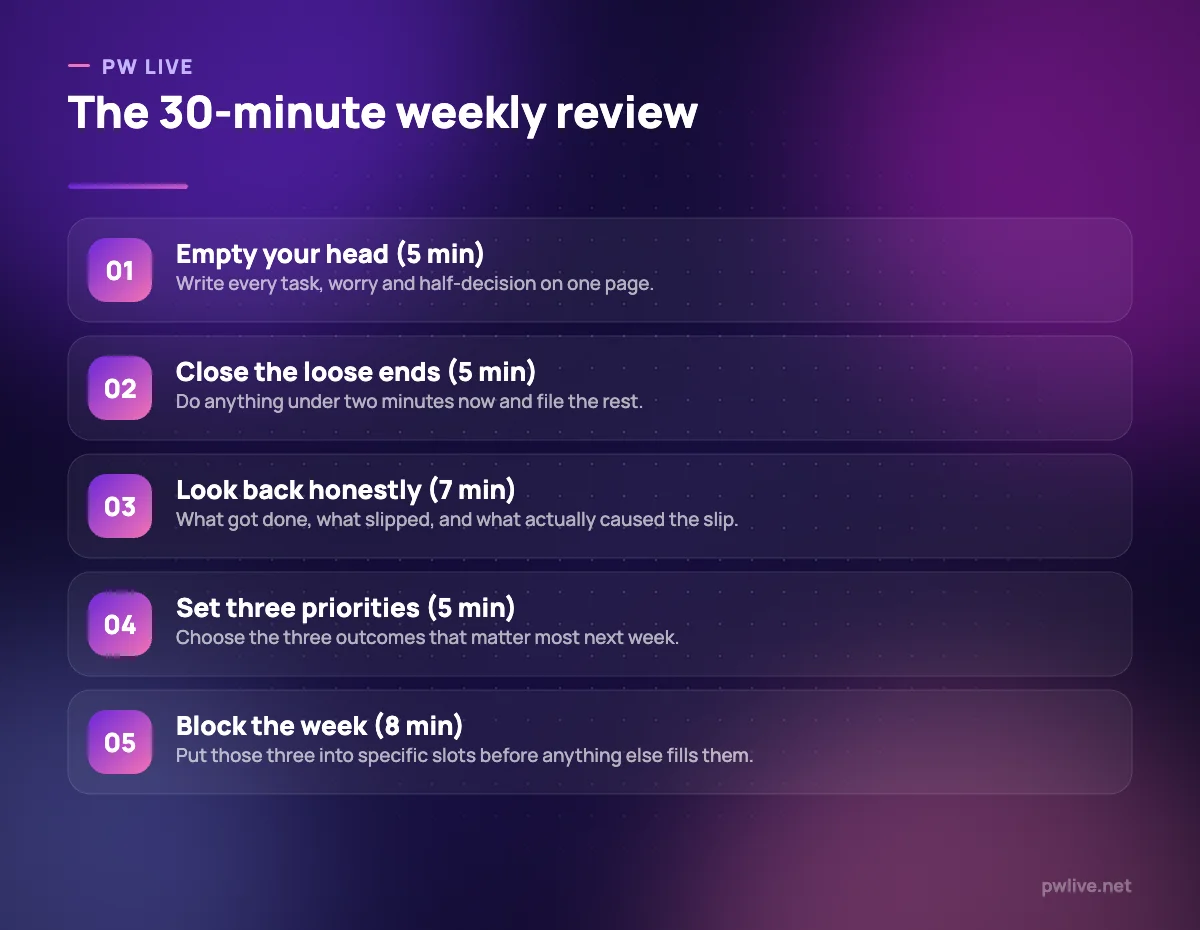
Step one: empty your head onto one page
Start by writing everything currently occupying your attention. Assignments, unread messages, a form you have not submitted, a call to your grandmother, a chapter you skipped, the fee deadline you half remember.
Do not organise while you write. Speed matters more than order. Five minutes, one page, everything.
This step alone accounts for most of the relief people feel afterwards. Anything you are holding in memory is costing you attention continuously; on paper it costs nothing until you choose to look at it.
Step two: sweep your real sources
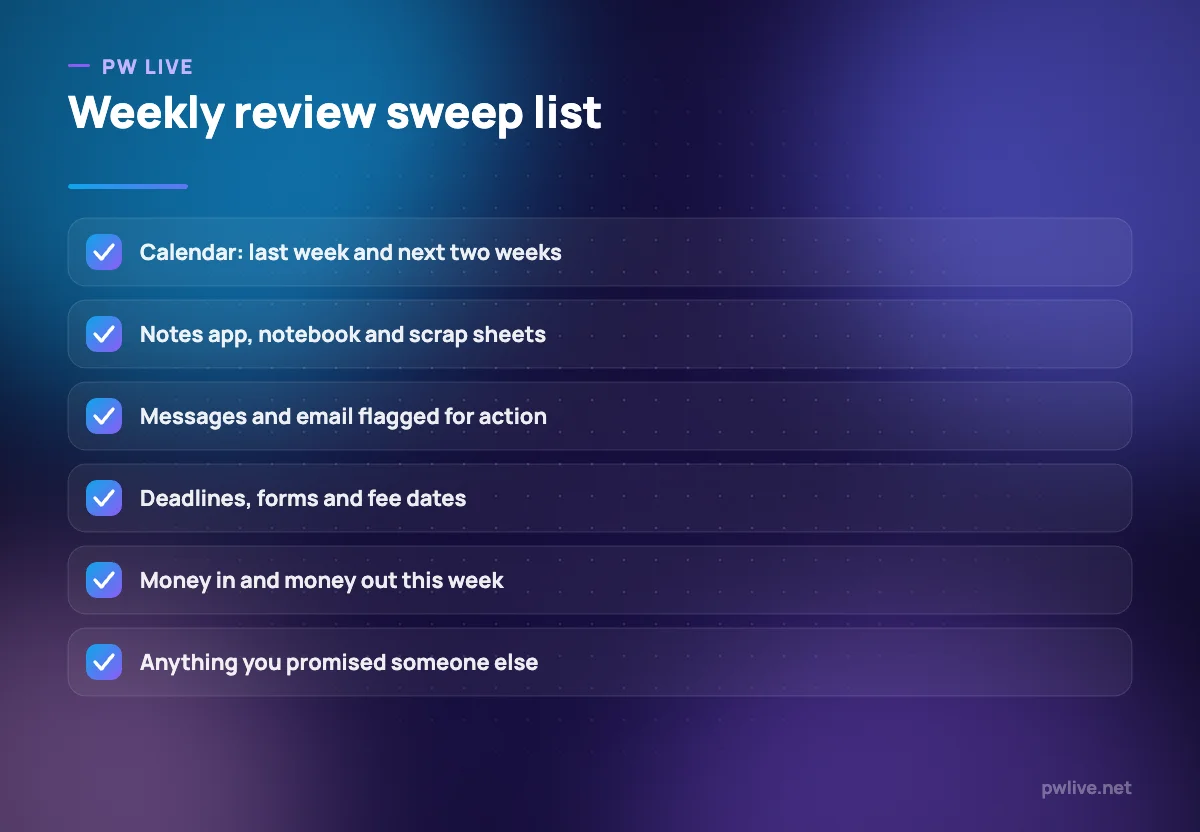
Your head is not a complete record. Do a quick sweep of the places where commitments actually live.
Check your calendar for the past week and the next two, your notes and scrap sheets, flagged messages, and any deadlines for forms, fees or applications. Add anything new to the page.
Look two weeks ahead, not one. Most avoidable panic comes from things that were visible a fortnight earlier and simply never got looked at.
Step three: look back honestly, without a verdict
Spend a few minutes on what actually happened. Three questions, written down:
- What did I finish this week?
- What slipped?
- What caused the slip: a bad plan, an interruption, low energy, or avoidance?
That third question is the one that changes things. “I did not study on Wednesday” is not useful. “I planned three hours on a day I had a shift until nine” is, because it points at a fix.
Note the wins too, briefly. Not as self-congratulation, but because a week with no visible progress usually contains more than you remember, and forgetting that is how motivation quietly drains.
For subject-level review, this pairs well with our guide to analysing a mock test properly, which does the same honest diagnosis at the level of individual questions.
Step four: choose three priorities, not fifteen
Look at your page and pick three outcomes for next week. Outcomes, not activities: “finish the thermodynamics chapter and 30 questions” rather than “study physics”.
Three is the right number because it is small enough to remember and large enough to matter. Everything else on the page stays on the page; it is not forgotten, it is just not this week’s promise.
If you cannot choose, ask which item would most reduce your stress if it were done, and which would most block other work if it were not. Those two usually pick themselves.
Step five: put the priorities into actual slots
An unscheduled priority is a wish. Before the week fills with other people’s requirements, place the three priorities into specific blocks.
Start with the fixed points: classes, shifts, travel, family commitments. Then place your three priorities in the hours where you think most clearly. Then let everything else fill the gaps.
Our guide to time blocking covers block sizing and buffers, and our guide to a weekly study timetable that survives real life covers the recurring skeleton that the review sits on top of.
What to keep in the review, and what to leave out
Keep it narrow enough to finish. A workable agenda for most readers covers:
- Study and work. Progress, backlog, deadlines.
- Money. A two-minute look at what came in and went out, and any bill due. Our guide to using spreadsheets for study planning and budgeting has a simple format.
- People. Anything you promised someone, and anyone you have been meaning to contact.
- Yourself. Sleep, movement, and whether you got any genuine rest.
Leave out anything that turns into a project. Reorganising your entire notes system is not a review task; it is a thing you schedule as a result of the review.
If you are working towards a specific skill, add one line on measured progress. Our guide to tracking your skill progress explains what is worth measuring.
Keep the habit alive when the week was bad
The weeks you least want to review are the weeks the review helps most. Skipping after a bad week is the usual point of failure.
Three rules that keep it going:
- Run a short version rather than none. Ten minutes: head dump, three priorities, block them. That is enough to hold the habit.
- Do not turn it into a trial. The review asks what happened and what changes, not whether you deserved the outcome.
- Restart without ceremony. If you have missed three weeks, do this Sunday’s review and move on. There is nothing to catch up.
For the mechanics of keeping any weekly habit alive, see our guide to making a new routine stick. More planning routines sit in the lifestyle and productivity archive and the productivity skill track.
Key takeaways
- Book one fixed 30-minute slot each week and treat it as an appointment.
- Start with a five-minute brain dump, then sweep calendar, notes and messages.
- Ask what slipped and why, since the cause is what you can actually change.
- Choose three outcomes for the week, not a list of fifteen activities.
- Schedule those three into real slots before the week fills up.
- After a bad week, run a ten-minute version rather than skipping entirely.
Frequently asked questions
When is the best time to do a weekly review?
Any quiet, repeatable slot works, with Friday afternoon and Sunday evening being the common choices. Consistency of the slot matters far more than which day you pick.
What if I have nothing to review because the week went badly?
That is exactly the week to review, because the useful output is the cause of the slippage rather than a list of achievements. Run the short version and pick three priorities.
Do I need an app for a weekly review?
No. A single sheet of paper and your calendar are enough, and many people find that paper keeps the review from turning into an hour of tinkering with software.
How is a weekly review different from writing a to-do list?
A to-do list collects tasks, while a review looks back at what happened, diagnoses why, and then decides what the coming week is actually for. The deciding is the part that changes outcomes.
Keep learning with PW Live
Browse every guide in Lifestyle & Productivity, or pick a skill track and follow the roadmap step by step.





Leave a Reply