
Email marketing basics come down to one uncomfortable truth: a list of people who asked to hear from you is worth more than ten times as many who did not. Everything else is technique.
Email is the only marketing channel you actually own. Social reach depends on an algorithm, ads stop when you stop paying, search rankings move without warning. A permission-based email list keeps working.
This guide covers how to collect subscribers properly, what to send, how often, and how to tell whether any of it is working. It assumes you are starting from zero.
Why email still outperforms most channels
Three structural advantages keep email useful.
- Ownership. You hold the relationship. No platform can throttle your reach overnight.
- Intent. Someone gave you their address on purpose. That is a stronger signal than a follow or a like.
- Directness. An email sits in an inbox until it is dealt with. A post scrolls past in a second.
The catch is that this only holds while people want the emails. The moment you send things nobody asked for, the asset turns into a liability: complaints rise, deliverability drops, and future emails stop reaching even the people who do want them.
Build the list with genuine consent
Never buy a list, never scrape addresses, and never add people because they gave you a card at an event or emailed you once about something else. Beyond the legal exposure, it poisons your sender reputation and the response rates are terrible.
Consent done properly looks like this:
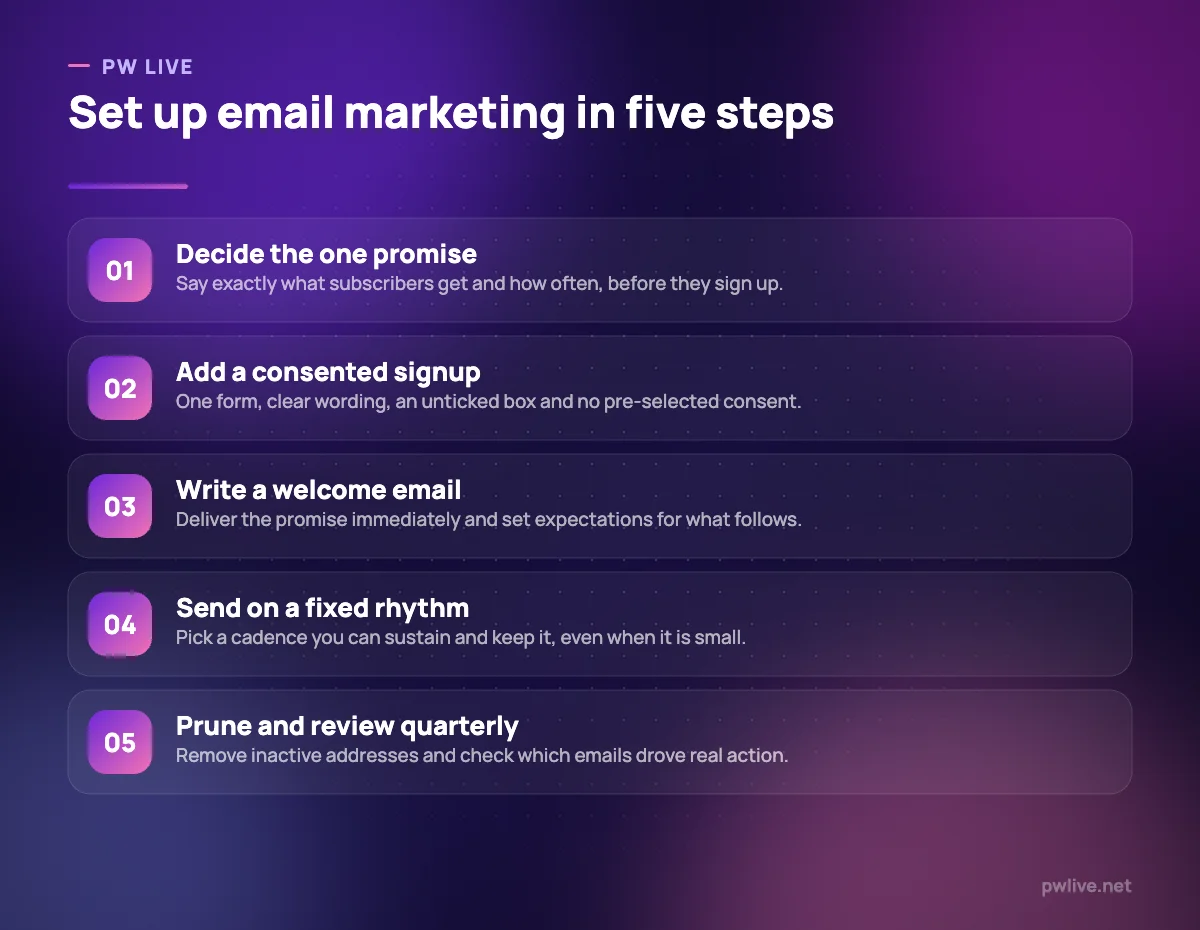
- The person actively opts in — a form they filled, a box they ticked themselves, never pre-ticked.
- You state plainly what they will receive and roughly how often, right next to the button.
- You confirm the subscription, ideally with a confirmation email they must click.
- You keep a record of when and where each person subscribed.
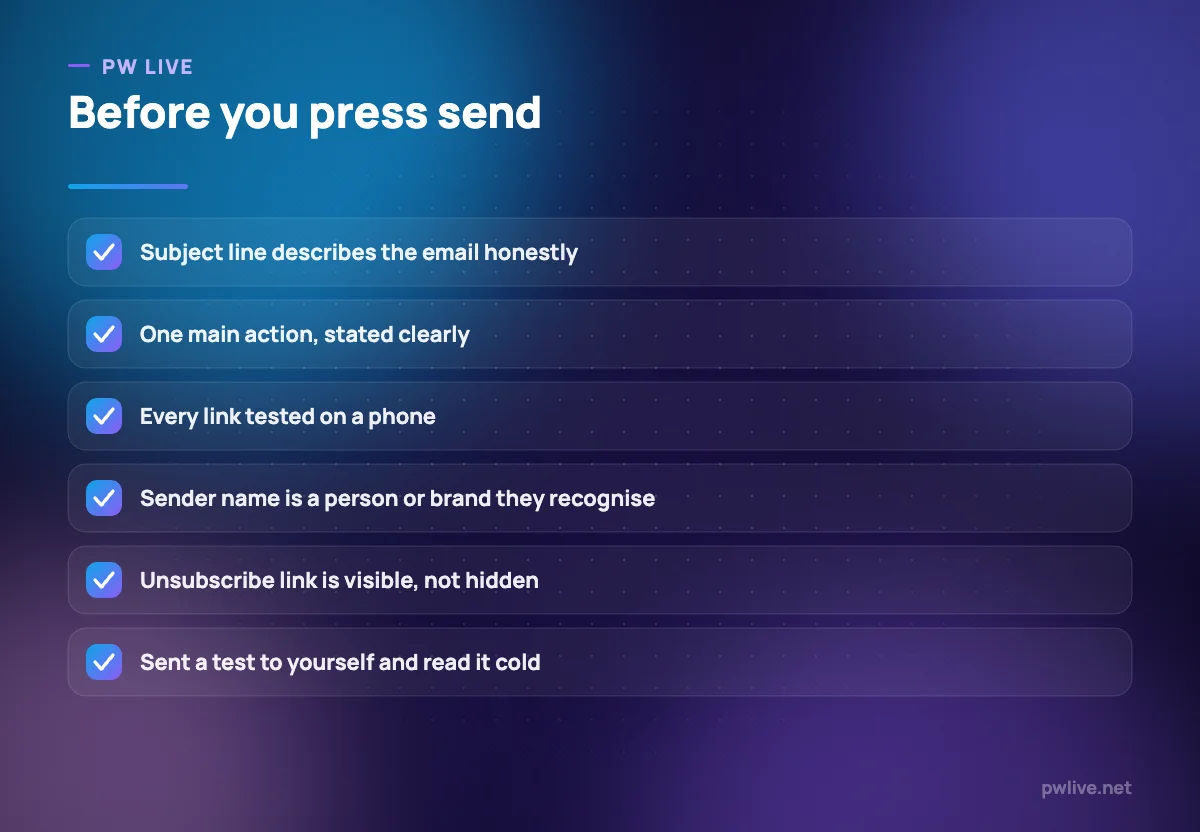
- Every email carries a working, one-click unsubscribe that you honour immediately.
That last point is not a formality. Making it easy to leave keeps your list made of people who want to be there, which is exactly the list that converts.
Give people a real reason to subscribe
“Subscribe to our newsletter” asks for something and offers nothing. Replace it with a specific promise.
Good reasons to hand over an address:
- A resource that solves an immediate problem: a template, a checklist, a worked example, a pricing calculator.
- Genuinely useful ongoing content they cannot get elsewhere, described concretely.
- Early or exclusive access to something they already want.
Keep the form short. Email address is usually enough; a first name if you will actually use it. Every extra field costs signups, so only ask for what changes what you send.
Place the form where interest peaks: at the end of a useful article, on the page describing what you do, and in a modest banner rather than an aggressive pop-up that blocks the content someone came to read.
Write emails people open and act on
An email has four parts that matter, in this order.
The sender name. People decide by who it is from before they read anything else. Use a consistent, recognisable name.
The subject line. Describe the email honestly and specifically. “Three things to check before you file GST this quarter” beats “Newsletter #14” and beats clickbait, which gets one open and a lifetime of distrust.
The opening line. Many inboxes preview it. Do not waste it on “Hope this email finds you well.”
The body. One idea, one action. If you have three things to say, you have three emails. Write it as you would to one person, because that is how it is read.
Keep the design simple. Text-forward emails render reliably, load fast on weak connections, and rarely look broken. The craft here is close to the craft of any other writing, so our guide on writing content people actually read applies directly.
Set up a welcome sequence
The first days after signup are when interest is highest and almost everyone wastes them.
A simple three-email welcome sequence, sent over the first week or two:
- Deliver the promise immediately. The resource they signed up for, plus one sentence on what to expect next.
- Establish who you are. The problem you solve and who you solve it for, with one specific example or short story.
- Point to your best work and invite a reply. Ask what they are struggling with. Replies improve deliverability and tell you what to write next.
Only after that should the regular rhythm begin. Set this up once and every new subscriber gets a proper introduction without you doing anything.
Segment and personalise without being creepy
Segmentation just means sending different things to different groups. It is the single biggest lever on results once your list is past a few hundred people.
Useful, low-effort segments:
- What they signed up for, if you offer more than one resource.
- Customers versus people who have not bought.
- Engaged versus dormant, based on whether they have opened anything in the past few months.
Personalisation means using what someone told you or did with you. It does not mean referencing information they never knowingly gave you. If a line would make a subscriber feel watched, cut it.
Dormant subscribers deserve one honest re-engagement email asking whether they still want to hear from you, then removal if they do not respond. A smaller engaged list outperforms a bloated one on every measure that matters, including whether your emails reach inboxes at all.
Measure what actually matters
Open rates have become unreliable because of privacy features that load images automatically. Treat them as a rough directional signal, not a target.
Watch these instead:
- Clicks on the main action, as a share of emails delivered.
- The outcome after the click — enquiries, purchases, bookings.
- Unsubscribes and complaints, which tell you when you have pushed too hard or drifted off-topic.
- List growth net of removals, so you see real momentum rather than a gross number.
For a framework on connecting these to business results rather than dashboard noise, see our guide to the marketing metrics that matter. If you sell online, email is also the main tool for reducing cart abandonment, and it pairs well with the outreach approach in finding your first ten customers.
Email works best as one part of a plan. The marketing and sales archive covers the neighbouring channels, and the digital marketing skill track sequences them into a learning path.
Key takeaways
- Only email people who actively asked to hear from you, and make leaving easy.
- Offer something specific in exchange for an address. “Newsletter” is not an offer.
- One idea and one action per email, written as if to a single person.
- A three-email welcome sequence captures the moment interest is highest.
- Judge results by clicks and outcomes, not opens, and prune dormant subscribers regularly.
Frequently asked questions
How often should I email my list?
Whatever you can sustain, stated upfront and kept. A predictable monthly email beats an erratic weekly one that stops after six weeks.
Is it ever acceptable to add someone without asking?
No. Adding people who did not opt in damages your sender reputation, generates complaints and creates legal risk. Invite them to subscribe instead.
Do I need paid email software to start?
Not immediately. Most email platforms have a free tier that covers a small list, and the important work at the start is the offer and the writing, not the tooling.
What should I do about a low open rate?
Check deliverability first, then sender name and subject lines, then relevance. If a segment has ignored everything for months, ask them once whether they still want the emails and remove them if not.
Keep learning with PW Live
Browse every guide in Marketing & Sales, or pick a skill track and follow the roadmap step by step.





Leave a Reply