

Most content fails in the first ten seconds. If you want to write content people read and share, the problem is almost never your vocabulary. It is that the piece never made a promise worth staying for.
Readers are not hostile, they are busy. They arrived with a question, they are scanning for evidence you can answer it, and they will leave the moment they suspect you are padding.
This is a working method, not a theory. Pick a reader, promise something specific, build a structure that survives scanning, then edit hard. Do that repeatedly and sharing takes care of itself.
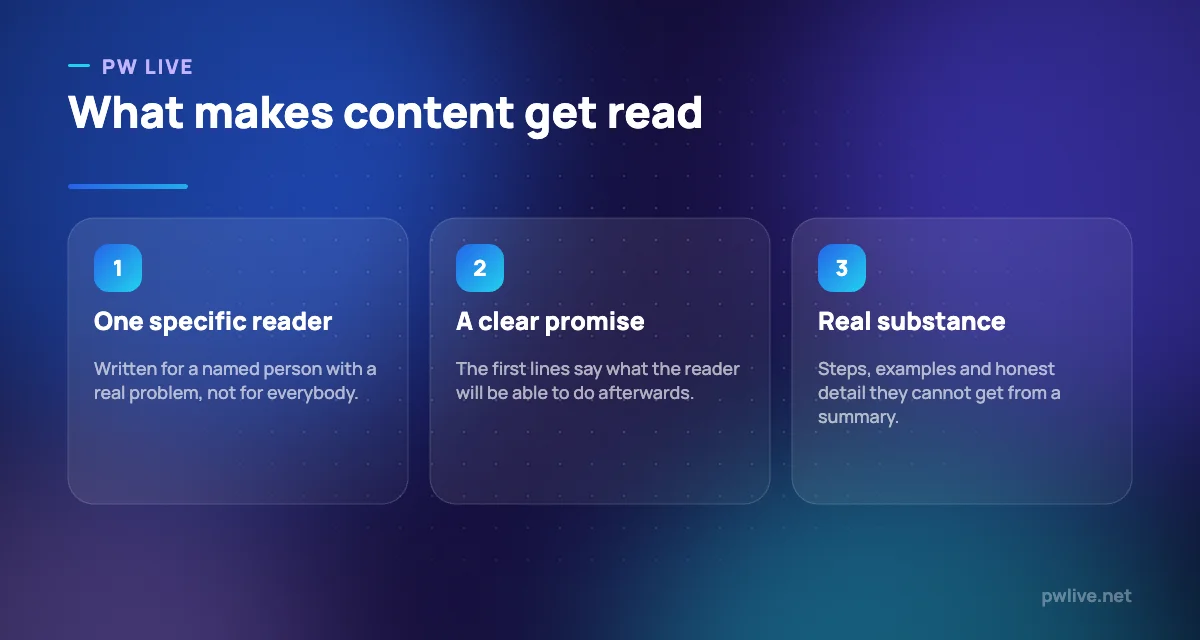
Write for one person, not an audience
“Small business owners” is not a reader. “A two-person bakery owner who has just been asked to send an invoice with GST and has no idea how” is a reader.
The specific version tells you what to explain, what to skip, what tone to use and which examples will land. The vague version produces writing that is technically correct and completely forgettable.
Before you draft, write two sentences at the top of your document:
- Who this is for, including what they already know.
- What they will be able to do after reading, that they could not do before.
Delete those two sentences before publishing. Their job is to keep you honest while you write.
Earn the first thirty seconds
The opening has one job: prove the piece is for this reader and worth their time. Three patterns do this reliably.
- State the problem plainly. “Your emails get opened and then ignored.” The reader recognises themselves immediately.
- Make the promise concrete. Not “learn to write better” but “you will have a working outline in twenty minutes”.
- Open with the specific. A small, real situation beats a general observation every time.
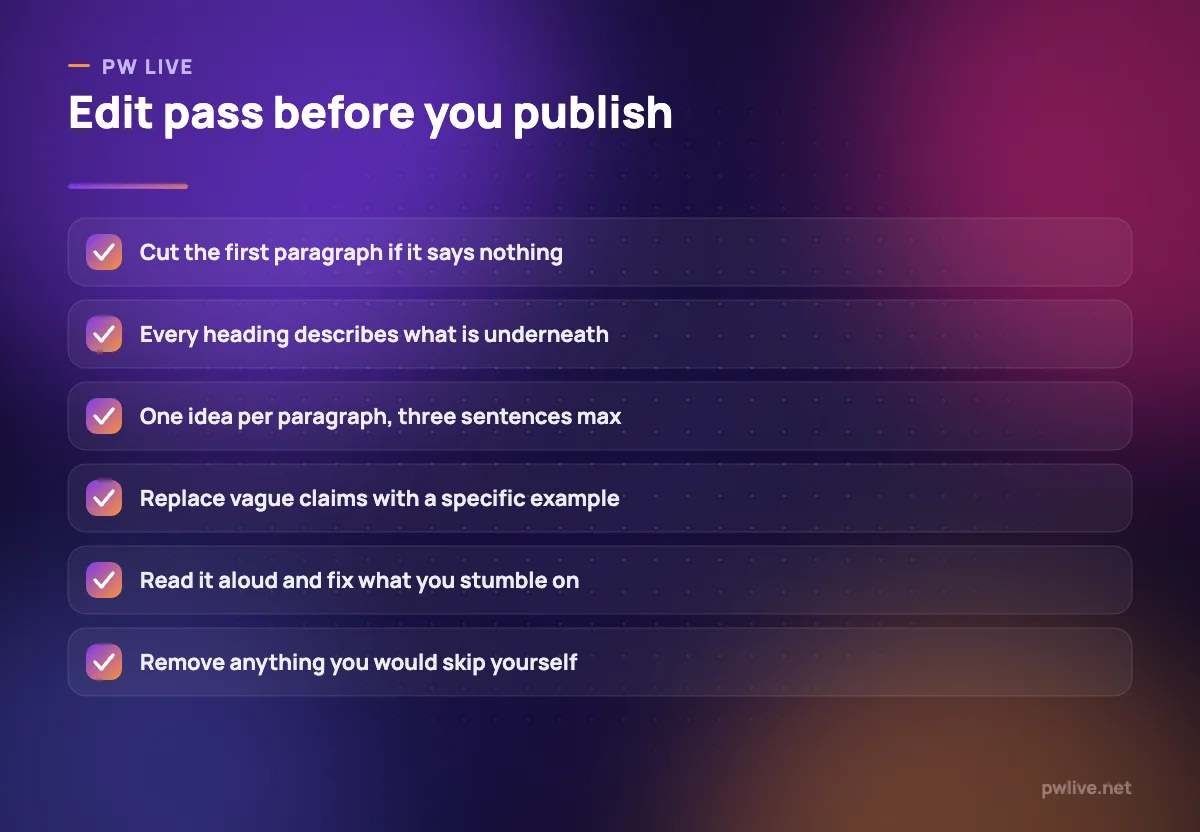
What kills openings is throat-clearing: history of the topic, why it matters in the modern world, a definition nobody asked for. If your first paragraph could sit at the top of any article on the subject, cut it.
Build a structure that survives scanning
Assume the reader will scan the headings before deciding to read a word. So the headings have to carry the argument on their own.
Write your headings first, as a list, before any body copy. Then read them top to bottom. If someone who read only those headings would still get the gist, your structure works. If they read like labels — “Introduction”, “Background”, “Some tips” — rewrite them into statements of what the section delivers.
A few structural habits that make long pieces feel short:
- Short paragraphs, one to three sentences. White space is not wasted space.
- Lists where the content is genuinely a set of items or an ordered process, not as decoration.
- Sub-headings inside long sections so nothing runs more than a screen without a signpost.
- The most useful section early, not saved for a big finish.
The same discipline helps in other formats. If you are structuring information for yourself rather than for readers, our guide on taking notes you will actually revise uses a related logic.
Put real substance in every section
The difference between content that gets shared and content that gets skimmed is almost always specificity.
Generic: “Respond to customer complaints quickly.” Specific: “Acknowledge within a working day even if you cannot solve it yet, name the person handling it, and say when you will come back with an answer.”
Sources of specificity you already have:
- Numbers from your own work, clearly labelled as your own.
- A mistake you made and what it cost you.
- The exact wording you use in a real email, quote or script.
- A comparison of two approaches you have both tried.
Never invent statistics to add weight. Made-up figures are easy to spot, and one exposed fabrication costs more trust than a hundred careful sentences build. If you do not have a number, describe the mechanism instead.
Write the way you speak, then tighten
Two drafts, two different jobs.
The first draft is for getting the thinking out. Write it fast, in plain spoken language, without editing. Perfectionism at this stage produces a paralysed writer and a stiff page.
The second draft is where the work happens. Cut adverbs that add nothing. Replace abstract nouns with verbs. Split any sentence you have to read twice. Delete the sentence that restates the previous sentence.
A useful test: read the piece aloud. Every place you stumble is a place the reader will stumble. Fix those, and you have done most of what a professional editor would do.
Give people a reason to share
People share things that make them look useful, informed or understood by their own network. Nobody shares an advertisement.
Practical ways to build that in:
- Include one thing that is genuinely reusable: a checklist, a template, a script, a decision rule.
- Take a clear position where you actually have one. Balanced-to-the-point-of-blandness does not travel.
- Make the title an accurate promise. Overclaiming gets clicks and destroys the trust you needed for the share.
- Make it easy to quote. A crisp sentence that stands alone gets screenshotted.
Do not ask for shares in every paragraph, and do not run engagement-bait tactics that platforms actively penalise. Ask once, at the end, if at all.
Fit content into a wider marketing plan
Good writing that nobody finds is a hobby. Publishing it where your reader already is turns it into marketing.
Search is the most durable channel for evergreen pieces, so it is worth pairing this craft with the basics in our guide to SEO for beginners and the phrase-selection method in keyword research without expensive tools. Persuasive pages need a different muscle again, covered in copywriting fundamentals.
If you write for products, the same principles narrow down neatly in writing product descriptions that convert. And for a broader sense of how writing sits beside email, social and paid work, browse the marketing and sales archive or follow the structured communication skills track.
Key takeaways
- Write for one specific person with one specific problem. Vague audiences produce forgettable writing.
- The opening must state the problem or the promise plainly. Cut all throat-clearing.
- Draft your headings first and check they tell the story alone.
- Replace every generic claim with a concrete example, and never invent statistics.
- Build in one genuinely reusable thing, and ask for the share once, at most.
Frequently asked questions
How long should an article be?
Long enough to answer the question properly and no longer. Let the question set the length rather than a word target, and cut anything the reader would skip.
Should I use AI tools to write content?
They are useful for outlines, alternative phrasings and catching weak sentences. The specifics, the examples and the opinions have to come from you, or the piece will read like every other summary on the topic.
How do I write when I am not an expert?
Write about what you have actually done, including the parts that went wrong. First-hand experience at any level is more useful to a reader than a confident summary of things you have only read about.
How often should I publish?
Whatever cadence you can sustain for a year. One strong piece a month beats a burst of weekly posts followed by six months of silence.
Keep learning with PW Live
Browse every guide in Marketing & Sales, or pick a skill track and follow the roadmap step by step.





Leave a Reply