

Getting your first ten customers is not a marketing problem. It is a conversation problem. At this stage nobody is searching for your brand, so waiting to be found is the same as waiting.
The good news is that ten is a small number. Ten customers is reachable through direct effort in a few weeks, without a budget, a website or an advertising account.
This guide gives you the sequence: build a list, choose the warmest names, start real conversations, make a clear offer, then turn early buyers into the source of the next ten.
Ten is a target you can count, not a market you must capture
Before anything else, get precise about what you are selling and to whom. Vagueness is what makes outreach feel awkward.
Write one sentence: I help [specific group] with [specific problem] by [specific offer], for [price]. If you cannot fill in all four blanks, fix that first with our guide to validating a business idea before you spend a rupee.
Then set the goal properly. You are not trying to reach thousands of people. You are trying to have perhaps fifty real conversations, from which ten purchases is a realistic outcome.
That reframing matters. Fifty conversations is a task you can plan and do. “Get customers” is not.
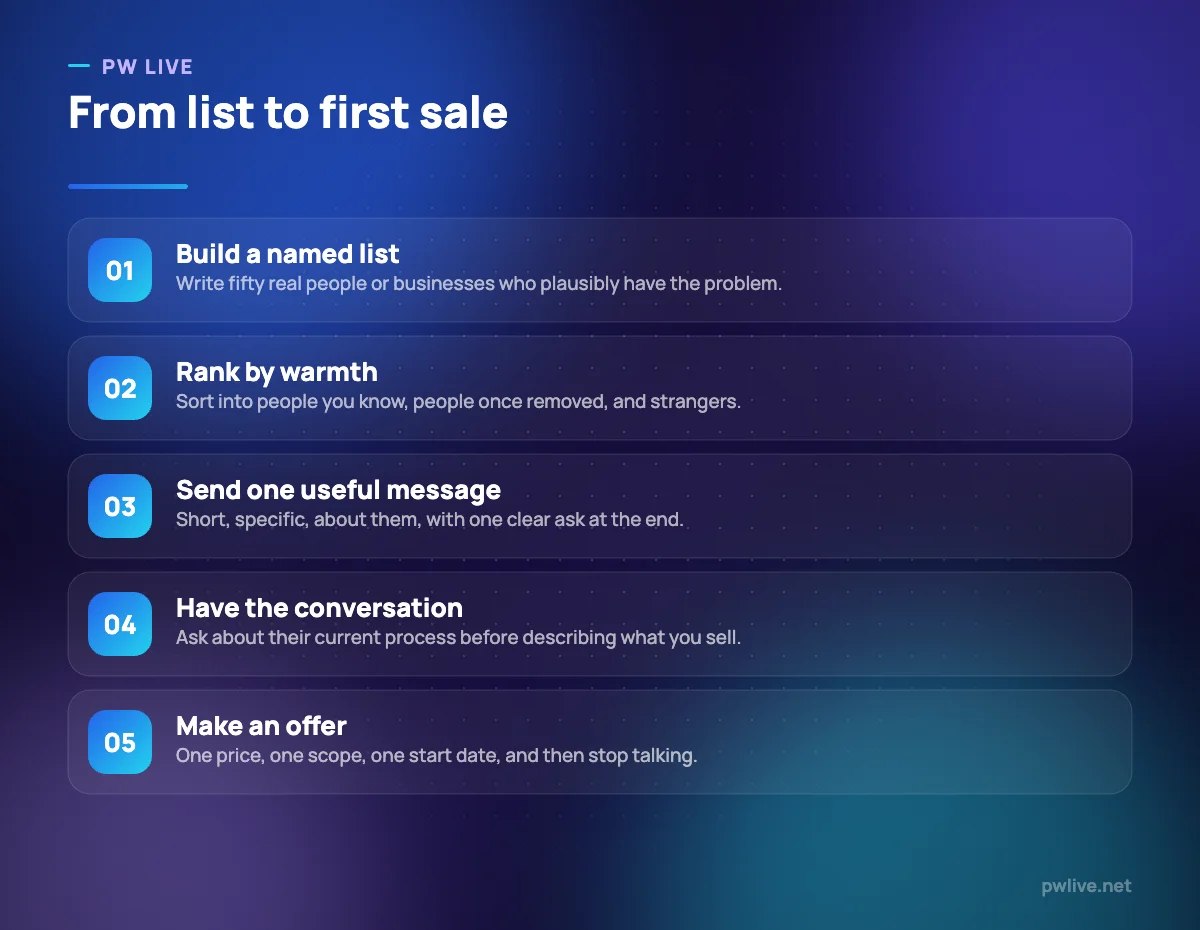
Build a list of fifty named prospects
Open a spreadsheet with columns for name, how you know them, contact route, date contacted, response, and next step. Then fill fifty rows. This will take a couple of hours and it is the most valuable work of the week.
Sources to mine:
- Your phone contacts and messaging apps, scrolled properly rather than skimmed
- Former colleagues, managers, clients and classmates
- Local businesses you can walk to, if your customer is a business
- Members of groups you already belong to, online or offline
- People who have publicly asked about the problem you solve, in forums or comment threads
- Anyone who has mentioned the problem to you in passing over the last year
Do not filter as you write. Get all fifty down, then rank them.
Rank by warmth, not by size
Sort your list into three tiers:
- Warm. People who know you and would answer a message today.
- One step removed. People you could reach through a shared contact who would introduce you.
- Cold. Strangers who fit the profile.
Start at the top. Early customers should be easy to reach and forgiving of a rough first version, because your delivery will not be polished yet.
Chasing an impressive logo before you have any customers is a common and expensive detour. The large client that takes six months to say no would have been three warm customers in the same period.
Write messages people actually reply to
The message that works is short, specific to the person, and asks for one small thing. Four lines is plenty:
- Line one: why you are writing to them specifically, with a real detail.
- Line two: what you do, in one plain sentence with no adjectives.
- Line three: what you noticed or want to understand about their situation.
- Line four: one ask, sized small. Fifteen minutes, or a yes or no question.
Things that kill replies: a paragraph about your journey, a link to a brochure with no context, an ask for “a quick call to explore synergies”, and a message that could have been sent to anyone.
Follow up twice, politely, spaced several days apart, then stop. A follow-up that adds something useful, such as a relevant example or an answer to a question they raised, works better than “just bumping this”.
If cold outreach makes you uncomfortable, work through the communication skills track, and read our guide to finding opportunities through networking rather than applications, which uses the same muscles.
Run the first conversation as an interview
The instinct is to pitch. Resist it. Your first job in the conversation is to understand how they currently handle the problem, because that tells you both whether they will buy and what to charge.
Ask about the past, not the future. “What did you do the last time this came up?” tells you the truth. “Would you use something like this?” gets you a polite yes that means nothing.
Useful questions:
- How do you handle this today, step by step?
- What does it cost you in time or money?
- What have you already tried, and why did you stop?
- Who else is involved when you decide to buy something like this?
- What would have to be true for you to change how you do it?
Take notes in their words, not your summary. The phrases they use are the phrases that should appear in your offer. Our guide to talking to users and finding problems worth solving goes deeper into this technique.
Make a clear offer and ask for the sale
Somewhere in the conversation, the moment arrives. Make the offer explicit and small enough to say yes to:
- One scope. Exactly what they get, listed in three or four lines.
- One price. A single number, not a range.
- One start date. When you would begin.
- One next step. What happens if they say yes.
Then stop talking and let them answer.
If they hesitate, find out what the hesitation actually is: money, timing, trust, or authority to decide. Each has a different response, and guessing wrong wastes the opening.
A first-customer offer can be smaller than your eventual product. A pilot, a single job, a one-month trial at full price. What matters is that money changes hands, because a paying customer teaches you things a free user never will.
Do not give the work away to build a portfolio. Discounts create customers who never intended to pay. Read how to price your product or service without guessing before you set the number.
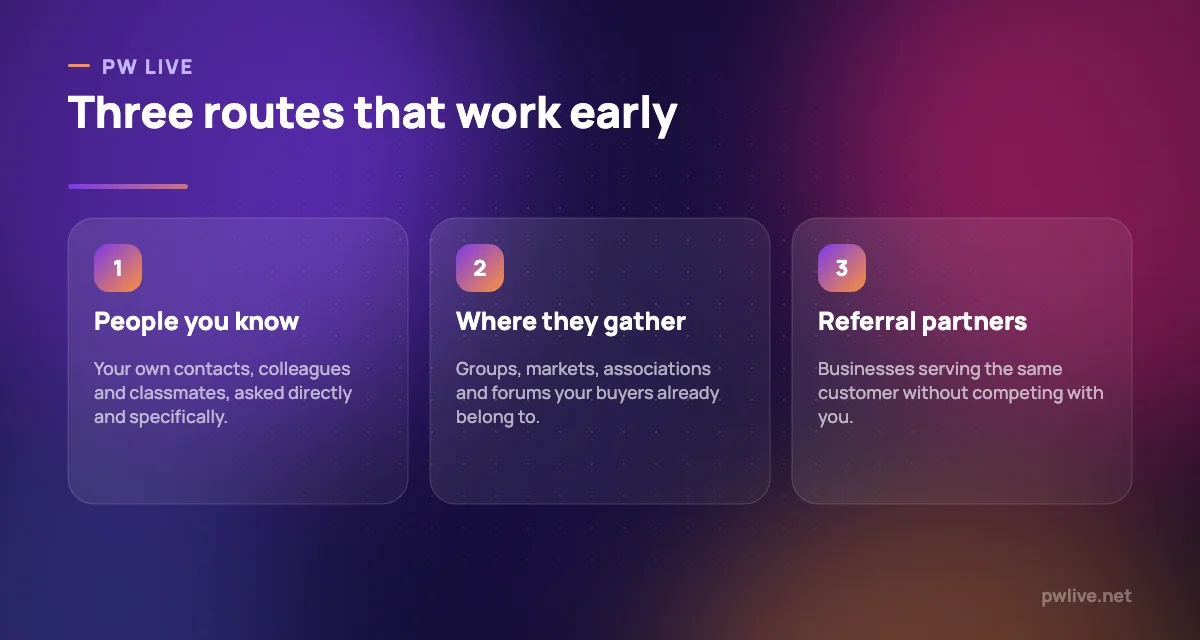
Go where your customers already gather
Alongside your list, spend time in the places your buyers already are. This is slower to pay off but it compounds.
- Local and trade groups. Associations, markets, meetups, WhatsApp and community groups where your buyers discuss their work.
- Online communities. Forums and groups where people post the exact problem you solve. Answer questions thoroughly and publicly, with no pitch. People notice who is genuinely useful.
- Referral partners. Businesses that serve the same customer without competing. A photographer and a printer, an accountant and a lawyer, a tutor and a stationery shop. Offer to send them work first.
One rule keeps this from becoming a waste of time: never join a community only to post about yourself. Contribute for a few weeks before you mention what you sell.
For the online side, social media strategy for small businesses on a small budget explains where to focus limited effort.
Turn each customer into the next two
Every early customer is a source of three things: money, evidence and introductions. Most founders collect only the first.
After each job, do the following while the result is fresh:
- Ask what nearly stopped them buying. That answer improves your offer more than any brainstorm.
- Ask for a written line about the result. Two sentences with a specific outcome is worth more than a paragraph of praise.
- Ask for one introduction. Not “know anyone?” but “who else runs a place like yours nearby?” A specific question gets a specific name.
- Write down what you delivered and what it cost you. By customer ten you will have real data on your margins.
Sellers moving into e-commerce can extend the same approach with our guide to getting your first 100 orders. For the wider set of tactics, browse the marketing and sales archive.
Key takeaways
- The first ten customers come from direct conversations, not from advertising or waiting to be found.
- Build a spreadsheet of fifty named prospects and rank them by how warm they are, not how impressive.
- Short, specific messages with one small ask get replies; long pitches do not.
- Ask how they handle the problem today, because past behaviour predicts buying and future intentions do not.
- Make one offer with one scope, one price and one date, then stop talking.
- Ask every early customer for a written result and one specific introduction.
Frequently asked questions
Do I need a website before I start selling?
No. A clear message, a way to be paid and a document explaining your offer are enough for the first ten. Build the website once you know which words actually convince people, because early customers will hand you that copy.
How many people do I need to contact to get ten customers?
There is no fixed ratio, and it varies enormously by offer and warmth of list. Plan for far more conversations than sales, track your own numbers from the first week, and use your real ratio rather than someone else’s.
Should I offer free work to get started?
Prefer a small paid pilot to free work. Paying customers give honest feedback, show up to meetings and can be asked for referrals, while free users rarely do any of the three.
What if my first ten customers are all friends?
That is fine as a start, but test the offer on at least a few people who owe you nothing. If strangers will not buy at the same price, the friendly sales were about you rather than about the product.
Keep learning with PW Live
Browse every guide in Business & Entrepreneurship, or pick a skill track and follow the roadmap step by step.





Leave a Reply