

Government exam preparation while working full time is not a smaller version of full-time preparation. It is a different problem, and treating it as “the same plan with fewer hours” is why so many working candidates stall after two months.
You have less time, but you also have something full-time aspirants do not: income, a routine that already exists, and no pressure to clear the exam this attempt or nothing. Used properly, those advantages offset a lot of lost hours.
This guide sets out a system built for ninety minutes to three hours a day, with weekends doing the heavy lifting and a structure that absorbs a bad week without collapsing.
Choose one exam and stop browsing notifications
Recruitment exams in India overlap heavily in their syllabus, but not enough that you can prepare for six at once. Pick one primary target, and treat any others as bonus attempts that your main preparation happens to cover.
Choosing well takes an evening, not a month. Look at the role itself and whether you would actually want the job, the eligibility conditions, the broad stages of selection, and how the syllabus matches subjects you are already reasonable at.
Eligibility rules, age criteria, vacancy details, exam stages and fees change with each recruitment cycle and each notification. Read the official notification for the current cycle on the recruiting body’s own website before you build a plan, and check it again when a fresh notification is released. Group forwards and aggregator sites are frequently out of date.
Audit your week before you promise yourself anything
Most failed plans start with a fantasy schedule written on a Sunday. Before designing anything, track one ordinary week: when you actually wake, when you actually reach home, how much energy you actually have at nine at night.
Then count what is genuinely available. For most working candidates it looks something like this:
- 45 to 90 minutes on a weekday morning, before work claims your attention.
- 30 to 60 minutes in the evening, quality depending heavily on the day.
- 20 to 40 minutes of commute, if you travel by public transport.
- Four to six usable hours across a weekend, not twelve.
That is roughly 15 to 20 hours a week. It is enough, over a year, if none of it is wasted on deciding what to study.
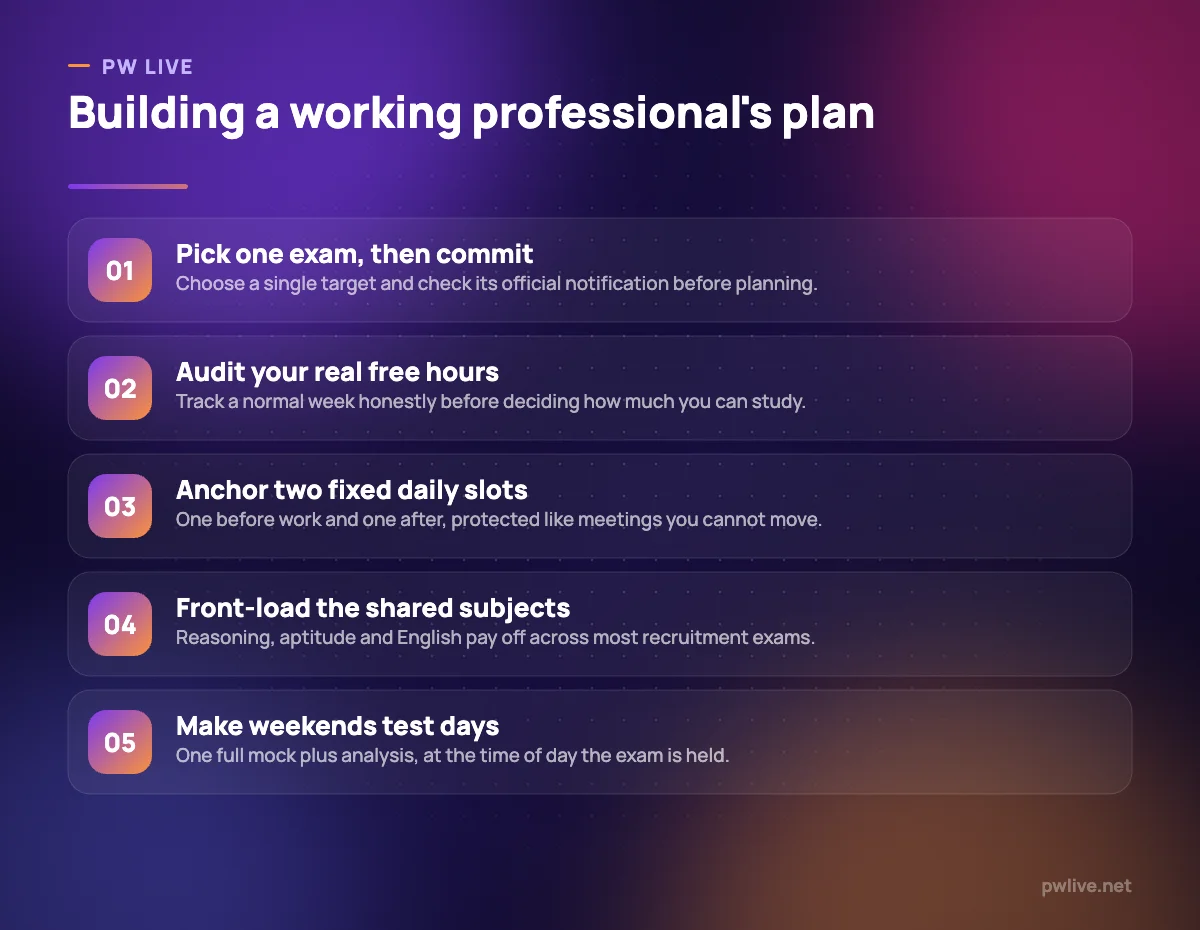
Two fixed slots beat one heroic session
Consistency beats intensity here, because your evenings are unpredictable and your mornings usually are not.
Put the harder, thinking-heavy work in the morning slot: quantitative aptitude, reasoning, anything requiring fresh attention. Put lighter, repeatable work in the evening: current affairs, vocabulary, revision of what you did that morning, or a short set of practice questions.
Protect both slots the way you protect a meeting. Same time, same place, materials already open from the night before, phone in another room.
If evenings collapse regularly because of work, do not fight it. Shift the load to mornings and weekends and accept a shorter evening habit of fifteen minutes. Our guide to managing your energy rather than your time is directly relevant when the hours exist but the attention does not.
Front-load the subjects that appear everywhere
Most recruitment exams share a common core: quantitative aptitude, reasoning ability, English language, and general awareness. Whatever your target, work on that core first, because it transfers across almost every exam you might attempt later.
Within the core, prioritise by return on time:
- Reasoning. Highest score per hour for most candidates, and improvement is fast with daily practice.
- Quantitative aptitude. Slower to build, so start early and practise a little every day rather than in bursts.
- English. Reading comprehension and grammar improve steadily with daily reading and short exercises.
- General awareness. Cheap to maintain daily, expensive to cram, so start the habit immediately.
Exam-specific or technical sections come after the core is stable, unless the notification makes them the dominant part of the paper.
Use commute and dead time properly, not guiltily
Commute time is real study time if you match the activity to the conditions. What it cannot do is replace focused problem solving.
What works while travelling or queueing:
- Revising current affairs notes you wrote earlier.
- Listening to audio explanations of topics you have already studied.
- Flashcard-style recall on vocabulary, static general knowledge or formulas.
- Reviewing your error log from the last mock.
What does not work: attempting new quantitative topics, or timed practice sets. Save those for a desk.
Set this up once so it needs no decisions later. Notes synced to your phone, a small set of cards, and a rule about what you do first when you sit down. If you use a spaced-repetition tool, our guide to spaced repetition explains how to space the reviews so they stay short.
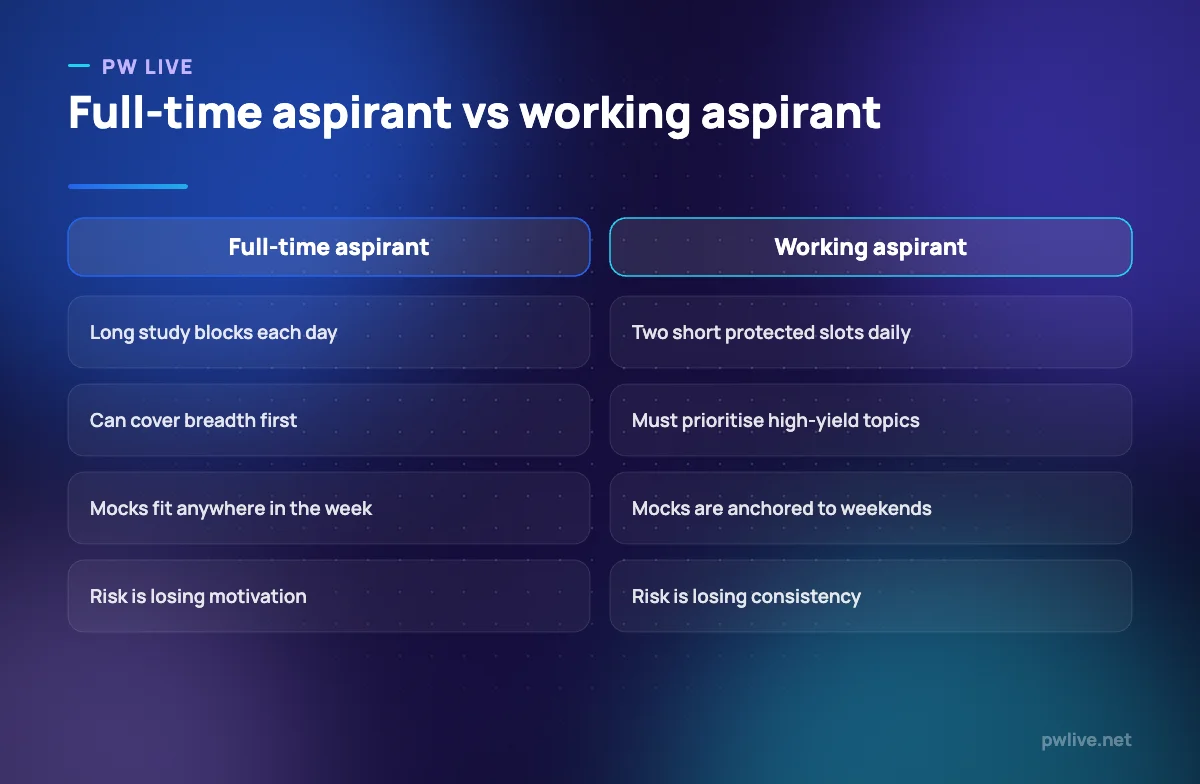
Weekends are for full papers, not catching up
The strongest habit a working candidate can build is a weekly full-length mock, taken at the same time of day the real exam runs, in one sitting, without pauses.
Do it on a Saturday or Sunday morning, then spend at least an hour analysing it. The analysis is where your weekday plan for the next week comes from, so it is not optional. Our method for analysing a mock test properly breaks the process into passes you can finish in ninety minutes.
Since most recruitment exams penalise wrong answers, use mocks to work out your personal attempting threshold rather than guessing under pressure. Our guide to negative marking strategy covers how to decide when a guess is worth it.
Keep one weekend slot free of study entirely. Preparation that runs for a year needs a rest day more than it needs one extra session.
Manage the job, the people and the guilt
Two failure modes catch working aspirants. The first is telling everyone and creating pressure; the second is telling nobody and being unable to protect any time.
A middle path works best. Tell the few people whose cooperation you need, in practical terms: “I study from six to seven thirty on weekday mornings and Saturday mornings.” Specific requests are easy to respect; vague ambitions are not.
At work, protect your evenings by finishing decisively rather than drifting. Learning to say no and protect your study time matters more here than any study technique.
And drop the guilt maths. An hour of genuine focus is worth more than four distracted hours, and comparing your schedule to a full-time aspirant’s is a way of feeling bad rather than a way of scoring more. If deep focus in short windows is the problem, the productivity track has practical routines, and more exam material sits in the exams and admissions section.
Plan for the long game
Most working candidates need more than one attempt, and that is normal rather than a verdict. Build a plan you could sustain for eighteen months, not a sprint that burns out in eight weeks.
Review progress monthly, not daily. Track mock accuracy, topics cleared and consistency of your slots. If two of those three are improving, the plan is working even when the score is flat.
Keep a decision date in mind too. If a year of honest effort has not moved you, that is information about strategy or fit, not about your worth, and there are other routes worth considering.
Key takeaways
- Choose one primary exam and verify the current notification on the official website.
- Audit a real week before designing a schedule; 15 to 20 honest hours is workable.
- Anchor two protected daily slots, harder work in the morning.
- Front-load reasoning, aptitude, English and general awareness, since they transfer across exams.
- Use commute time for revision and recall, never for new topics.
- Take one full mock every weekend and let its analysis set the next week’s plan.
Frequently asked questions
How many hours a day are enough while working full time?
Two to three focused hours on weekdays plus four to six at the weekend is a realistic and sufficient base for most recruitment exams, provided the time is consistent and the weekly mock happens.
Should I quit my job to prepare full time?
Rarely a good first move. Give a structured year of working preparation an honest attempt first, since income removes pressure and most successful working candidates clear exams without resigning.
How do I keep up with current affairs with so little time?
Fifteen minutes daily with one reliable source, plus a running one-page monthly note. Daily contact beats weekend cramming, and the note is what you revise before the exam.
Where do I confirm eligibility, vacancies and exam stages?
Only in the official notification published by the recruiting body for the current cycle. These details change between cycles, so verify them yourself rather than relying on forwarded messages.
Keep learning with PW Live
Browse every guide in Exams & Admissions, or pick a skill track and follow the roadmap step by step.





Leave a Reply