

You can practise something for years and stay exactly where you started. Anyone who has driven for a decade without becoming a better driver, or solved a hundred practice questions without their score moving, has met this problem directly.
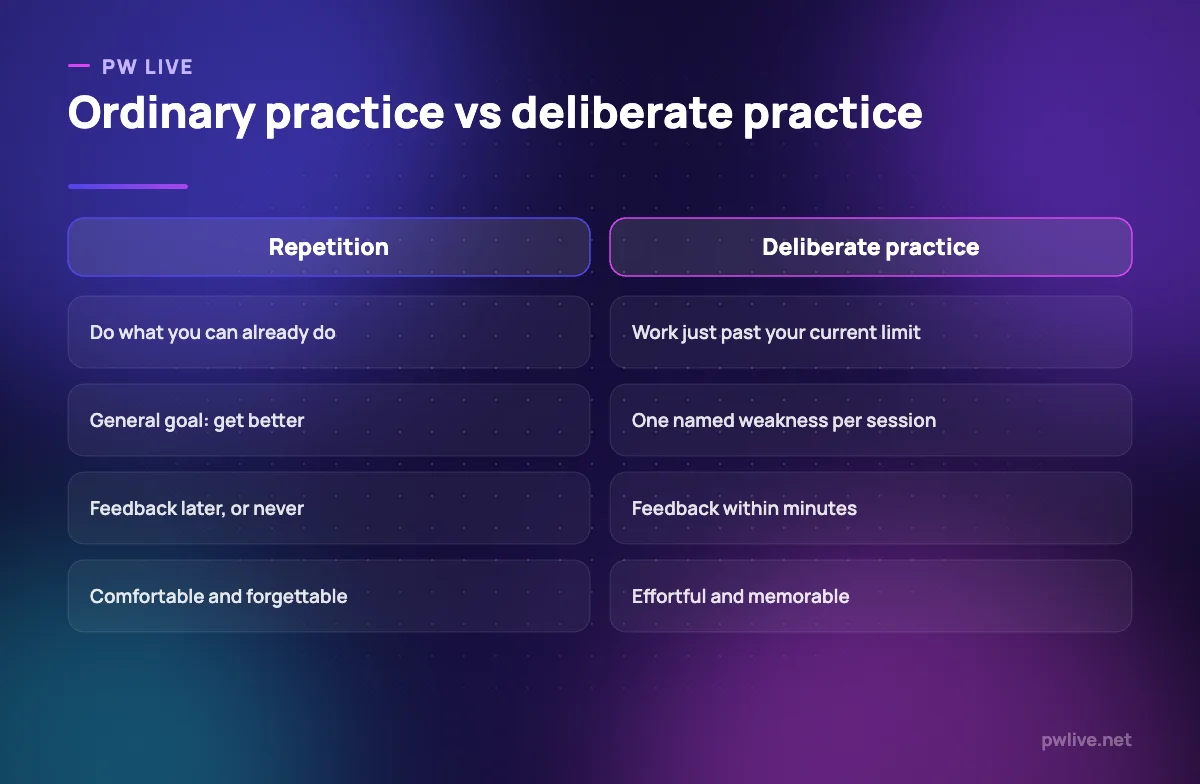
Deliberate practice is the answer to it. It is a specific way of working that produces improvement, as opposed to repetition, which mostly produces comfort.
The distinction matters because the two feel similar while you are doing them, and only one of them changes what you are capable of.
What deliberate practice actually means
The term comes from research into how people reach high levels of performance in demanding fields. The core finding is easy to state: experts do not simply accumulate more hours than everyone else, they spend their hours differently.
Deliberate practice has a particular shape. You work on a specific component of the skill, at a difficulty just beyond your current ability, with feedback that arrives quickly enough to change your next attempt, and you repeat with adjustments.
Everything else, including the popular idea that a fixed number of hours produces mastery, is a distraction. Hours are the container, not the mechanism.
Why repetition stops working
When you first learn something, every step requires attention. With repetition, the skill becomes automatic, which is genuinely useful because it frees up mental space.
The catch is that automatic performance does not improve. Once your brain has a workable routine, it stops looking for a better one, and further repetition simply reinforces whatever you are already doing, including the errors.
This shows up everywhere:
- The student who re-reads notes and re-solves questions they already get right
- The programmer who writes the same kind of code for years and never reads anyone else’s
- The presenter who gives the same talk repeatedly without ever watching a recording of it
- The writer who publishes weekly and never edits anything twice
Comfort is the warning sign. If practice feels smooth, you are performing, not improving.
The four ingredients
Every genuinely effective practice session has these four things. Missing any one of them explains most plateaus.
- A specific target. Not “get better at maths” but “stop making sign errors when rearranging equations”. One target per session.
- Difficulty just past your limit. Hard enough that you fail sometimes, easy enough that you can tell why. Constant success means you have set the bar too low; constant failure means it is too high to learn from.
- Fast, honest feedback. You need to know whether the attempt was right before the next attempt, and the feedback must be capable of telling you that you were wrong.
- Adjustment. Feedback you do not act on is trivia. Each repetition should differ from the last in one deliberate way.
The fourth is the one most people skip. They repeat, receive feedback, feel bad, and then repeat identically.
How to design a 45-minute practice session
Structure beats motivation. Use the same shape each time.
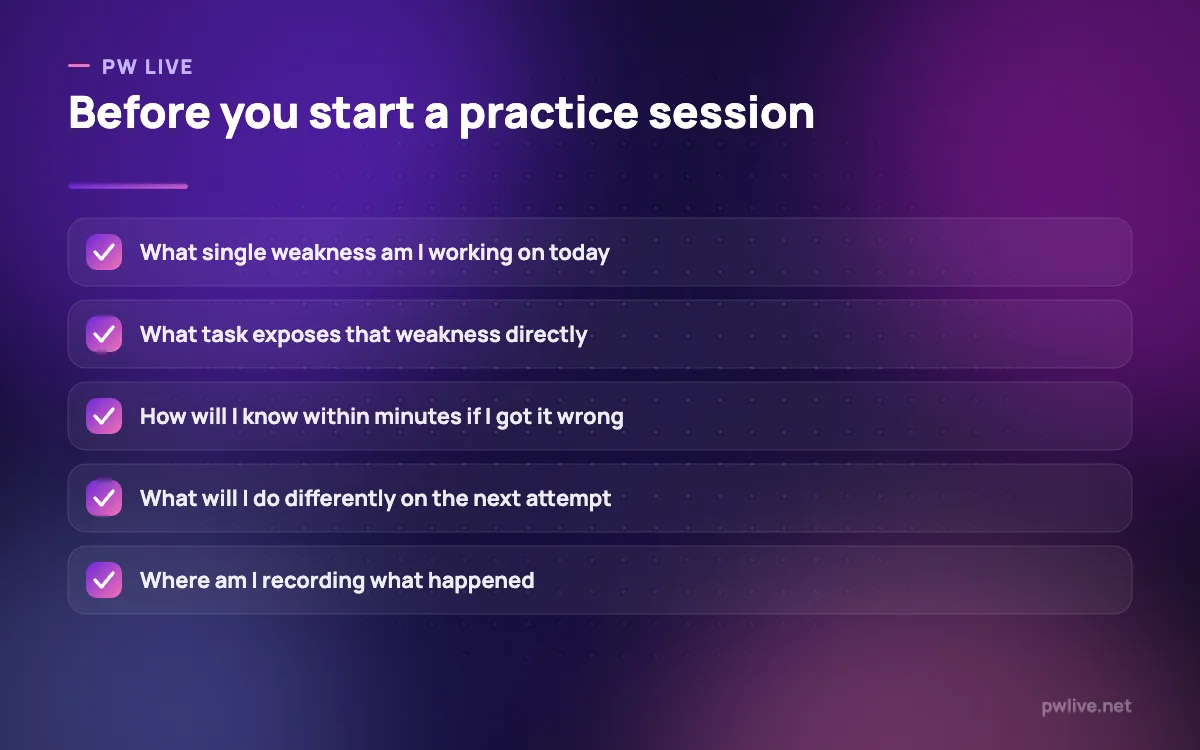
- 5 minutes: choose the weakness. Look at your last session’s notes and pick one thing that went wrong.
- 5 minutes: warm up on something you can already do, to get into the skill.
- 25 minutes: focused attempts. Work only on the chosen weakness, repeating the difficult part rather than the whole task. Musicians drill four bars, not the whole piece. Apply the same logic to a proof, a paragraph, a function or the opening of an answer.
- 10 minutes: review. Compare your work against a strong example or a rubric, write down one thing to change, and note it for next time.
Notice how little of this is new material. Deliberate practice is mostly re-working things you have already met, at higher standards.
Where feedback comes from when you practise alone
Most people practise without a coach. That is workable, provided you build feedback into the task itself.
- Self-marking against a model answer, comparing line by line rather than just checking the final result
- Recording yourself for anything spoken, then watching it once for content and once for delivery
- Automated checks such as tests, compilers and grammar tools for the mechanical layer
- Structured error logs, where you write the mistake and its cause rather than just the correct answer
For exam preparation, the highest-value feedback loop is a properly analysed mock test rather than another attempted paper. Our guide on how to analyse a mock test sets out that process, and the exam strategy track applies the same principle across subjects.
What it looks like in different skills
The four ingredients stay constant; the tasks change.
- Studying: stop re-reading and start testing yourself, then practise only the questions you got wrong, using active recall and scheduled review through spaced repetition.
- Coding: rewrite a working solution three ways, read code better than yours, and fix a bug in an unfamiliar codebase.
- Writing: rewrite one paragraph five times with different constraints, or edit an old piece rather than starting a new one.
- Speaking: rehearse only the opening and the transitions, which is where most talks fail, with the drills in the communication skills track.
- Design: recreate work you admire closely, then articulate why each choice was made.
Making it sustainable
Deliberate practice is tiring, which is why nobody does it all day. Treat it as a concentrated portion of your time rather than a new standard for every working hour.
A realistic split for most people is three to five focused sessions a week, with everything else being ordinary practice and normal work. That is enough to keep moving without burning out.
Two habits keep it going. First, log every session in one line, because visible progress is what sustains effort when the work is hard. Our guide to tracking your skill progress covers formats that survive a busy month. Second, separate practice from performance. Real work is not the place to experiment, so give experimentation its own protected slot, alongside the wider study techniques in the education category.
Key takeaways
- Repetition makes a skill automatic; only deliberate practice makes it better.
- Every effective session needs a specific target, edge-of-ability difficulty, fast feedback and adjustment.
- Comfort during practice is a sign you are performing rather than improving.
- Drill the difficult fragment, not the whole task, then review against a strong example.
- Build your own feedback when you have no coach: model answers, recordings, tests, error logs.
- Three to five focused sessions a week is enough; the rest can be ordinary practice.
Frequently asked questions
How long should a deliberate practice session be?
Between 30 and 60 minutes for most people. Concentration at the edge of your ability drops sharply after that, and a tired hour tends to reinforce old habits.
Is deliberate practice the same as just studying harder?
No. Studying harder usually means more hours on the same material, while deliberate practice means fewer hours aimed precisely at what you cannot yet do.
Can I use it for soft skills like communication?
Yes, though feedback is slower. Record yourself, ask one person for a specific critique after a meeting, and practise a single element such as opening a conversation or handling an objection.
What if I do not know what my weaknesses are?
Take a test or attempt a real task at full difficulty and note every point where you slowed down, guessed or looked something up. That list is your practice agenda for the next month.
Keep learning with PW Live
Browse every guide in Skills Development, or pick a skill track and follow the roadmap step by step.





Leave a Reply