

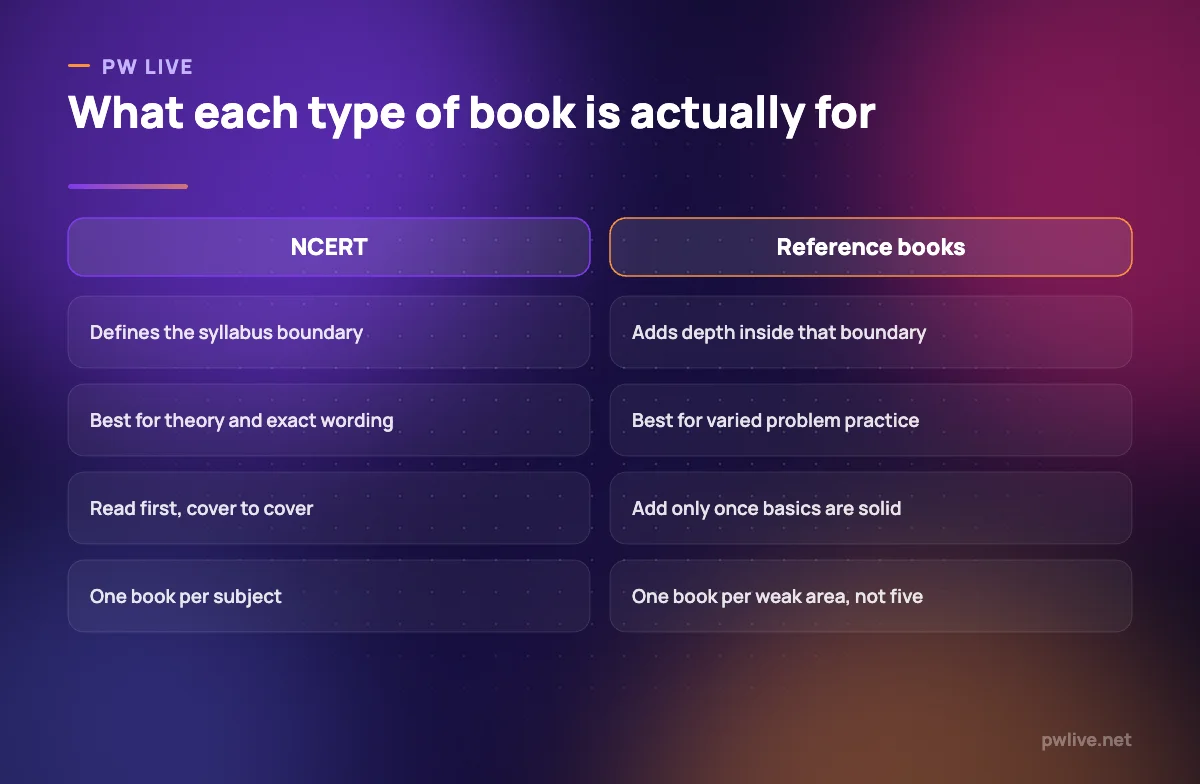
The NCERT vs reference books argument costs students more time than almost any other preparation question, and it is usually framed wrongly. These are not two competing options. They do two different jobs, and the mistake is using one for the other’s work.
Walk into any bookshop before an exam season and you will see aspirants buying four thick reference books for a subject they have not finished the textbook in. Six months later, most of those books are unopened past chapter three.
This guide explains what each type of book is genuinely good at, how to decide when you are ready to add a reference, and how to avoid the collection habit that quietly eats your study hours.
What NCERT textbooks are actually good at
NCERT books define the boundary. For most national entrance exams in India, the prescribed syllabus is anchored to the school curriculum, which means the textbook tells you what is inside the fence and, just as usefully, what is outside it.
They are also written tightly. The theory is compressed, the definitions are careful and the diagrams are the ones that turn up again and again in question papers.
Three things NCERT does better than any reference book:
- Exact statements. Definitions, laws and standard results in the wording examiners expect.
- Coverage discipline. It stops you from studying material nobody will ask you about.
- Speed of revision. A chapter you have annotated can be re-read in twenty minutes; a reference chapter cannot.
For biology and inorganic chemistry in particular, the textbook is not a starting point you graduate from. It is the primary source you keep returning to, including in the final weeks.
What NCERT does not do for you
The textbook is thin on practice. It gives you the idea and a handful of questions, then stops well short of the variety a competitive paper throws at you.
Physics and mathematics are the clearest cases. You can understand every line of a chapter on rotational motion and still be unable to solve a multi-step problem, because problem solving is a separate skill built by volume and exposure.
The textbook also rarely shows you multiple solution routes, standard traps, or the shortcuts experienced solvers use under time pressure. That is exactly the gap a good reference book fills.
How to know you are ready for a reference book
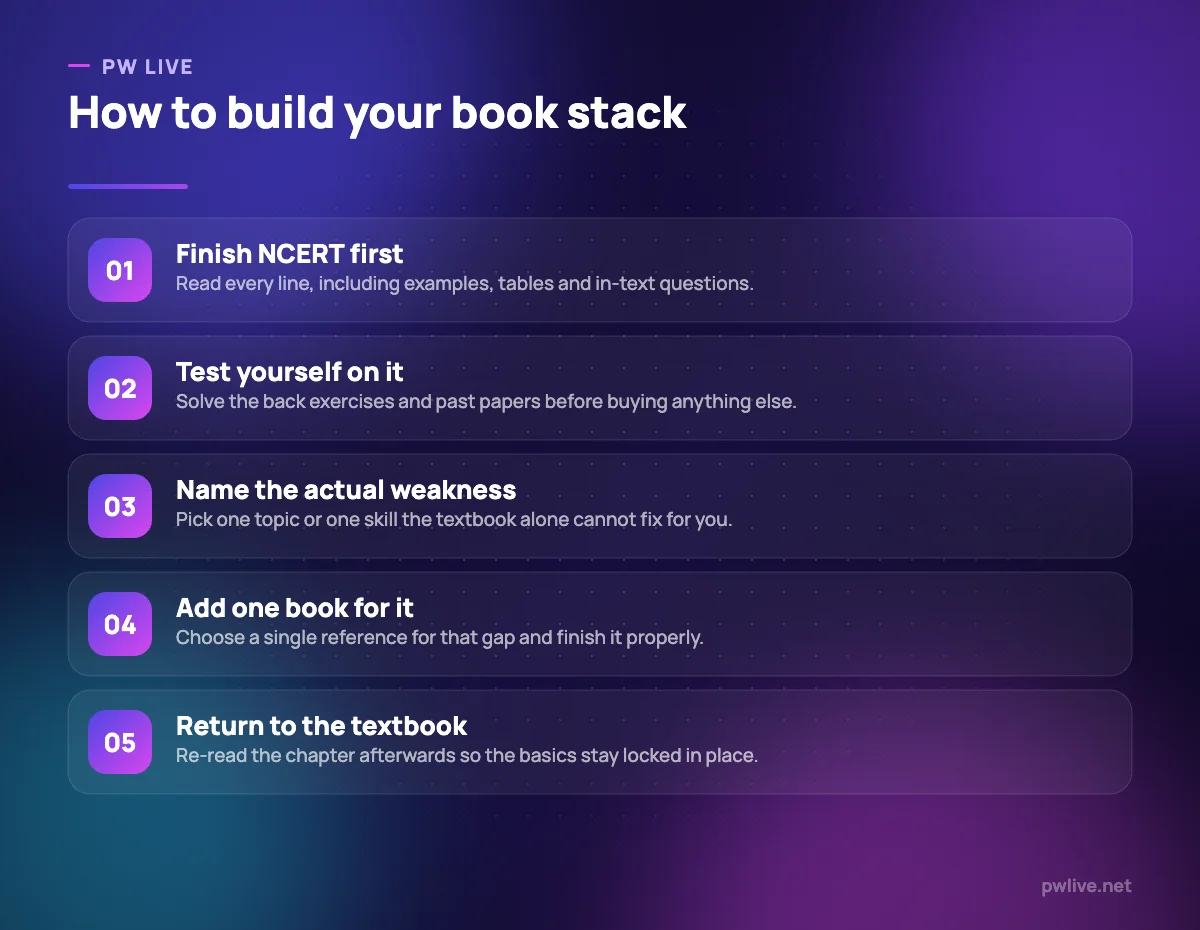
The test is simple and it is not about how many days you have studied. Ask yourself whether you can do this, chapter by chapter:
- Explain the main concepts of the chapter aloud without opening the book.
- Solve every in-text example and back exercise question unaided.
- Get most of the past-paper questions from that chapter right, and understand the ones you missed.
If you can, a reference book will now teach you something new. If you cannot, it will mostly confuse you, because you will be reading harder explanations of ideas you have not yet secured.
This is why so many students feel a reference book is “too hard”. Often it is not too hard, it is just too early. Testing yourself first is the honest way to find out, and the same principle sits behind active recall as a study technique.
Choosing a reference book without collecting five
Pick books by the gap, not by reputation. Before buying anything, finish this sentence: “I need a book because I cannot ___.”
Common honest answers, and what they point to:
- “I cannot solve unfamiliar problems” — a problem book with graded difficulty and full solutions.
- “I cannot follow the derivations” — a theory-heavy text that works through the mathematics slowly.
- “I cannot remember reactions or facts” — not a book at all, but a better revision system.
- “I cannot finish papers in time” — not a book either, but mock practice and proper analysis of each paper.
Two rules keep the stack sane. One book per subject per purpose, and no new book bought in the last two months before the exam. A half-finished third reference is worth less than a fully solved first one.
When you evaluate a title, look for solutions that explain reasoning rather than just printing the answer, question difficulty that climbs gradually, and a chapter order that matches your syllabus. That is the same filter we suggest for judging any study material in our guide to learning from free resources without getting lost.
Subject by subject: where the balance sits
The right mix is not identical across subjects, and treating them the same is a common error.
Biology. Weighted heavily towards the textbook. Read it line by line, including tables, captions and boxed material. References are best used for question practice and for clarifying a small number of stubborn topics.
Chemistry. Split it. Inorganic chemistry leans on the textbook, where the facts and trends live. Physical chemistry needs numerical practice from a problem source. Organic chemistry needs mechanism understanding from the textbook and then heavy reaction practice elsewhere.
Physics. The textbook establishes the concepts, but you will not build solving speed without an external problem set. This is the subject where a reference earns its place earliest.
Mathematics. Similar to physics. Practice volume matters more here than reading volume, so choose a problem book with a wide difficulty range and work through it rather than sampling it.
Read a book once, use your notes many times
Whichever books you use, they are not your revision material. Your notes are.
A reference book cannot be revised in the final month; it is too long. What you revise is the condensed version you made while reading it, which is why a running formula and revision notebook matters more than the shelf behind you.
Annotate the textbook lightly as you read, then transfer only what surprised you into your own notes. Our guide to taking notes you will actually revise covers the format in detail.
Common mistakes that waste months
- Buying before finishing. Ordering a reference in week one, then reading neither book properly.
- Reading in parallel. Alternating between two treatments of the same topic and absorbing neither.
- Chasing recommendations. Switching books because a senior or a video suggested a different one.
- Skipping the textbook because it seems easy. Easy to read is not the same as fully known, and the difference shows up in the exam hall.
- Using books as a substitute for practice. Reading feels productive. Solving questions is what actually moves your score.
If you are still deciding how much external structure you need overall, our comparison of self-study and coaching is a useful companion piece, and you will find more study material in the education section. For a broader framework on paper technique and planning, see the exam strategy track.
Finally, always confirm the current prescribed syllabus and any changes to it on the official exam authority’s website rather than relying on a book’s cover claim or a forum post.
Key takeaways
- NCERT defines the syllabus boundary; reference books add depth inside it.
- Do not buy a reference until you can solve the textbook’s own questions unaided.
- Choose a book to close a specific named gap, not because it is popular.
- Biology and inorganic chemistry stay textbook-led; physics and mathematics need external problem practice earliest.
- One book per subject per purpose, and no new books in the final two months.
- Your notes, not your books, are what you revise at the end.
Frequently asked questions
Is NCERT enough on its own for JEE or NEET?
For fact-heavy subjects like biology and inorganic chemistry it carries most of the load. For physics and mathematics you will almost always need additional problem practice beyond the textbook.
Should I read the textbook again after finishing a reference book?
Yes, and it takes less time than you expect. A quick re-read after harder material often makes the basics click properly and catches details you skimmed the first time.
How many reference books should I use per subject?
Generally one, occasionally two if they serve clearly different purposes such as theory and problems. Finishing one book beats sampling four.
Where should I check what is actually in the syllabus?
On the official exam authority’s website, which publishes the current syllabus and any revisions. Book covers and coaching lists can lag behind changes, so verify before you plan around them.
Keep learning with PW Live
Browse every guide in Exams & Admissions, or pick a skill track and follow the roadmap step by step.





Leave a Reply