

Choosing between mutual funds and fixed deposits is one of the first real money decisions most people face, usually the moment a salary starts arriving. The comparison is often framed as safe versus risky, which is too crude to be useful.
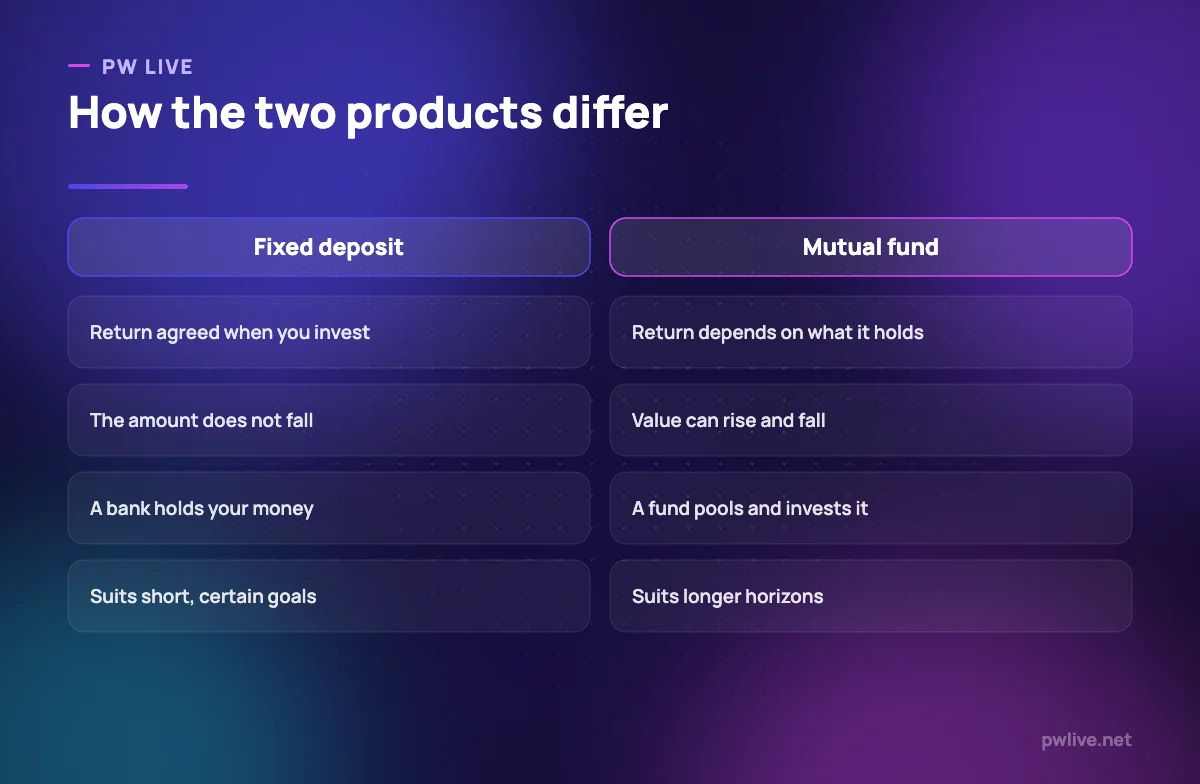
They are different kinds of product doing different jobs. A fixed deposit is a loan you make to a bank on agreed terms. A mutual fund is a pooled vehicle that buys assets on your behalf, and what you get back depends on what those assets do. Neither is better in the abstract. What matters is the goal you are matching it to.
This article is general educational information, not personalised financial advice. Product features, rates, charges and tax rules change, so verify current details with the provider or an official source, and consult a qualified adviser before deciding.
What a fixed deposit actually is
You give a bank a sum for a set period. The bank agrees a rate at the start and returns your money with interest at the end. The rate you are offered is fixed for your deposit even if rates in the wider market move afterwards.
The appeal is certainty. You know the maturity amount when you start, and the balance does not fluctuate along the way.
The trade-offs are worth knowing. Breaking a deposit early usually carries a penalty. Deposits at scheduled banks in India carry deposit insurance, but only up to a limit set by the regulator, and that limit changes over time. And the interest is taxable in a way that can differ from other products, which affects what you actually keep.
What a mutual fund actually is
A mutual fund collects money from many investors and buys a portfolio of assets with it. What it buys depends on its stated mandate: some hold shares, some hold bonds and other debt instruments, some hold a mix, and some simply track an index.
You own units, and the value of a unit moves with the value of what the fund holds. There is no promised return. A fund can be up over one period and down over another, and past performance is not a forecast.
In exchange for that uncertainty, funds give you diversification, professional management and, for equity funds over long periods, exposure to the growth of the businesses they hold. They also charge for it, through an expense ratio deducted from the fund, and sometimes through exit charges if you leave early.
Match the product to the time horizon
The single most useful question is when you need the money.
- Within a year or two. Certainty matters more than return, because there is no time to recover from a fall. Deposits, savings accounts and other stable options suit this. Your emergency fund belongs firmly in this bucket.
- Three to five years. A middle zone. Some people use a mix, or debt-oriented funds, accepting mild fluctuation for the chance of a better outcome.
- Beyond five to seven years. Time becomes an ally. Longer horizons let equity-oriented investments ride out downturns, which is the reason they are commonly used for retirement or a child’s higher education.
Working backwards from the goal is far more reliable than picking a product first and then finding a use for it. Our guide to setting money goals you will stick to covers how to define those horizons properly.
Risk is not just the chance of loss
People treat fixed deposits as risk-free. They are free of one risk, not all of them.
- Market risk is the risk that your investment falls in value. Funds carry it; deposits do not.
- Inflation risk is the risk that your money buys less over time even though the number went up. If prices rise faster than the interest you earn, you have lost purchasing power quietly.
- Reinvestment risk applies when a deposit matures and the rates available then are lower than the one you had.
- Behavioural risk is the risk that you sell a fund at the worst moment because you did not expect the fall.
Certainty over one year and certainty over twenty years are very different things. Choosing only for the absence of fluctuation can be its own long-term cost.

Access, lock-ins and how you get your money out
Check the exit before you enter.
Most open-ended mutual funds let you redeem on any business day, with the money reaching your account after a settlement period. Some fund categories carry a lock-in, and some charge an exit load if you leave within a short window. Certain tax-linked schemes lock money for a fixed number of years by design.
Deposits are available before maturity in most cases, but usually with a penalty on the rate. Some are structured with no premature withdrawal at all.
Neither is a problem. Being surprised by it is.
Cost and tax change the outcome
Two products with similar headline returns can leave you with different amounts.
Look at three things. Charges: a fund’s expense ratio is deducted from returns every year, so a small percentage difference matters over long periods. Exit costs: penalties and loads bite exactly when you need flexibility. Tax: interest and capital gains are not taxed identically, holding periods can matter, and the rules are revised from time to time.
Do not carry the tax rules you read in an old article into a decision today. Check the current position on an official source before you invest, and read our income tax basics for first-time earners for how the pieces fit together.
A practical way to decide
- Name the goal and the date. “House deposit in four years” is a decision you can act on; “investing” is not.
- Decide how much fluctuation that specific goal can tolerate.
- Shortlist product categories that fit, not individual products.
- Read the documentation for charges, lock-ins and exit rules.
- Check how the returns will be taxed in your situation.
- Start, then review at a set interval rather than on every headline.
Most people end up using both, for different jobs. A deposit or savings account for the near-term and emergency money, and market-linked investments for goals far enough away to justify the ride. If you are starting from scratch, personal finance for students is a gentler entry point, the finance category collects the rest, and the personal finance skill track walks through the basics in order.
Key takeaways
- A fixed deposit is a loan to a bank with agreed terms; a mutual fund buys assets on your behalf with no promised return.
- The time until you need the money should drive the choice more than any comparison of headline returns.
- Avoiding fluctuation is not the same as avoiding risk, because inflation erodes stable money quietly.
- Charges, lock-ins, exit rules and tax treatment can change the outcome significantly.
- Rates, limits and tax rules change, so verify current details from official sources rather than from any article.
- Using both, for different goals, is normal rather than a compromise.
Frequently asked questions
Are mutual funds safe?
They are regulated, but they are not guaranteed. The value of your units moves with the assets the fund holds, so it can fall as well as rise, and different fund categories carry very different levels of fluctuation.
Can I lose money in a fixed deposit?
The deposited amount with a scheduled bank is protected up to a regulator-set insurance limit, so outright loss is unusual. The more common risk is that inflation and tax leave you with less buying power than you started with.
Which gives better returns?
Over long periods, equity-oriented funds have historically been used for growth while deposits have been used for stability, but no product’s future return can be promised. Compare them against your own goal and horizon rather than against each other.
Should a beginner start with one or use both?
Many people keep near-term and emergency money in stable options while investing longer-term money for growth. The split depends on your income stability, goals and comfort with fluctuation, which is a good conversation to have with a qualified adviser.
Keep learning with PW Live
Browse every guide in Finance & Investing, or pick a skill track and follow the roadmap step by step.





Leave a Reply