

From the outside, digital marketing looks like a dozen unrelated jobs: running ads, writing posts, staring at dashboards. Underneath, it is one discipline built on a few ideas that barely change, even as the tools do.
This roadmap covers those ideas in the order a beginner should learn them: what each channel is for, which skills to build first, how to tell whether anything is working, and how to spend your first three months so you finish with proof of ability.
What digital marketing actually is
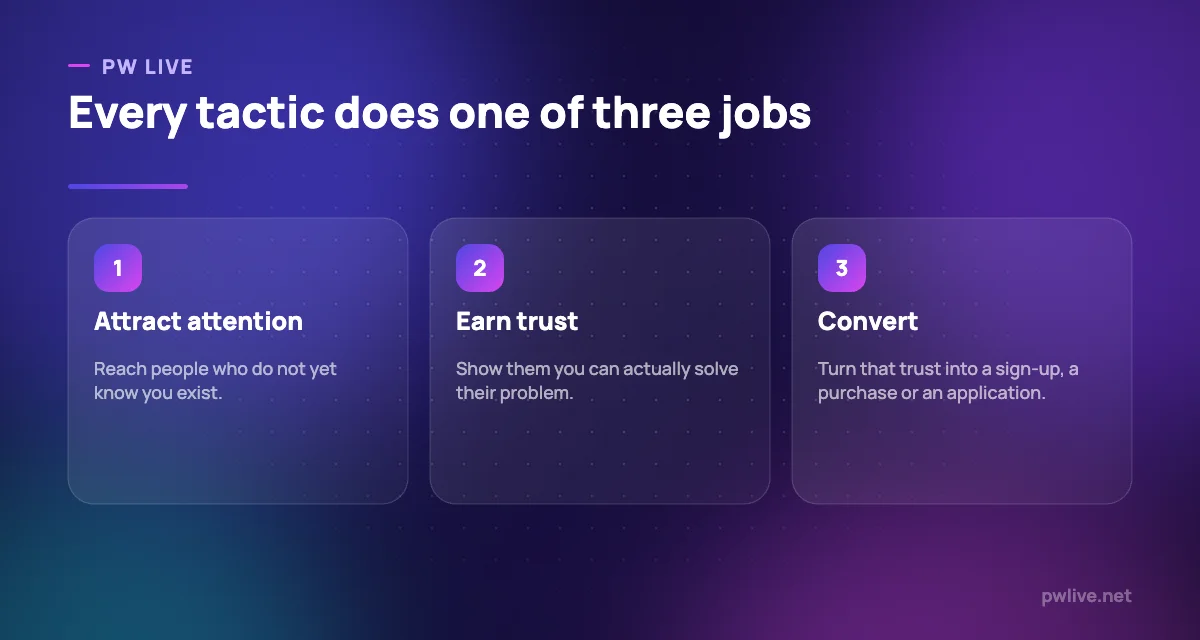
Strip away the jargon and digital marketing is reaching the right people, at the right moment, with a message that moves them to act. Every tactic does one or more of three jobs:
- Attract attention from people who do not yet know you exist.
- Earn trust so they believe you can solve their problem.
- Convert that trust into an action: a sign-up, a purchase, an application.
When you meet a new channel or trend, ask which job it does and for whom. That stops you chasing tactics that look impressive but move nothing.
The core channels and what each one is for
- Search. Organic search (SEO) and paid search capture demand that already exists; people arrive with intent typed into a box. It rewards good pages, clear site structure and content that answers the question best.
- Content. Articles, videos and guides people actually want. Content feeds every other channel: something for search to rank, social to share and email to send.
- Social media. Built for attention and conversation, not closing sales. Treat follower counts as a weak signal and engagement quality as a stronger one.
- Email and messaging. Owned channels with no algorithm in between, where trust deepens and most conversions are nudged over the line. A small engaged list beats a large indifferent one.
- Paid advertising. Buys reach quickly. It is the fastest way to test a message and the fastest way to burn a budget. Learn it last.
The funnel: one model to organise everything
Marketers use the funnel to describe how strangers become customers:
- Awareness: they learn you exist.
- Consideration: they compare you with alternatives.
- Conversion: they take the action you wanted.
- Retention: they come back, or tell others.
Map every channel and piece of content to a stage: a post explaining a problem serves awareness, a comparison page consideration, a checkout reminder conversion, a newsletter retention. Once you can see the funnel, gaps become obvious.
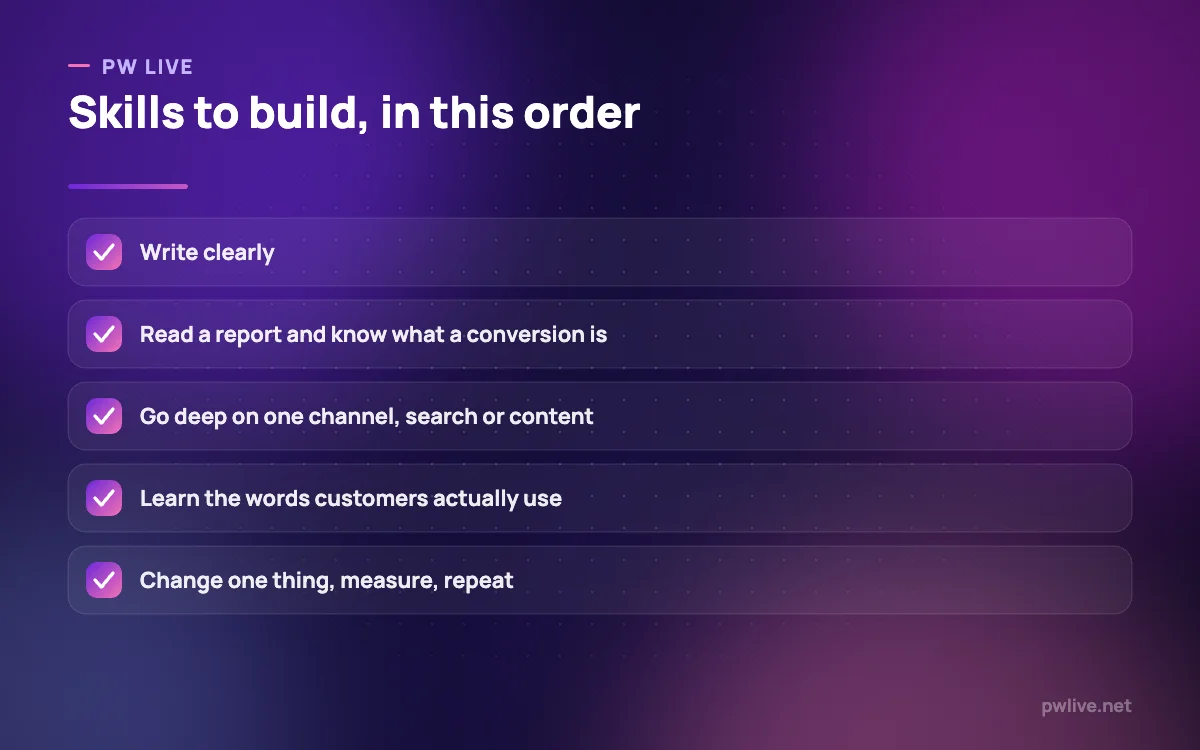
Skills to build first, in this order
Tools change every year; these skills transfer.
- Clear writing. Every channel runs on words. If you can explain something simply, you can market it. Start with the communication skills page.
- Analytics literacy. Read a report, know what a conversion is, and tell a metric moving from a metric mattering.
- One channel in depth. Pick search or content first. Both compound and teach you how audiences behave.
- Customer understanding. Read reviews and forum threads, talk to people, and note the exact words customers use.
- A testing mindset. Form a hypothesis, change one thing, measure, repeat.
AI assistants now handle much of the mechanical work. Use them to move faster, but spend your learning time on judgment, which they cannot replace.
A 90-day beginner roadmap
An illustrative plan; adapt the days to your schedule.
Days 1 to 30: learn and observe
- Study one channel’s fundamentals using free platform documentation and a structured path such as the digital marketing skill page.
- Reverse-engineer three brands you admire: where do they get attention, what earns trust, what asks for action?
- Keep a swipe file of headlines and ads that made you act.
Days 31 to 60: build something
- Choose a small project: a niche blog, a newsletter, or a product page for a friend’s business.
- Publish weekly. The goal is reps, not reach.
- Set up basic analytics from day one.
Days 61 to 90: run a real experiment
- Form one hypothesis. For example: a headline that names the reader’s problem will get more clicks than a clever one.
- Run the test, record the result honestly, and write up what you learned. That write-up is your first portfolio case study.
Metrics that matter, and mistakes to avoid
Three kinds of numbers:
- Reach (impressions, followers, views) says people saw something. Easy to inflate.
- Engagement (click-through rate, time on page, replies) says people cared.
- Outcomes (leads, sign-ups, sales, cost per result) say whether the work paid off.
Report on outcomes; use the others to diagnose them.
The most common beginner mistakes are learning a tool before the principle it automates, trying to be on every platform at once, publishing with no measurement, and copying a big brand’s tactic with a different budget. For more, follow the marketing category.
Key takeaways
- Digital marketing has three jobs: attract, earn trust, convert.
- Learn the funnel, then map every channel and piece of content to a stage.
- Build writing, analytics and customer understanding before touching paid ads.
- Go deep on one channel; search and content compound best.
- Finish your first 90 days with a real experiment and a written case study, and judge yourself on outcomes, not reach.
Frequently asked questions
Do I need a degree to work in digital marketing?
No. Employers and clients care about demonstrated results; one or two honest case studies usually outweigh a certificate with no work behind it.
Which channel should a complete beginner start with?
Search or content. Both force you to understand what your audience wants, and the skills carry over to every other channel.
How long before I can freelance or apply for a role?
It varies, but a focused three months ending in a real project with measurable results is a realistic starting point for entry-level roles or small freelance work.
Keep learning with PW Live
Browse every guide in Marketing & Sales, or pick a skill track and follow the roadmap step by step.





Leave a Reply