

A social media strategy for small business does not need a budget, an agency or a full-time person. It needs one platform, a repeatable content rhythm and the patience to keep going past the quiet first months.
The trap most small businesses fall into is presence without purpose: five profiles, all half-updated, none producing an enquiry. That is worse than one page that actually works.
This is a plan you can run yourself in a few hours a week, with a phone, a free design tool and no paid promotion until you have something proven to promote.
Decide what social media is actually for
Before choosing a platform, decide which job you are hiring social media to do. The honest answers are usually one of three.
- Discovery: reaching people who have never heard of you.
- Proof: convincing people who found you elsewhere that you are real and good at this.
- Retention: staying present for past customers so they return and refer.
Most small businesses need proof far more than discovery. A prospect who got your name from a friend will check your page before calling. If it is empty or six months stale, you have lost a sale you already earned.
That single realisation changes what you post. Proof content is easier to make than viral content, and it converts better.
Choose one platform and go deep
Pick the platform where your customers already spend time and where your work shows well. A tailor or a bakery needs images. A B2B consultant needs text and professional context. A local service business may find more value in a well-maintained maps listing than in any feed.
Run this test before committing:
- Search your category and city on the platform. Are customers actually discussing it there?
- Look at three competitors. Are they getting real comments and questions, or silence?
- Ask five recent customers where they looked you up. Believe their answers over your assumptions.
- Ask yourself which format you can sustain: photos, video, or writing.
Then commit to one platform for at least six months. A second platform is only worth adding when the first runs on its own.
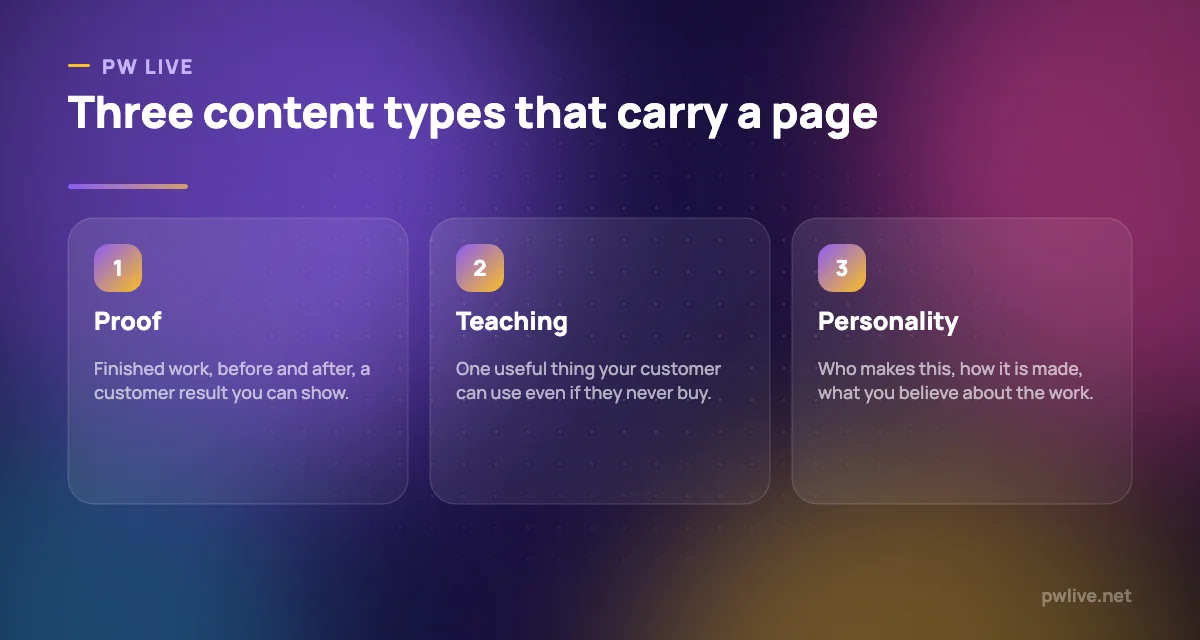
Build a content system, not a content calendar
Elaborate calendars collapse in week three. A system survives because it removes decisions.
Pick three recurring formats and rotate them. For example: a finished piece of work on Monday, a short teaching post on Wednesday, a behind-the-scenes or customer question on Friday. Once the slots are fixed, you are only ever answering “which example this week”, never “what should I post”.
Then batch the work. Set aside two hours once a week to shoot, write and schedule everything. Posting live, daily, from your phone is how small business owners burn out on social media.
Ideas come from the same place every time: questions customers actually ask. Keep a running note on your phone, add to it after every call, and you will have a year of content within a month.
Make good content with a phone and free tools
Production quality matters less than clarity and consistency, but basic competence still helps.
- Shoot near a window, with the light on your subject rather than behind it.
- Keep backgrounds plain. Clutter reads as unprofessional even when the work is excellent.
- Hold the phone steady, or brace it against something. Shaky footage is the most common avoidable flaw.
- Write captions assuming the sound is off. Most feeds play silently.
- Use one consistent set of two or three fonts and colours so your posts are recognisable in a scroll.
Our practical guide to taking good product photos with a phone covers the shooting side properly, and free design tools for students and small businesses covers the layout and template side without any subscription.
Write posts that stop the scroll honestly
The first line is the whole battle. It should say something specific enough that the right person stops and the wrong person scrolls past, which is exactly what you want.
Compare “We offer quality tailoring services” with “The three measurements people get wrong when ordering a shirt online.” One is a claim, the other is a reason to stay.
A structure that works for most text-led posts:
- A specific opening line that names a problem or a surprising detail.
- Two to five short lines that deliver something genuinely useful.
- One clear closing line: a question, or a simple next step.
Avoid engagement bait, fake giveaways, follow-for-follow schemes and bought followers. Platforms actively suppress that behaviour, and a follower count that never buys anything is a number you cannot spend. The writing principles in our guide to content people actually read and share transfer directly to captions.
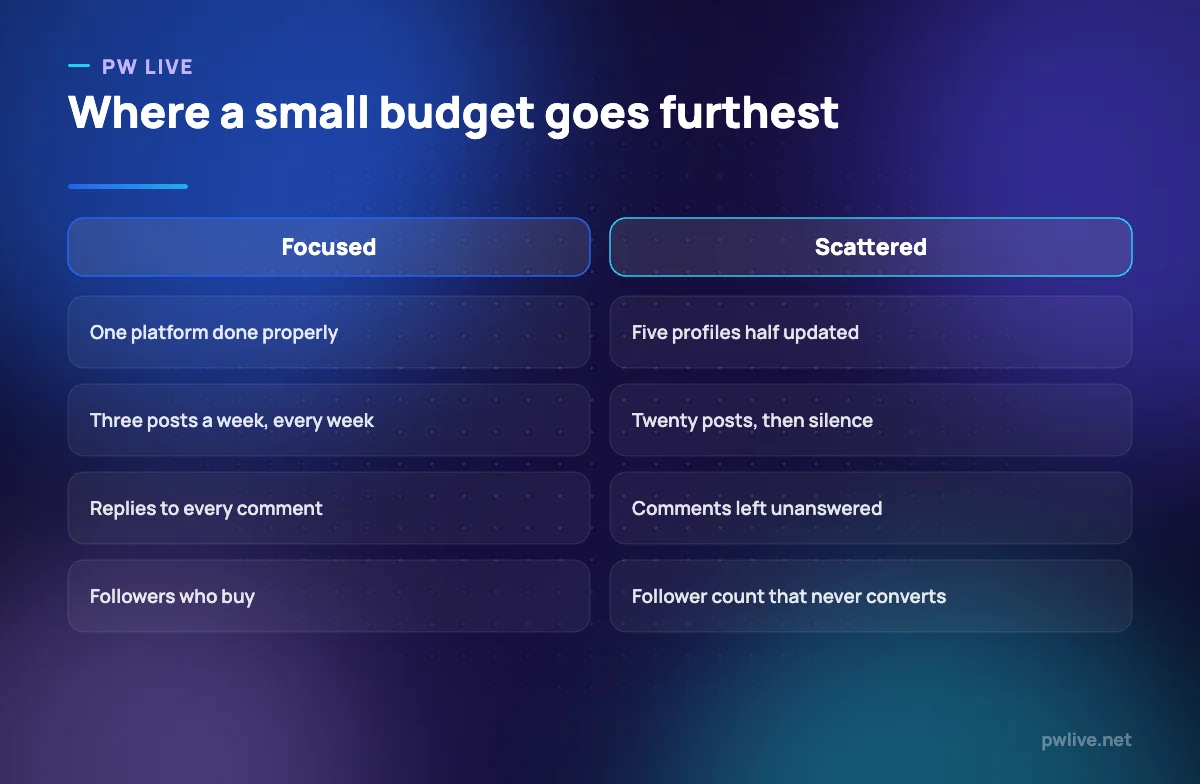
Turn attention into enquiries
Followers are not customers until you give them a path. Make it short and obvious.
- Put the action in your bio: what you do, who for, and how to contact you in one line.
- Keep a link to a page that answers the obvious next question rather than a generic home page.
- Reply to every comment and message quickly. Response speed is visible, and it is a competitive advantage most small businesses give away.
- Pin two or three posts that answer the questions every prospect asks before buying.
- Ask happy customers for a photo or a line you can share, with their permission.
Direct messages deserve special care. Answer questions properly, do not open with a sales pitch, and never send unsolicited bulk messages. That is spam, and it will get an account restricted.
Measure without a paid tool
The built-in analytics on any platform are enough at this scale. Once a month, note four numbers and nothing else.
- Reach or impressions, to see whether you are being shown at all.
- Saves and shares, which usually predict future reach better than likes.
- Profile visits and link clicks, which show interest turning into intent.
- Enquiries you can trace back to social, which is the only number that pays rent.
Track them in a spreadsheet and look at the direction over three months, not the wobble week to week. Our guide to the marketing metrics that matter explains how to connect this to revenue, and once something reliably produces enquiries organically, it becomes a sensible candidate for your first paid ad campaign.
For the wider picture, browse the marketing and sales archive or work through the digital marketing skill track in order.
Key takeaways
- Decide whether you need discovery, proof or retention. Most small businesses need proof.
- Choose one platform where your customers already are, and commit for at least six months.
- Rotate three fixed content formats and batch the work weekly, instead of planning elaborate calendars.
- Never buy followers or run engagement bait. Platforms suppress it and it converts nothing.
- Track reach, saves, profile visits and traceable enquiries monthly, and ignore the rest.
Frequently asked questions
How often should a small business post?
Two or three times a week, sustained for months, beats daily posting that stops after a fortnight. Choose a rhythm you can keep during your busiest week.
Do I need to pay for ads to get seen?
Not to start. Prove that a type of post produces enquiries organically first, then consider putting a small budget behind that proven post rather than a cold campaign.
How long before social media brings customers?
Usually several months before it produces enquiries on its own, though it can support sales immediately by reassuring people who found you elsewhere. Judge it at six months, not six weeks.
Should I hire someone to run my social media?
Only after you have a working system and know what results look like. Handing over an undefined job to a freelancer usually produces posts that look fine and sell nothing.
Keep learning with PW Live
Browse every guide in Marketing & Sales, or pick a skill track and follow the roadmap step by step.





Leave a Reply