

Your salary slip explains the gap between the number in your offer letter and the number that lands in your account. Most people glance at the last line and file the document away, which is how payroll errors survive for months and how tax surprises build up quietly in February.
A payslip is not complicated once you know it has two halves: what you earned, and what was taken out. Everything else is naming conventions that vary by employer.
This article is general educational information, not personalised financial advice. Tax rules, contribution rates and statutory limits change, so check current details with your employer, an official source or a qualified adviser before acting on them.
The two halves of a payslip
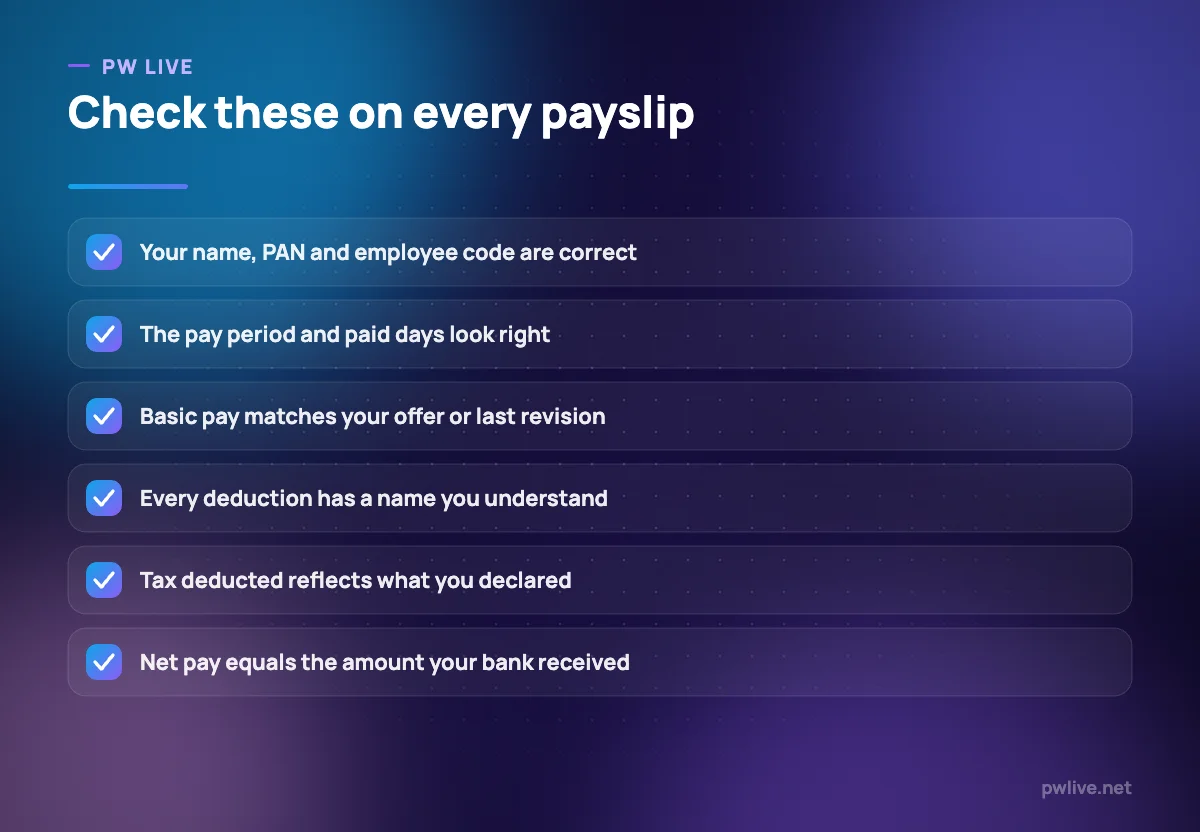
At the top you will find identification details: your name, employee code, designation, PAN or tax identifier, bank account number, the pay period and the number of days paid.
Below that, almost every format splits into two columns. Earnings on one side, deductions on the other. Earnings added up give gross pay. Deductions subtracted from gross give net pay, which is what actually reaches your bank.
If your net pay does not match your bank credit, something is wrong and it is worth asking immediately rather than at year end.
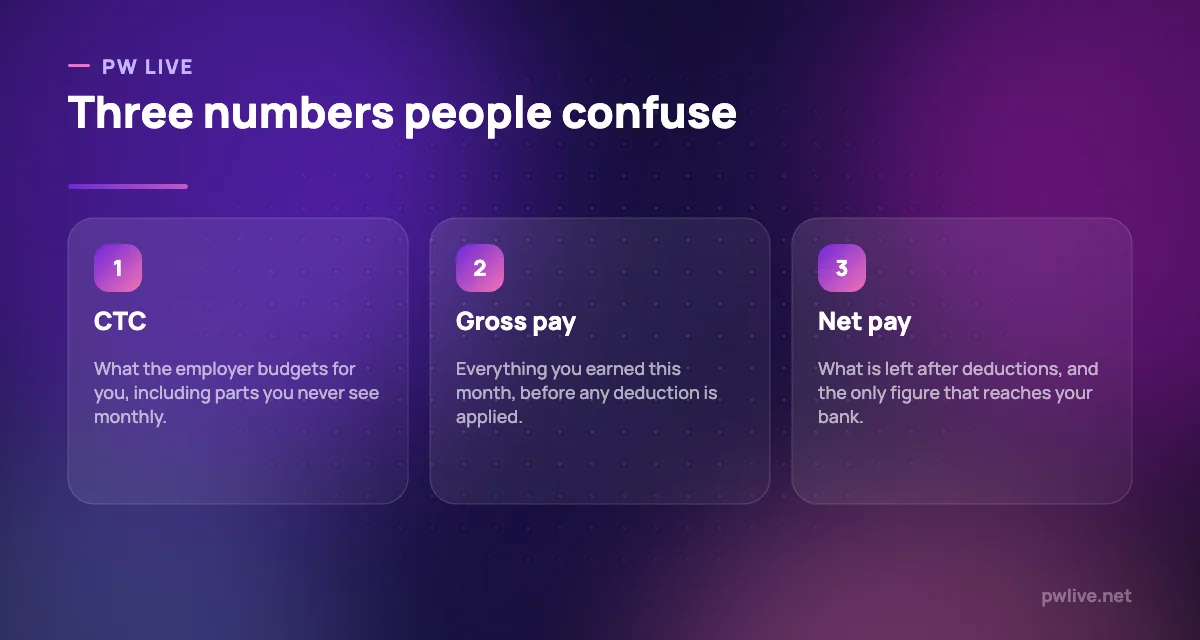
CTC, gross and net are three different numbers
Cost to company is the total the employer has budgeted to spend on you in a year. It can include things that never appear in a monthly credit: the employer’s provident fund contribution, gratuity provisioning, insurance premiums, a variable bonus that depends on performance, and sometimes notional values for perks.
Gross pay is the monthly total of your earnings lines. Net pay is what remains after deductions.
The practical consequence is that your monthly take-home is usually well below one twelfth of your CTC, and the gap is not a trick. It is components you either receive later, receive in kind, or receive as a contribution into something in your name. When you are negotiating, ask for the breakup rather than the headline figure, a point we cover in how to negotiate your first salary.
The earnings side, line by line
Names differ between companies, but the components are broadly familiar.
- Basic salary. The foundation of the structure. Several other items, including provident fund contributions and gratuity calculations, are usually derived from it, so its size affects far more than its own line.
- House rent allowance. Paid towards accommodation. Whether any part of it reduces your taxable income depends on rules that specify conditions and proofs, and those rules change, so check the current position.
- Dearness or special allowance. Often the balancing figure that makes the structure add up to the agreed gross.
- Conveyance, meal, telephone or education allowances. Smaller fixed components, sometimes with their own documentation requirements.
- Overtime, incentives, shift allowance or bonus. Variable lines that appear only in the months they are earned.
- Reimbursements. Money paid back to you for expenses you incurred. These behave differently from allowances and are usually shown separately.
If you are joining or leaving mid-month, expect a pro-rated calculation and check the number of paid days shown at the top.
The deductions side, line by line
This is where the questions usually are.
- Provident fund. A statutory retirement contribution deducted from your pay, with a separate employer contribution that appears in your CTC rather than your monthly credit. Rates and wage ceilings are set by rules that change, so confirm the current ones.
- Professional tax. A state-level deduction. It does not apply everywhere and the amounts vary by state.
- Income tax deducted at source. Your employer estimates your annual tax liability and spreads it across the year. It moves when you submit or fail to submit investment declarations and proofs.
- Employee state insurance or group insurance premium. Applicable depending on your wage level and your employer’s schemes.
- Voluntary deductions. Contributions you opted into, loan or advance recovery, notice period adjustments, or canteen and transport charges.
Any line you cannot name is worth an email to payroll. Deduction errors compound month after month because nobody questions them.
Why your take-home changes from month to month
A payslip that varies is not necessarily wrong. Common reasons include:
- Tax deducted at source recalculations. If you declared planned tax-saving investments in April and did not submit proofs later in the year, the deduction usually rises sharply in the final months.
- Variable pay. Incentives, overtime and bonuses land in particular months.
- Loss of pay. Unpaid leave reduces the paid-days count and everything derived from it.
- Structure revisions. A salary revision, promotion or change in allowance policy changes the whole calculation.
- Arrears. Back pay from a revision applied retrospectively appears as a separate line.
Because of this, budgeting on your best month is a reliable way to run short. Plan around your lowest normal take-home and treat variable pay as extra, ideally directed towards your emergency fund or a named goal.
What to do with your payslip once you have read it
Payslips are documents you will need again.
- Save every one. Loan applications, visa applications, rental agreements and new employers routinely ask for the last three to six months. Keep them in a folder you back up.
- Reconcile once a year. Compare the tax deducted across your payslips with the annual tax statement your employer issues and with your own tax records before filing.
- Check your provident fund account. Contributions shown on your payslip should be reflected in the fund’s records. Mismatches are easier to fix early.
- Use it as the base for your budget. Your net pay, not your CTC, is the number your monthly plan should start from. Our guide to personal finance for students and first earners shows how to split it sensibly.
If the tax lines are the part that feels opaque, read income tax basics for first-time earners next. The finance category covers the surrounding topics, and the personal finance skill track puts them in a sensible order.
Key takeaways
- A payslip has two halves: earnings that make up gross pay, and deductions that produce net pay.
- CTC includes employer contributions and variable components, so it is never one twelfth in your bank each month.
- Basic salary drives several other calculations, so its share of the structure matters.
- Deductions typically include provident fund, professional tax where applicable, tax at source and any voluntary items.
- Take-home varies because of tax recalculations, variable pay and unpaid leave, so budget on your lowest normal month.
- Save every payslip and reconcile the annual tax deducted before you file your return.
Frequently asked questions
Why is my take-home so much lower than my CTC?
CTC includes items you do not receive monthly, such as the employer’s retirement contributions, gratuity provisioning, insurance premiums and any variable bonus. Deductions from your gross pay then reduce it further to your net pay.
What should I do if I spot an error on my payslip?
Email payroll with the specific line, the month and what you expected, and keep the thread. Corrections are usually made in a later cycle, and having it in writing matters if the difference is significant.
Why did my tax deduction jump towards the end of the year?
Employers estimate annual tax from the declarations you submit at the start of the year. If proofs are not submitted by the deadline, the estimate is revised and the shortfall is recovered across the remaining months.
Do I still need payslips after I leave a job?
Yes. Lenders, landlords, visa processes and future employers often ask for recent payslips, and they are useful evidence if a provident fund or tax record ever needs to be corrected.
Keep learning with PW Live
Browse every guide in Finance & Investing, or pick a skill track and follow the roadmap step by step.





Leave a Reply