

Most students take notes they never open again. The pages get written, the highlighter comes out, the notebook fills up, and revision week arrives to find forty pages of material that is somehow both too long and not useful. Knowing how to take notes that survive to revision is a different skill from writing quickly in class.
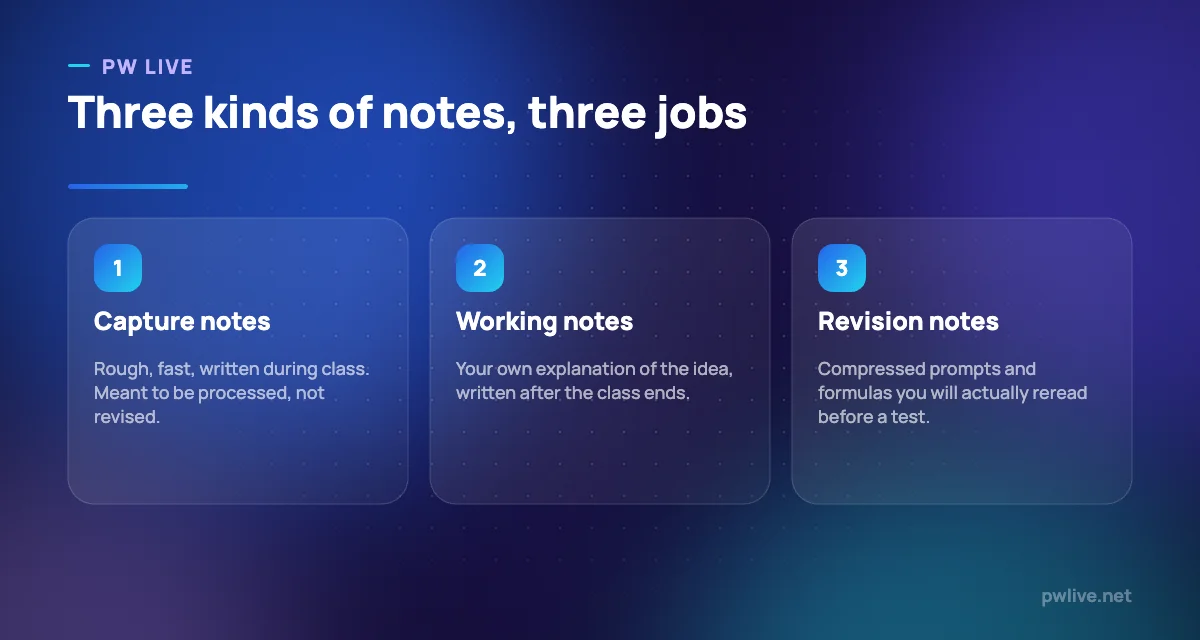
The core problem is that note-taking and note-using are two different jobs, and almost everybody optimises for the first. Notes written to keep up with a teacher are, by design, a transcript. Transcripts are terrible revision material.
This guide shows you how to separate those jobs, what to physically write on a page, and how to make a notebook you will still be using in the final month.
Stop transcribing and start selecting
If your notes look like the board, you were copying, not learning. Copying feels productive because your hand is busy, but it uses almost none of the thinking that creates memory.
The fix is a rule for what goes on the page. During a class or lecture, write only four kinds of thing:
- The structure: what the topic is, what it breaks into, what leads to what
- Worked examples, especially the step where the teacher does something non-obvious
- Anything you did not understand, marked clearly so you can find it later
- The teacher’s shortcuts, conditions and warnings, which rarely appear in textbooks
Everything else exists in the book. You do not need a second copy of the book.
This is even more important with recorded content, where the pause button makes it tempting to transcribe everything. Our guide to studying from video lectures without wasting hours covers the pacing rules that keep this under control.
Give every page the same three zones
A page you can revise from has a consistent shape. Divide each page into three areas before you start writing.
The main column holds the content: explanations, derivations, examples.
A narrow left margin holds cues: the question each block answers, a keyword, a formula name. You write these after the class, not during it. This margin is what you cover up when you test yourself.
A strip at the bottom holds a two or three line summary in your own words. If you cannot write that summary, you did not understand the page, and that is useful information on the day rather than three weeks later.
The layout is doing real work here. It forces you to convert content into questions, which is the step that turns notes into practice material rather than reading material.
Process notes the same day, in fifteen minutes
Raw class notes have a short shelf life. The context that makes them readable, which is your memory of the class, fades within a couple of days.
Build a short daily routine:
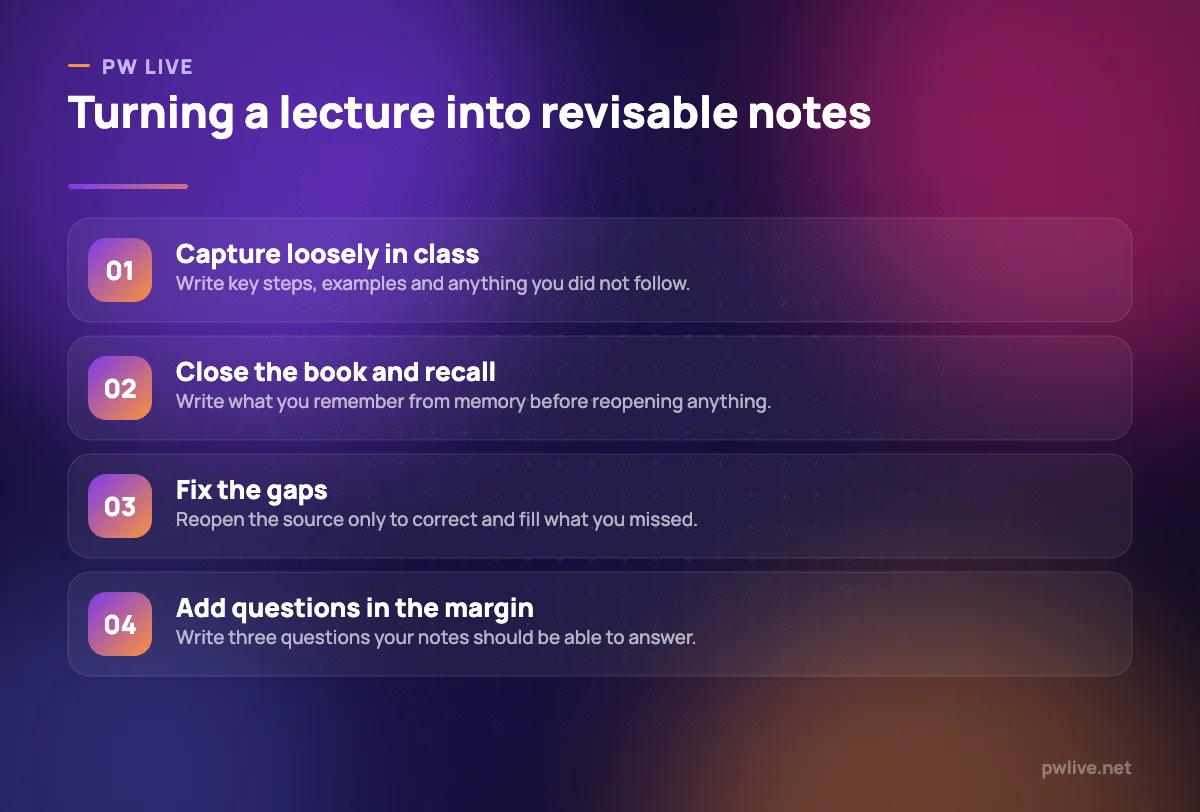
- Recall first. Close the notebook and write down what the class covered from memory. Two minutes, on scrap paper.
- Compare. Open your notes and see what you missed. Those gaps are the parts to focus on.
- Fill in the margin cues and the bottom summary.
- List your doubts in a separate running list with the date and page number, so they can be resolved in one batch rather than one at a time.
This routine costs about fifteen minutes per subject per day and eliminates most of the panic later. It is also a direct application of active recall, which is the technique that makes the difference between notes you have read and material you can produce under exam conditions.
Write for your future self, who is in a hurry
The version of you who opens these notes will have thirty minutes and no memory of the class. Write for that person.
Practical rules that make a real difference:
- Date and topic every page, top right, always. Undated notes are unsortable.
- Number your pages and keep a one-page contents list at the front of the notebook.
- Use one idea per block, with white space between blocks. Dense pages do not get revised.
- Write full sentences for conclusions, not fragments. “Increases with T” is meaningless in six weeks.
- Mark your own confusion in a consistent way, such as a question mark in the margin, so you can scan for it.
- Never highlight while reading for the first time. Highlight only on a second pass, when you know what actually matters.
The last rule is the one people resist most. First-pass highlighting marks what felt new, not what is important, and it leaves you with a page that is mostly yellow.
Build a compressed revision layer
Full notes are for learning. They are too long for revision. You need a second, much shorter layer that you build as you go, not in the last week.
For each chapter, maintain a single page containing only:
- The formulas, definitions and standard results
- The three or four question types the chapter produces
- The specific mistakes you have made in this chapter
- One line on when to use each method
This page is what you will actually reread ten times. For quantitative subjects, this is essentially the formula and revision notebook approach, and it is worth setting up properly from the start of the year.
Keep the error list honest. A note that says “forgot to convert units in gas problems” is worth more than any amount of neatly copied theory, because it names a repeatable failure you can eliminate.
Handwritten or digital: choose on retrieval, not aesthetics
Both work. The question is not which is superior in general, but which one you will actually search, reread and test yourself from.
Handwriting is slower, which forces selection and helps encoding. It suits diagram-heavy and mathematical subjects, and it has no notifications.
Digital notes are searchable, backed up, and easy to reorganise. They suit text-heavy subjects, long courses and anyone who takes notes across several devices.
A common sensible split is handwritten for maths-heavy subjects and digital for theory subjects, with photographs of the handwritten pages stored alongside the digital ones. If you go digital, pick a tool for its search and export rather than its templates; our comparison of how to choose a note-taking app sets out what to look for, and backing up your notes properly matters more than most students realise until the week it does not.
Schedule the rereading, or it will not happen
Notes only pay off if they are revisited on a schedule. Left to feel, you will reread the chapters you enjoy and avoid the ones you need.
Attach every set of notes to a review plan: a quick look the next day, again after about a week, and again after a few weeks, each time by testing yourself against the margin cues rather than reading the page. Our practical guide to spaced repetition explains how to set those intervals without turning it into a full-time job.
The test of a good notes system is simple. Open a random page from two months ago and try to answer its own margin questions. If you can, the system works. If the page tells you nothing, the problem was never your memory.
More study-system material is collected in the education and learning archive, and the productivity skill track covers the scheduling side.
Key takeaways
- Class notes are a capture step, not revision material; the processing step is what matters
- Write only structure, worked examples, doubts and teacher shortcuts during a lecture
- Use a three-zone page layout so every page carries its own test questions
- Spend fifteen minutes the same day recalling, filling gaps and listing doubts
- Maintain a one-page compressed layer per chapter, including your own repeated errors
- Attach notes to a review schedule and revise by self-testing, not rereading
Frequently asked questions
Should I make notes if the teacher gives printed material?
Yes, but make short ones. Annotate the printed material with your own margin questions and keep a separate one-page summary per chapter rather than duplicating what you already have.
How long should notes for one chapter be?
Short enough to review in about fifteen minutes. If a chapter needs more than a few pages, split it into a full set for learning and a one-page compressed set for revision.
Is it worth rewriting notes to make them neater?
Rewriting purely for neatness is wasted time. Rewriting to compress a chapter into a shorter, question-driven page is one of the most effective things you can do.
What should I do with notes from a class I did not understand?
Mark the confusion clearly, write the specific question you need answered, and add it to a running doubt list. Resolve the list in batches with a teacher, a friend or a second explanation.
Keep learning with PW Live
Browse every guide in Education & Learning, or pick a skill track and follow the roadmap step by step.





Leave a Reply