

A formula and revision notebook is the single most useful object a competitive exam aspirant owns in the final month, and almost every student builds one badly. They copy formulas neatly from a textbook, never open it again, and discover in the last week that it is both too long and full of things they already knew.
The problem is what goes in. A notebook built by copying is a duplicate of the book. A notebook built from your own mistakes is a map of exactly what you are likely to get wrong.
This guide covers how to structure one, what earns a place in it, how to keep it short, and how to actually use it rather than admire it.
What this notebook is for, and what it is not
Your revision notebook has one job: to be the only thing you need to read in the last two weeks before an exam.
That means it is not a set of class notes, not a summary of every chapter, and not a place to redo derivations. Those things have their uses, but they are too long to revise when time runs out.
Think of it as a compressed personal file: the formulas you forget, the ideas you confuse, the exceptions that catch you, and the errors you keep repeating. If a fact is already automatic for you, it does not belong there, however important it is.
This is why a copied notebook fails. It contains what the book thought was important instead of what you keep getting wrong.
Four sections, not one long list
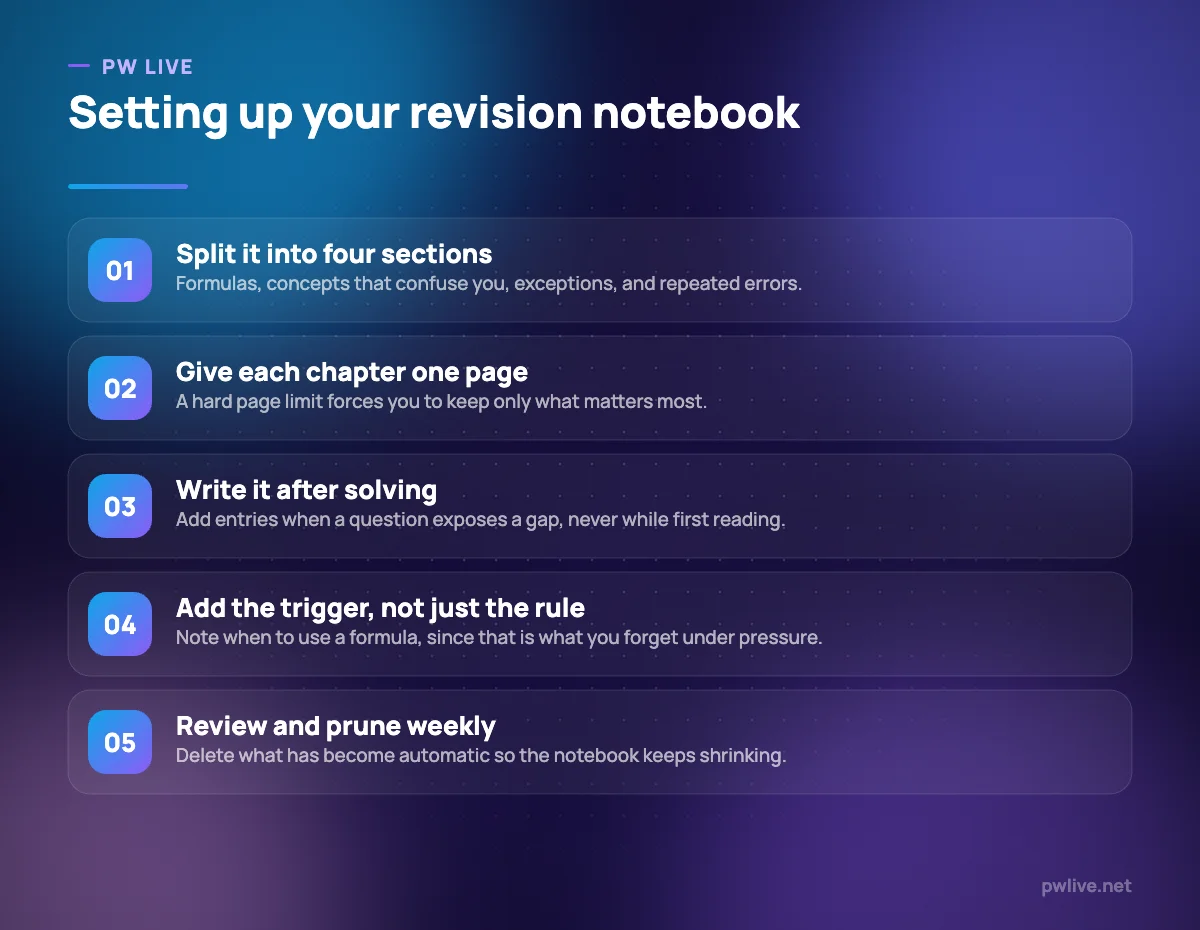
Divide your notebook, whether it is paper or digital, into four parts per subject. Most students use one notebook per subject with these as sections.
- Formulas and standard results. With the conditions under which each applies.
- Concepts I confuse. Pairs of ideas you mix up, written as the distinction between them.
- Exceptions and special cases. The things that break the general rule you learnt.
- My repeated errors. Corrections drawn straight from your mock analysis.
The fourth section is usually the most valuable and the one nobody keeps. It is fed by every mock you analyse, so it should grow steadily. Our method for analysing a mock test produces exactly the raw material for it.
Keep a hard limit of about one page per chapter. The limit is the point: it forces every entry to compete for space, which is what keeps the notebook revisable.
Write entries after solving, not while reading
The timing rule matters more than the format. Do not build the notebook while first reading a chapter, because at that stage you cannot tell what you will forget.
Build it while solving. When a question catches you out, that is the moment you have found something worth writing down, and you now know precisely why it belongs.
A good entry captures three things:
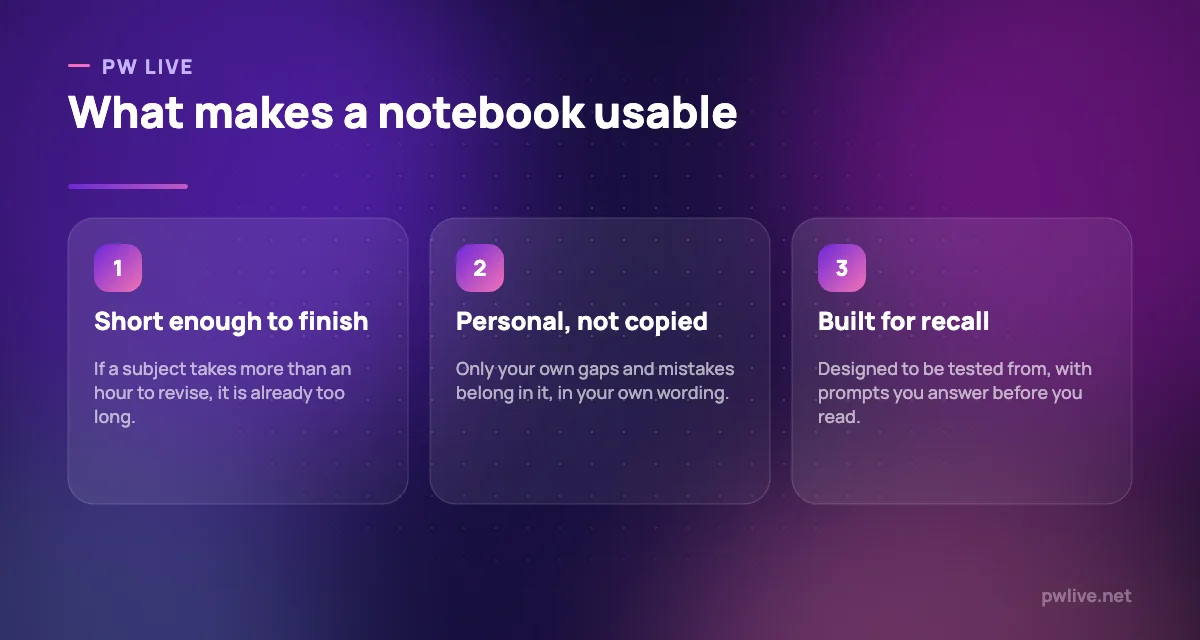
- The rule, formula or distinction, written in your own words.
- The trigger: what in a question tells you to use it.
- A one-line note on what you got wrong, if this came from an error.
The trigger is the part students skip and the part that decides marks. Remembering a formula is easy; recognising the situation that calls for it under time pressure is the actual skill.
For example, rather than writing only a formula for a special case, write when the special case applies and what wording in a question signals it. That single line converts stored knowledge into usable knowledge.
Keep it short by pruning, deliberately
A revision notebook should get shorter as the exam approaches, not longer. If it keeps growing, it is turning into a textbook.
Review it once a week with a pen. Mark every entry as one of three things:
- Automatic. You recall it instantly and have not erred on it recently. Strike it out.
- Still shaky. Keep it, and star it if it keeps reappearing in your errors.
- Never actually used. Something you copied hopefully but no question has needed. Strike it out.
Pruning feels wrong because the entries cost effort to write, but the notebook’s value comes entirely from its length. Fifty pages nobody reads is worth less than eight pages you can finish in an hour.
Star ratings help in the final week. A three-star entry, one you have got wrong repeatedly, deserves five readings. A one-star entry deserves a glance.
Paper or digital: choose by how you will revise
Both work, and the honest deciding factor is where you will actually read it.
Paper wins on writing speed for formulas, diagrams and mathematics, and on freedom from distraction. Handwriting also tends to force compression, which helps.
Digital wins on searchability, on being available during a commute, and on never being lost. If you travel to coaching or work, a phone-accessible notebook gets read far more often.
A practical hybrid many students use: handwrite while studying, then photograph pages weekly into a folder organised by subject and chapter. You get the writing benefits and a backup.
Whatever you choose, back it up. Losing a year of accumulated notes a month before an exam is a genuinely common disaster, and our guide to backing up your notes takes ten minutes to implement. If you are choosing a digital tool, our comparison of note-taking apps for students covers what to look for.
Use it as a test, not a text
The final mistake is reading the notebook passively, which produces a comfortable feeling of familiarity and very little recall.
Use it in question form instead. Cover the right side of the page, read only the topic or trigger, and say the formula or distinction aloud before you look. That converts reading into retrieval, which is the whole basis of active recall.
Space the reviews rather than clustering them. A chapter reviewed today should come back in about a week, then again a fortnight later, which is the practical form of spaced repetition for exam study.
In the final stretch, this notebook becomes your primary material. When you plan how to revise the whole syllabus in the last 30 days, the notebook is what the last week runs on, and it is also the only thing worth reading on the morning of the exam.
A realistic weekly routine
Fitting this in takes about forty minutes a week, spread out.
- After each study session, five minutes. Add any entry a question exposed today.
- After each mock, fifteen minutes. Move corrections from your error log into the errors section.
- Once a week, twenty minutes. Prune, star and reread one subject, testing yourself rather than reading.
That is enough. The notebook is a by-product of good studying, not a separate project, and the moment it starts eating study time it has gone wrong.
For the broader note-taking system that sits around it, see our guide to taking notes you will actually revise, and more study material in the education section and the exam strategy track.
Key takeaways
- The notebook exists to be the only thing you read in the last two weeks.
- Split it into formulas, confusing concepts, exceptions and repeated errors.
- Write entries after solving questions, never while first reading a chapter.
- Record the trigger for each formula, not just the formula itself.
- Prune weekly so the notebook gets shorter as the exam approaches.
- Revise it by testing yourself, and back it up wherever you keep it.
Frequently asked questions
When should I start a formula notebook?
From the first chapter you study, but build it from the questions you get wrong rather than from the text. Starting late is still worth it; starting by copying is not.
How long should the notebook be?
Short enough to revise one subject in about an hour. If a subject takes much longer than that, prune it rather than accepting the length.
Should I include solved examples?
Only rarely, and only when the method itself is what you keep forgetting. Write the approach in two lines instead of copying a full solution you will never reread.
Is a digital notebook as good as a handwritten one?
Yes, if you actually reread it. Handwriting suits formulas and diagrams; digital suits searching and commute revision. Choose by where you will realistically read it, and back it up either way.
Keep learning with PW Live
Browse every guide in Exams & Admissions, or pick a skill track and follow the roadmap step by step.





Leave a Reply