

If you need to revise an entire syllabus in the last 30 days, the first thing to accept is that you cannot cover everything equally. A month is enough time to do this well, but only if you decide early what gets full attention, what gets a light pass, and what gets left alone.
Panic makes people do the opposite. They start at chapter one, revise the early topics beautifully, and run out of days somewhere in the middle of the second subject.
This is a plan built around triage, testing and repetition. It assumes you have studied the material before at least once, and that the job now is retrieval, not first-time learning.
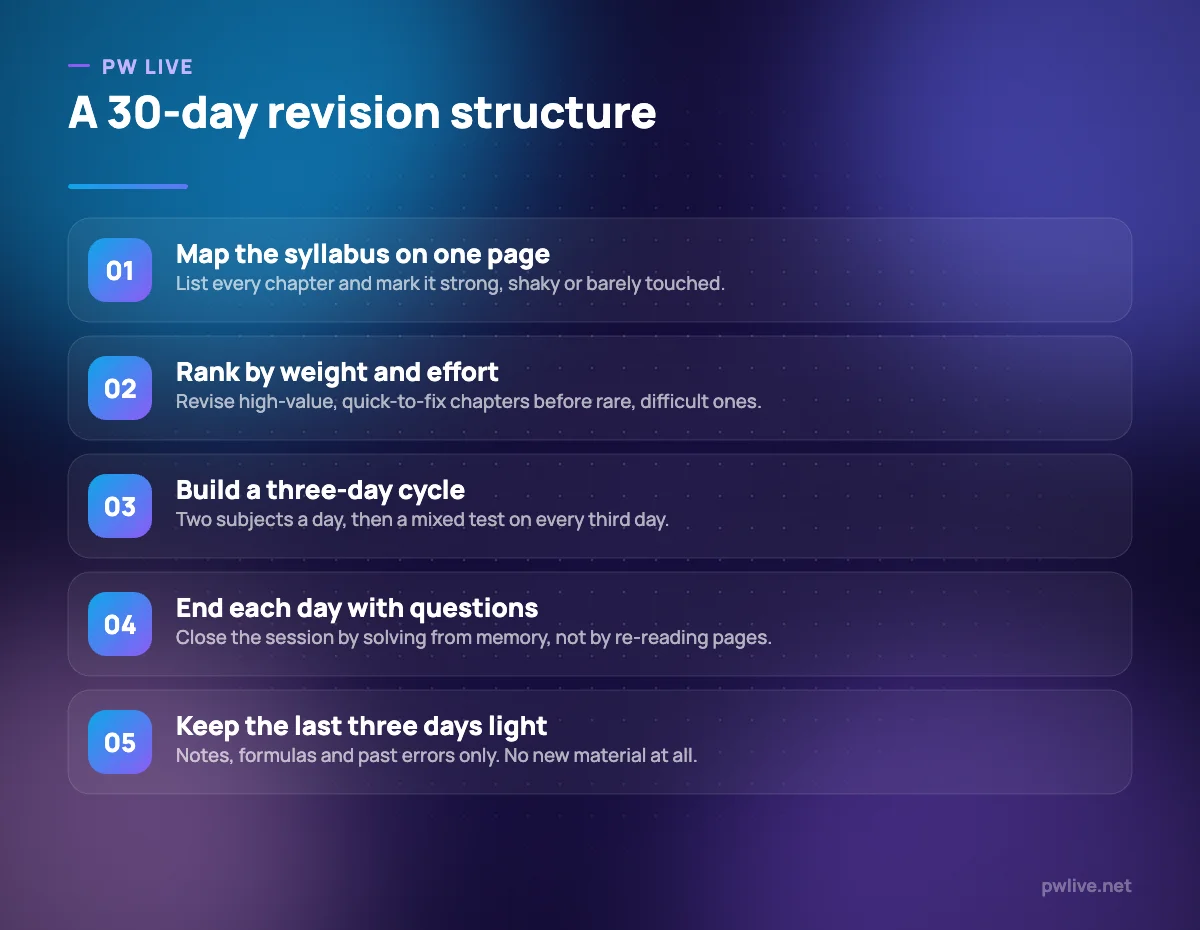
Day one: map the syllabus before you revise anything
Spend the first two or three hours making a single page that lists every chapter in every subject. Not a beautiful chart, just a list you can see all at once.
Against each chapter, write one of three marks:
- Strong. You can solve standard questions from it today.
- Shaky. You know the ideas but make mistakes or work slowly.
- Cold. You have barely touched it, or you have genuinely forgotten it.
Then add a second mark for weight: how much of the paper this chapter typically accounts for, based on past papers you have actually seen rather than rumour.
Those two marks decide everything. Shaky chapters with high weight are your gold mine, because a small effort moves a lot of marks. Cold chapters with low weight are usually where you stop spending time.
Decide what to cut, deliberately
Cutting is uncomfortable, so most students never do it explicitly. They just run out of time and cut by accident, which is worse because the accidental cuts are random.
Make the decision on paper. A reasonable rule for a final month: if a chapter is cold, low-weight and conceptually heavy, you accept those marks are unlikely and stop opening it.
Two cautions. Do not cut a chapter that other chapters depend on, because the damage spreads. And never cut something merely because you dislike it, if the weight is high.
Build a three-day cycle, not a 30-day list
Long linear plans break within a week and then demoralise you. A short repeating cycle survives real life and self-corrects.
A simple version that works for a multi-subject exam:
- Day one. Two subjects, roughly three hours each, chapters from your shaky-and-heavy list.
- Day two. Two different subjects, same structure.
- Day three. A mixed test in exam conditions, then analysis of it, then a lighter evening.
Repeat the cycle for the month. Each pass through the syllabus is faster than the last, because you are pruning what has become solid and keeping only what still leaks.
The advantage of a cycle is that a bad day costs you one slot, not the whole plan. You lose a day, you pick the cycle up where it stopped, and nothing needs to be redesigned.
If you have never planned time in blocks before, our time blocking guide explains how to fit this into a real day with meals, travel and family around it.
Revise by testing, not by reading
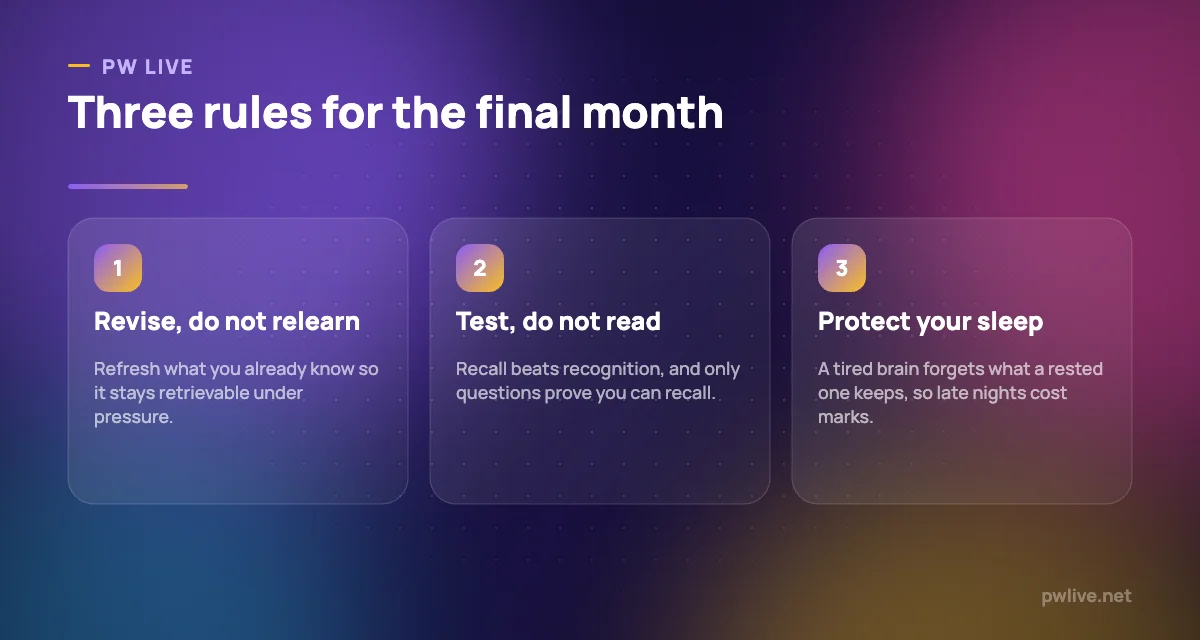
Reading a chapter again produces a strong feeling of familiarity and very little memory. Under exam pressure, familiarity collapses.
Use a simple pattern for each chapter. Close the book, write down everything you remember on blank paper, then open your notes and mark what was missing. Fill only the gaps.
Then solve questions. Ten to fifteen mixed questions per chapter is usually enough to prove whether the revision worked, and getting them wrong now is the entire point.
Spread repeats out rather than clustering them. A chapter revised on day three should reappear around day ten and again near day twenty-four, which is the practical form of spaced repetition when time is short.
Use full papers as a diagnostic, not a scoreboard
Take a full-length paper every third day if the exam is a single long test, or every second day in the final fortnight if you are already comfortable.
Take it at the actual time of day your exam will be held. Sitting a three-hour paper at eleven at night trains a version of you that will not sit the exam.
Then analyse it properly. Which chapters failed, which mistakes repeated, where the time went. Our step-by-step method for analysing a mock test fits neatly into the third day of each cycle, and its output should directly change what you revise in the next cycle.
Expect scores to move unevenly. In the final month, accuracy stabilising matters more than the raw number climbing every time.
Keep a one-page sheet per subject
By the second cycle you should be building a compressed sheet for each subject: formulas, exceptions, reaction conditions, definitions you keep confusing, and the mistakes from your error log.
Keep it to one or two sides. If it grows longer, it stops being revisable in the final week, which is the only reason it exists.
This is where a running formula and revision notebook pays for itself. If you have not been keeping one, build it now from your weakest chapters rather than from scratch across the whole syllabus.
Protect sleep, food and one hour off
A 30-day sprint tempts you into cutting sleep. It is the worst available trade, because memory consolidation happens while you sleep and a tired brain both learns slower and makes more careless mistakes.
Keep a fixed wake-up time, even after a bad night. Keep meals regular, because low blood sugar looks exactly like poor concentration.
Keep one hour a day genuinely off, without a screen if possible. The evidence students report themselves is consistent: the person who takes a real break at eight o’clock studies better at nine than the person who half-studied through it. Our guide on why late nights cost you marks covers this properly, and if the pressure is turning into something heavier, the health section has practical material on managing it.
The final week
The last seven days have one job: keep everything retrievable and arrive calm.
- No new topics. Anything untouched by day 23 stays untouched.
- Revise from your one-page sheets and error log, not from textbooks.
- Reduce full papers to one or two, and stop them at least two days before the exam.
- Sort out logistics early, using an exam day checklist so nothing practical is left to the last morning.
- Move your sleep schedule to match exam day at least five days in advance.
Check the official exam authority’s website for reporting details, permitted items and any instructions specific to your centre, and rely on that rather than on messages forwarded in group chats. More planning material sits in our exam strategy track.
Key takeaways
- Map the syllabus on one page and mark every chapter strong, shaky or cold.
- Prioritise shaky chapters with high weight; deliberately cut cold, low-weight ones.
- Run a repeating three-day cycle instead of a fragile 30-day list.
- Revise by recalling and solving, not by re-reading.
- Take full papers at your real exam time and let the analysis steer the next cycle.
- Protect sleep, and spend the final week only on notes, formulas and past errors.
Frequently asked questions
Can I really revise a full syllabus in 30 days?
You can revise it, if you have studied it before. You cannot learn it from nothing in a month, which is why triage and honest marking of cold chapters matter so much on day one.
How many hours a day does this plan need?
Most students manage six to eight focused hours, split into blocks. More hours with poor attention is worse than fewer hours with real recall practice and full papers.
Should I still take full-length mocks in the last week?
One or two, then stop at least two days before the exam. The final days are better spent on your one-page sheets, your error log and sleeping properly.
What if I fall behind in the middle of the plan?
Restart the cycle from where you stopped rather than rebuilding the schedule. A cycle is designed so that a lost day costs one slot, not the entire month.
Keep learning with PW Live
Browse every guide in Exams & Admissions, or pick a skill track and follow the roadmap step by step.





Leave a Reply