

If you keep pushing your bedtime back to fit in more revision, your sleep and study performance are probably working against each other. The hours go up, the marks do not, and you cannot quite explain why.
Sleep is not the reward you get after studying. It is part of studying. What you read during the day gets consolidated while you sleep, and the attention you need to solve problems the next morning is built the night before.
This guide covers what late nights actually cost you, how to build a schedule that fits a real timetable, and how to repair a broken sleep cycle without losing a week to it.
What sleep is doing while you are not studying
Learning is not finished when you close the book. Your brain keeps working on new material after you stop, strengthening what you practised and connecting it to what you already knew.
That is why a chapter you struggled with on Tuesday sometimes feels easier on Wednesday morning without any extra effort. You did not get lucky. You slept.
Sleep also restores the boring but essential things: sustained attention, working memory, emotional steadiness. Those are exactly the abilities a three-hour paper demands. Cut them and you are sitting the exam with a weaker version of your own brain.
Why late-night cramming feels productive and usually is not
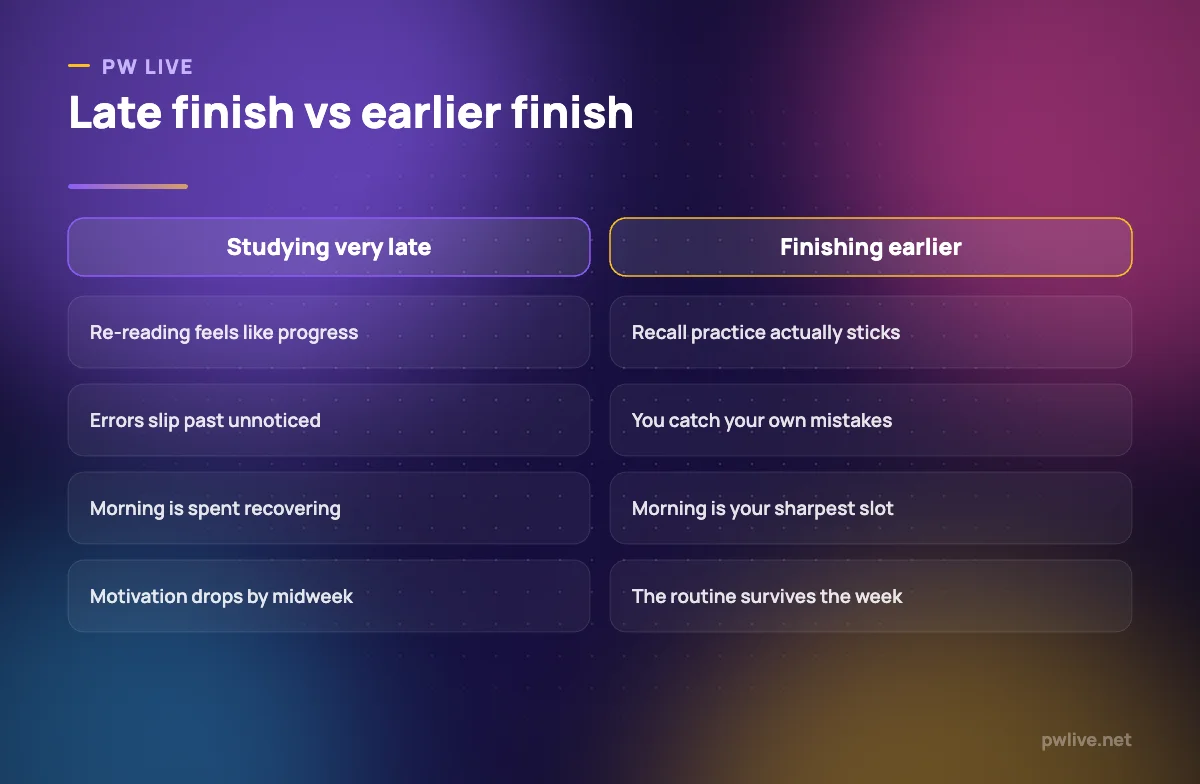
Late-night study has a trap built into it. Tiredness reduces your ability to judge how well you are doing, so low-quality work feels fine while you are doing it.
At 1am most students drift towards passive activities: re-reading notes, highlighting, watching one more explanation video. These feel like studying and produce almost no durable learning. Compare that with active recall, which is harder, more useful, and almost impossible to sustain when you are exhausted.
The second cost is hidden. A late night does not just affect tonight. It affects tomorrow’s focus, tomorrow’s mood, and how likely you are to stick to your plan for the rest of the week.
Build the schedule around a fixed wake time
Most students try to fix sleep by setting an earlier bedtime, then lie awake feeling like they are failing at that too. It is easier to anchor the other end.
- Pick a wake time you can hold on ordinary days, including weekends.
- Work backwards to a rough lights-out window, and treat it as a range rather than a single minute.
- Set a study hard stop shortly before that window, so your brain has time to slow down.
- Protect the first block after waking for your hardest subject, not for your phone.
- Review the whole thing once a week and adjust by small amounts, not dramatic ones.
A fixed wake time does more work than a fixed bedtime because it stabilises everything else: meals, energy dips, when you naturally get sleepy. If your timetable is already crowded, our guide to building a weekly study timetable that survives real life is a good place to fit sleep in as a fixed block rather than leftover time.
Make the last hour of the day boring on purpose
The hour before bed is where most sleep problems are actually created. You are still in problem-solving mode, still scrolling, still bracing for tomorrow.
Things that generally help:
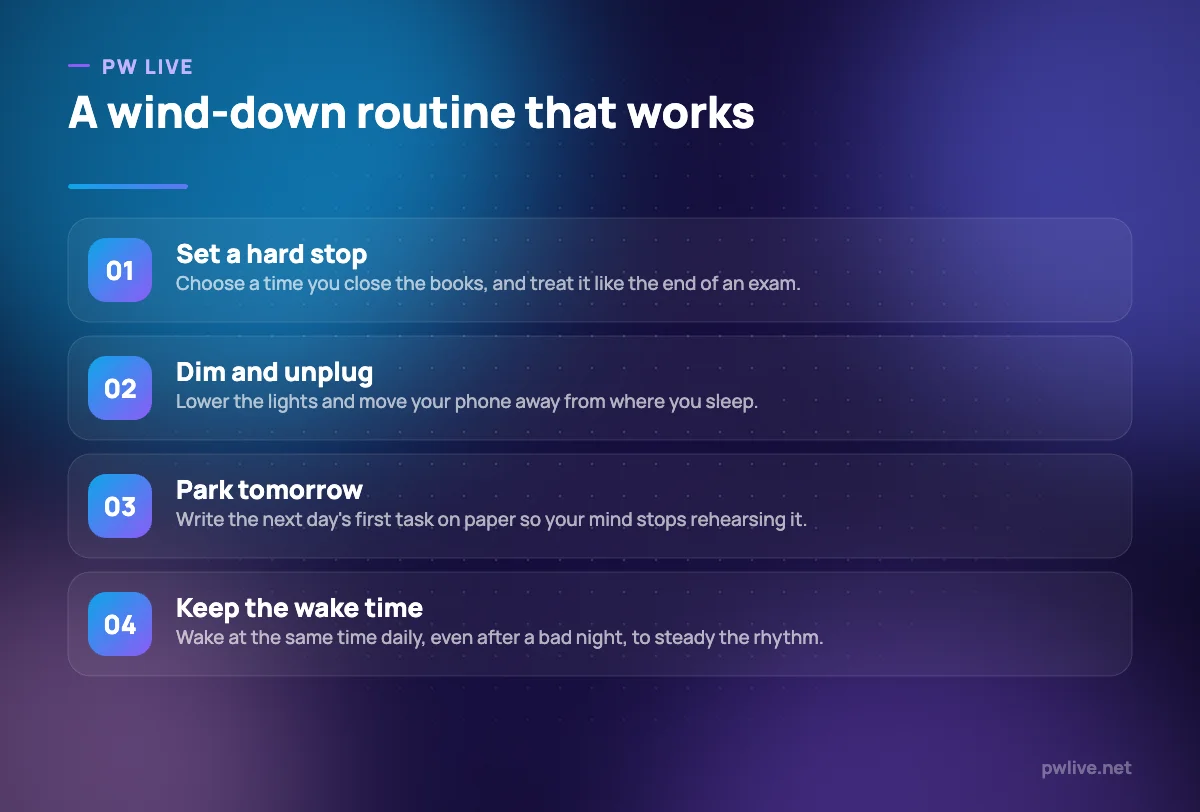
- A consistent order of small actions, so your body learns what is coming next.
- Lower light in the room for the last stretch of the evening.
- Writing down tomorrow’s first task and any worry that keeps resurfacing, so you are not holding it in your head.
- Keeping the phone out of arm’s reach, ideally charging in another part of the room.
- Doing something undemanding and analogue: a few pages of a novel, tidying your desk for the morning.
If the phone is the main obstacle, that is a habit problem rather than a sleep problem, and our digital detox guide walks through resetting it without going cold turkey.
Naps, caffeine and the fixes that backfire
A short early-afternoon nap can genuinely help if your night was poor. Long or late naps usually make the following night worse, so keep them brief and before the evening.
Caffeine is the more common mistake. Students often use it to extend a study session, then find it still working at midnight. If you rely on it, pull your last cup earlier in the day rather than trying to stop entirely in one go.
Two more habits worth watching. Studying in bed teaches your brain that bed is a place for alertness, so use a desk or table wherever possible. And staring at the ceiling for an hour rarely helps: if sleep is not coming, get up, do something calm and dull in low light, and return when you feel heavy.
How to repair a sleep cycle that has already drifted
If you have slipped into sleeping at 3am and waking at noon, do not try to correct it in one night. Sudden swings usually collapse within two days.
Shift your wake time earlier in small steps across several days, get bright daylight soon after you wake, and keep the new wake time even when the previous night was bad. The tiredness on day two is the price of the reset, and it passes.
Expect the first few days to feel worse before they feel better. That is normal, and it is not a sign the plan is failing. Pairing the reset with a small, repeatable structure helps, which is what our guide to building habits that stick is built around.
Sleep in the last weeks before an exam
The temptation to trade sleep for revision peaks exactly when you can least afford it. A tired brain revises slowly, forgets more and panics more easily.
In the final stretch, prioritise consistency over volume. Shorter, well-rested sessions with real recall practice will beat long foggy ones, and they leave you steadier on the day itself. Our exam day checklist covers the night before in more detail.
One honest caveat: sleep advice only goes so far. If you regularly cannot fall asleep, wake through the night, feel exhausted no matter how long you rest, or notice your mood and daily life slipping, please talk to a doctor, a counsellor, or a trusted adult or friend. Persistent sleep trouble is a common, treatable thing to ask for help with, and doing so early saves months. For more on managing pressure generally, see the wider health and wellness section and our exam stress and burnout guide.
Key takeaways
- Sleep is part of learning, not a reward for finishing it. Consolidation happens after you close the book.
- Late-night study drifts towards passive methods that feel productive and teach you very little.
- Anchor your routine to a fixed wake time rather than a fixed bedtime.
- Make the last hour of the day dull, dim and phone-free, and keep studying out of bed.
- Repair a drifted cycle in small steps over several days, not in one heroic night.
- If sleep problems persist or affect your daily life, speak to a doctor, counsellor or someone you trust.
Frequently asked questions
Is it better to sleep or to finish revising a chapter?
For most students, sleeping and returning to it early the next morning gives a better result than finishing at 2am. Tired revision is slow, and what you learn while exhausted is harder to recall under pressure.
Can I make up for lost sleep at the weekend?
Some recovery happens, but large weekend swings shift your body clock and make Monday harder. A smaller, steadier schedule across all seven days is easier to sustain than a debt-and-repay cycle.
Are power naps useful during exam preparation?
A short nap earlier in the day can restore focus after a poor night. Keep it brief and avoid late-afternoon or evening naps, which tend to push your bedtime back again.
What if I am too anxious to sleep before an exam?
Write down what is worrying you and the first thing you will do tomorrow, keep the lights low, and accept that one imperfect night will not undo your preparation. If anxiety before exams is a regular pattern, our guide on what helps with exam anxiety is worth reading, and it is worth telling someone you trust.
Keep learning with PW Live
Browse every guide in Health & Wellness, or pick a skill track and follow the roadmap step by step.





Leave a Reply