

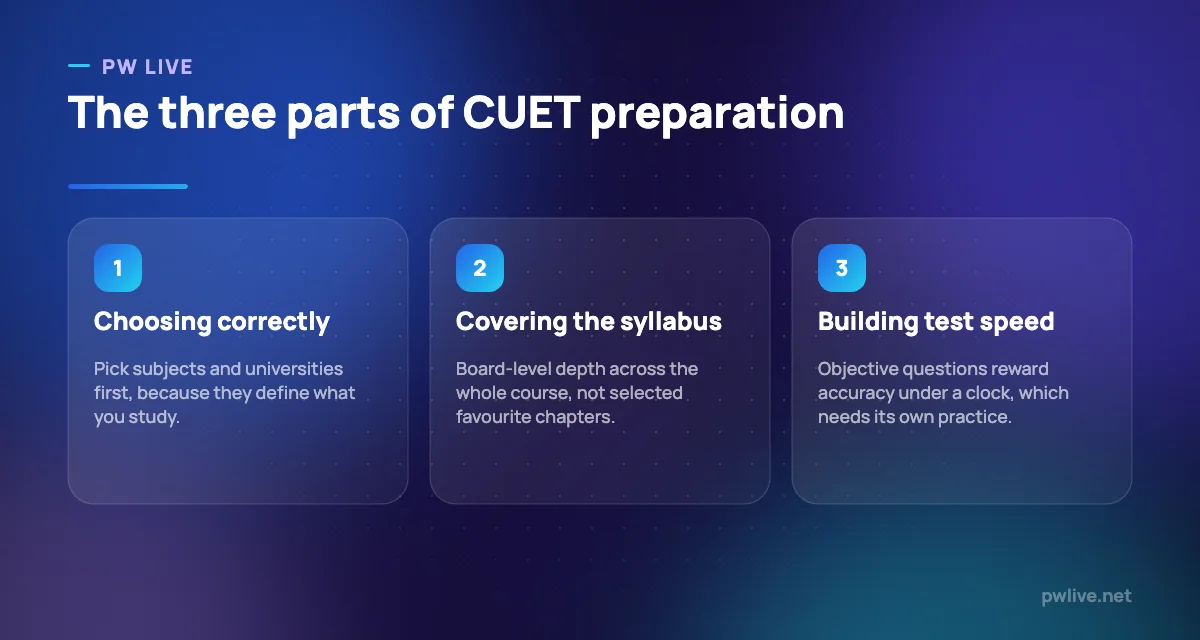
CUET preparation confuses most students for one simple reason: it is not a single exam you study for, it is a set of subject tests you assemble based on where you want to apply. Get the assembly wrong and even excellent studying can leave you ineligible for the course you wanted.
The Common University Entrance Test is used by a large number of central and participating universities in India for undergraduate admission, which means your choices about subjects come before your choices about books.
This guide walks through how the test is generally structured, how to decide what to take, and how to build a preparation plan that runs alongside Class 12 without wrecking either.
Start with the university, not the syllabus
The single most common mistake is starting to study before deciding where to apply. Different universities and different courses ask for different subject combinations, and some also weight particular subjects more heavily than others.
Work backwards instead:
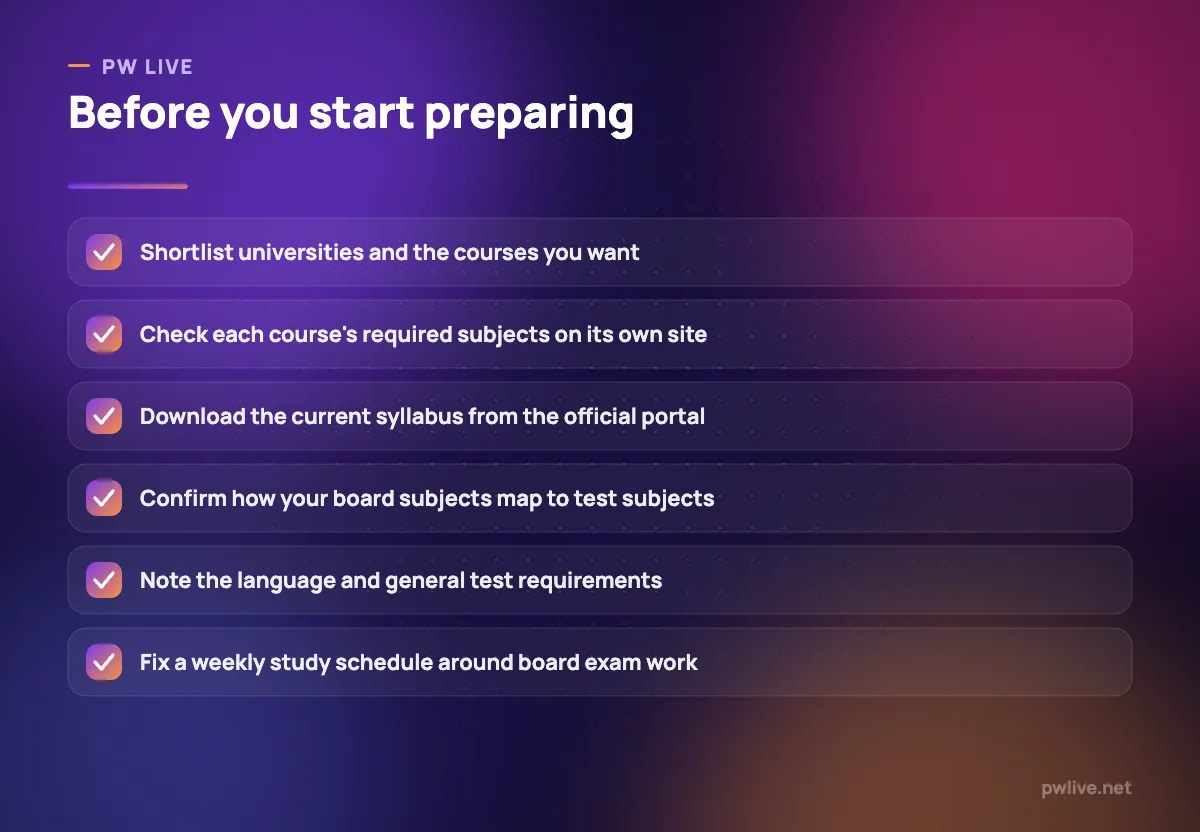
- Shortlist eight to ten courses across a realistic range of universities.
- Open each university’s own admission page and note the subjects that course requires or prefers.
- Find the overlap. The subjects that appear across most of your shortlist are the ones you must prepare thoroughly.
- Decide whether an extra subject genuinely widens your options or just adds workload.
Requirements, eligibility rules and subject mappings change between admission cycles and vary between universities, so confirm every detail on the official exam portal and on each university’s own admission page rather than from a coaching list or a social media post. Our guide to spotting misinformation about exams and admissions is worth reading before you trust anything forwarded to you.
How the test is generally structured
Broadly, CUET is a computer-based objective test made up of separate sections: language papers, domain subject papers tied to what you studied in Class 12, and a general test covering reasoning, general awareness and basic numerical ability.
You choose a combination from these based on your target courses, within limits the exam authority sets. Each section has its own duration and its own set of questions, and marking usually includes a penalty for wrong answers.
The exact number of sections you may take, the time allowed, the number of questions and the marking scheme are all things that have been revised between cycles. Treat them as details to verify on the official information bulletin for your year, not as facts to memorise from an article.
What is stable enough to plan around is the character of the test: objective questions, drawn from the Class 12 level syllabus, answered under time pressure, on a screen.
Domain subjects: board syllabus, different skill
Your domain papers are built on the same syllabus as your board exams, which sounds like good news and partly is. The content overlap means one round of studying serves both.
The skill, though, is different. Board exams reward structured written answers; an objective test rewards fast, precise recognition and elimination.
So study the content once, for boards, and then practise it twice: long-form for the board paper and objective-style for CUET. In practice that means finishing a chapter for school, then solving thirty multiple-choice questions on it the same week.
Do not skip chapters you consider unlikely. Objective papers can sample widely across a syllabus, and a chapter you dismissed is exactly where a cluster of easy marks tends to hide.
The general test needs its own slot
Students who prepare only their domain subjects usually underperform on the general section, because none of it is taught in school in the format the test uses.
Break it into three parts and give each a small, regular slot rather than a panic week at the end:
- Reasoning and mental ability. Series, analogies, arrangements, syllogisms, basic puzzles. Pure practice; twenty minutes a day builds real speed.
- Quantitative ability. Arithmetic up to roughly Class 10 level, percentages, ratios, averages, time and work, data interpretation.
- General awareness. Current affairs and static general knowledge, built by reading rather than cramming.
For awareness, a daily habit beats a monthly binge. Fifteen minutes with a newspaper or a reliable news summary, with a running one-page note of what you read, is enough. Our piece on reading education news without falling for rumours applies to general awareness preparation more widely than the title suggests.
Language sections reward reading speed
The language papers typically test reading comprehension, vocabulary, grammar and verbal ability. The limiting factor for most students is not knowledge but reading speed under pressure.
Practise with unfamiliar passages, timed. Read a passage of moderate length, answer the questions without looking back more than once, then check how long it took.
Build vocabulary in context rather than from lists. Words you meet in editorials and articles stick; words you meet on a memorised list rarely do.
Fitting preparation around board exams
You are preparing for two things at once, and the honest answer is that boards should stay the spine of your schedule. The syllabus overlap means good board preparation is already good domain preparation.
A workable weekly shape looks like this:
- Weekdays. School work and board-level study as usual, plus one 30-minute objective practice slot.
- Alternate evenings. Twenty minutes of reasoning or quantitative practice, rotated.
- Weekends. One longer session for the general test and one sectional test in exam conditions.
- After boards. Switch fully to objective practice, full-length mocks and revision.
Build this into a real calendar rather than a mental plan. Our guide to a weekly study timetable that survives real life covers how to make a schedule you will actually follow when school work spikes.
Mocks are where the marks are found
Once you have covered most of a subject, full-length and sectional mocks become the highest-value activity available to you.
Take them on a computer if the test is computer-based, so that scrolling, flagging questions and navigating the interface become automatic rather than distracting.
Then analyse them properly. Scoring a paper and moving on teaches almost nothing; the value is in sorting your mistakes into concept gaps, careless slips and timing failures. Our method for analysing a mock test and improving your score applies directly here.
Because most objective entrance papers penalise wrong answers, decide your attempting rules in advance rather than in the moment. Our guide to when to attempt and when to skip explains how to work out your personal threshold.
Books, notes and what to actually read
For domain subjects, your school textbooks carry most of the load, because the test is pegged to that syllabus. Our comparison of textbooks and reference books explains when adding anything else is justified.
Beyond that, you mainly need question banks and previous papers, not more theory. A short, personal set of notes per subject, built as you go, is what you will revise in the last fortnight.
More material on planning, revision and paper technique sits in our exam strategy track and across the education section.
Key takeaways
- Choose universities and courses first; they determine which subjects you must prepare.
- Verify subject requirements, eligibility and the marking scheme on official sources for your admission cycle.
- Domain papers follow the board syllabus, but need objective-style practice as a separate skill.
- Give the general test small, regular slots rather than a rushed week at the end.
- Practise language sections with timed, unfamiliar passages.
- Take computer-based mocks and analyse them properly instead of collecting scores.
Frequently asked questions
How early should I start CUET preparation?
Beginning in Class 11 or early Class 12 is comfortable, mainly because good board study doubles as domain preparation. What genuinely needs early, separate attention is the general test.
Do I need coaching for CUET?
Not necessarily. The content sits at Class 12 level, so self-study with question banks and mocks works for many students, though structured help can suit those who struggle to keep a schedule.
How many subjects should I take?
Only as many as your shortlisted courses genuinely require, within whatever limit the exam authority sets for your cycle. Extra subjects dilute preparation more often than they widen options.
Where do I confirm the current pattern and eligibility?
On the official exam portal’s information bulletin for your admission year, and on each university’s own admission page. These details have changed between cycles, so never plan around last year’s numbers.
Keep learning with PW Live
Browse every guide in Exams & Admissions, or pick a skill track and follow the roadmap step by step.





Leave a Reply