
You can learn almost any skill from free resources now. The problem is not access. It is that free material arrives as an unsorted pile, and a pile is very hard to learn from.
Most people respond by collecting. Twenty bookmarked playlists, four half-finished courses, a folder of PDFs, and a persistent feeling of being behind. The material is not the issue; the missing structure is.
Free learning works when you supply the three things a paid programme normally supplies: a sequence, a feedback loop and a finish line. All three are yours to build.
Why free resources leave people lost
Paid courses sell structure more than content. You are buying someone’s decision about what to learn, in what order, and when to stop.
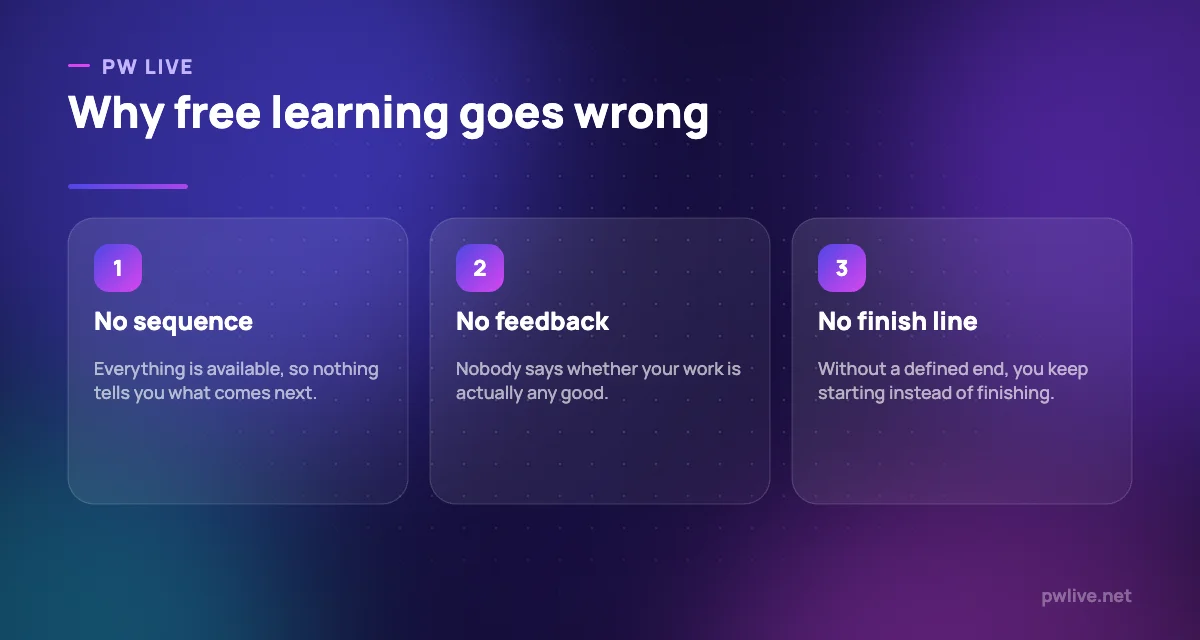
Free material gives you the content and none of the decisions. That produces predictable failure modes:
- Endless sampling. Every new video looks better than the one you are in the middle of.
- Uneven coverage. You end up strong on whatever is popular to teach and blank on the unglamorous basics.
- No correction. You practise mistakes confidently because nothing pushes back.
- False progress. Hours spent watching feel like hours spent learning, and they are not the same thing.
Naming the failure mode you fall into most often is genuinely useful, because each has a different fix.
Choose one spine and demote everything else
The single highest-value decision is to pick one primary resource, in order, and treat every other source as reference material you consult only when stuck.
Your spine should be a structured series with a clear start and end: a full course, a book, a documented curriculum, an official tutorial path. Follow it in sequence even when a section feels boring, because the boring sections are usually the foundations.
Everything else goes into a “reference” list you are not obliged to finish. That mental shift removes most of the guilt that makes people abandon free learning.
If you cannot tell whether a course is worth being your spine, our guide on choosing an online course you will actually finish covers the signals worth checking before you start.
How to judge a free resource quickly
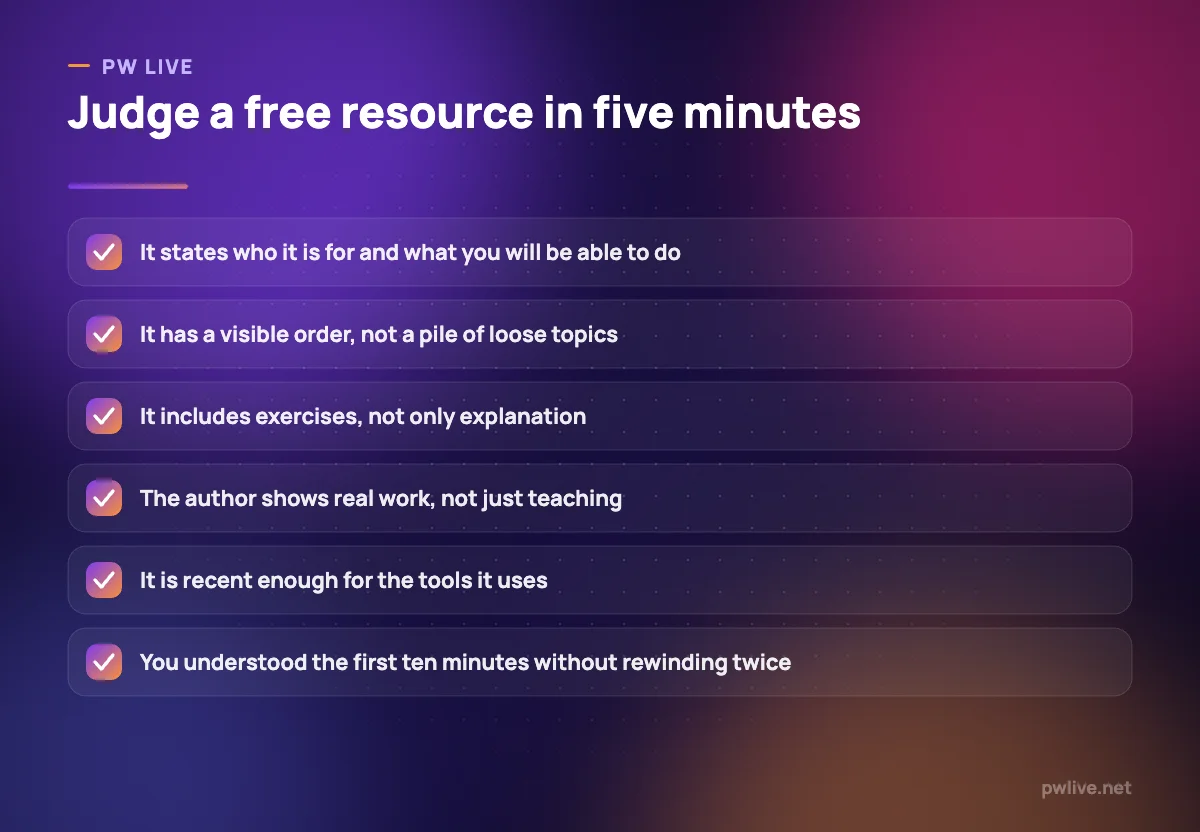
Quality varies wildly, and you cannot evaluate everything. Use a five-minute screen instead.
Look for a stated outcome, a visible order to the topics, exercises rather than only explanation, and some evidence that the author has done the work and not only taught it. Then watch or read the first ten minutes. If you are already lost, the level is wrong for you, which is a mismatch rather than a failing.
One caution specific to free material: check how old it is. For anything touching software, tools or platforms, material more than a few years old may teach steps that no longer exist.
Build your own syllabus in an hour
Before you start, spend one hour producing a document you will use for weeks.
- Write your outcome as a finished thing, for example “a working landing page with a form that stores responses”.
- List the topics your spine covers, as headings, in order.
- Add a checkbox next to each topic and a blank column for the date you completed it.
- Under each topic, write one small exercise you will do to prove you got it.
- Mark the three topics that matter most for your outcome. Those are the ones you slow down for.
This document is your course. It converts a playlist into a programme, and it is the same planning move behind our 90-day skill system.
Practise far more than you consume
A workable ratio is three parts practice to one part consumption. If you watch for 30 minutes, spend 90 minutes producing something with it.
That inversion is uncomfortable, because watching is pleasant and practising is not. It is also the entire difference between people who learn from free resources and people who accumulate them.
Practical ways to enforce it:
- Pause at the end of each concept and rebuild the example without the tutorial visible.
- Change one requirement deliberately, so you cannot copy the solution.
- Keep a running list of “things I could not do without looking” and clear it each week.
- Cap your inputs: one video source, one written source, nothing else this month.
Video is especially prone to passive drift. The techniques in our guide to studying from video lectures without wasting hours apply directly to free courses.
Create your own feedback loop
Free resources rarely tell you whether your work is good. You have to arrange that yourself, and there are more options than people assume.
- Automatic feedback. Tests, linters, compilers, quizzes, checkers. Fastest and least emotional.
- Comparison feedback. Do the exercise, then study a strong solution side by side and list every difference.
- Public feedback. Post the work in a community and ask one specific question rather than “any thoughts?”.
- Delayed self-review. Look at your own work a week later with a checklist you wrote in advance.
Ask narrow questions when you ask humans. “How would you have structured this function?” gets a useful answer; “is this good?” gets silence.
Keep one home for notes
Scattered notes are how free learners lose months of work. One searchable place, organised by skill rather than by source, is enough.
Keep notes that your future self can act on: worked examples, mistakes and their fixes, and short summaries in your own words. Copying slides verbatim is not note-taking, as our guide to taking notes you will actually revise makes clear.
A simple stack of free tools handles the rest, and the apps and tools category has options for storing, backing up and organising what you produce.
When free is not enough
Free resources cover foundations extremely well. They are weaker in three places: structured feedback on your specific work, accountability, and credentials that gate certain jobs.
If you are stuck for weeks despite genuine effort, or you keep abandoning things halfway, paying for structure can be rational. Buy the thing you are missing, which is usually a mentor or a deadline, rather than more content.
For most skills, though, free plus discipline is enough. Pick a track from the skills development hub, such as digital marketing or coding and programming, and follow one spine to the end before you buy anything.
Key takeaways
- Free material lacks sequence, feedback and a finish line, so build all three yourself.
- Choose one primary resource as your spine and treat everything else as reference.
- Screen a resource in five minutes: stated outcome, visible order, exercises, currency.
- Spend three parts practice to one part consumption.
- Manufacture feedback through tests, comparison with strong solutions and narrow questions.
- Pay for structure or feedback when you need it, not for more content.
Frequently asked questions
How do I stop collecting resources and start finishing one?
Pick your spine, then move every other bookmark into a folder you are not allowed to open until it is finished. Removing the choice removes the drift.
Are free courses good enough to get a job?
For the skills themselves, usually yes. What employers assess is the work you can show, so pair free learning with published projects rather than certificates.
How much time should I give a resource before abandoning it?
About two sessions. If you are still lost after that with no sense of progress, the level or teaching style is wrong and switching is sensible; switching a third time in a month is not.
Can I use AI chat tools while learning for free?
Yes, as an explainer and a reviewer rather than an answer machine. Ask it to critique your solution or explain an error, and see our guide on using AI chat tools for studying for the boundaries worth keeping.
Keep learning with PW Live
Browse every guide in Skills Development, or pick a skill track and follow the roadmap step by step.





Leave a Reply