

AI tools have made a lot of everyday work faster to produce, which raises a fair question for anyone planning a career: which skills stay valuable as AI changes work, and which ones are worth less than they were.
The honest answer is that nobody can predict specific job counts, and you should be sceptical of anyone who claims to. What you can reason about is the shape of the change, because it follows a pattern that earlier automation waves also followed.
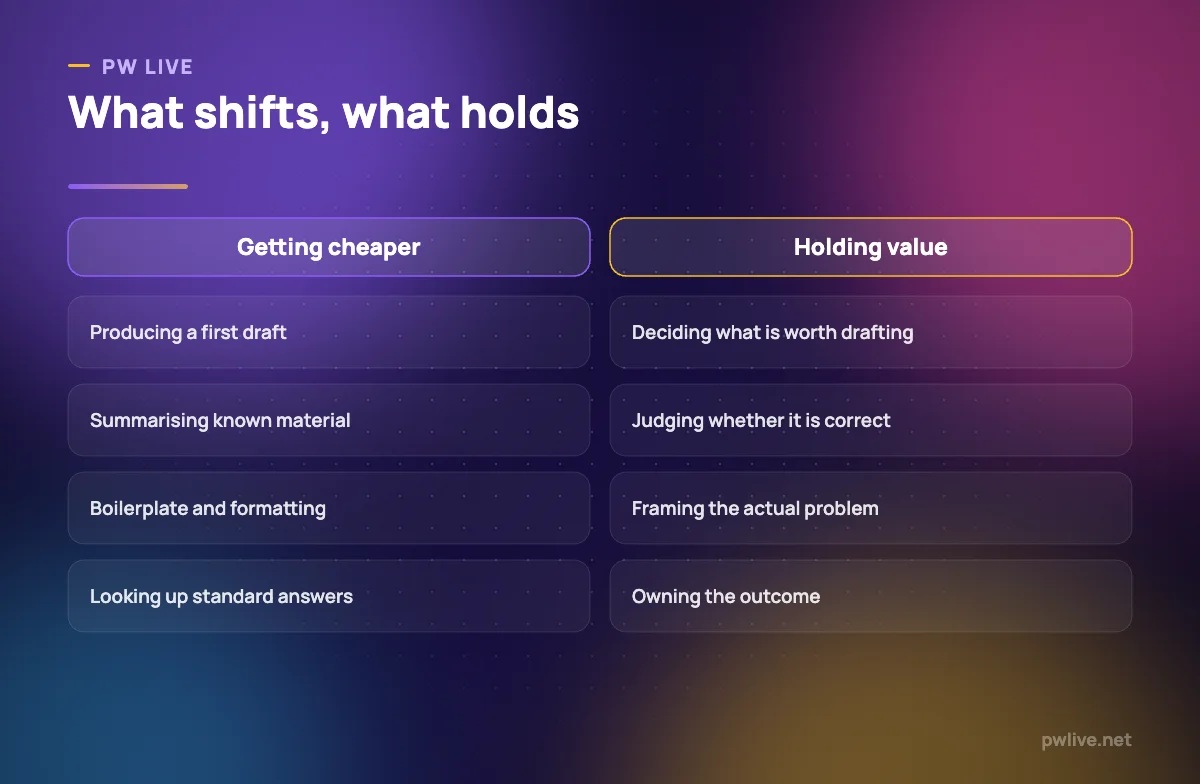
When producing something becomes cheap, the value shifts to deciding what to produce, judging whether it is any good, and being accountable for the result.
What actually changed
Current AI tools are strong at generating plausible material from patterns: drafts, summaries, translations, boilerplate code, first-pass analysis, routine correspondence. They are weak at knowing whether the output is true, whether it fits your specific situation, and whether the question was the right one.
That maps directly onto a change in what work costs. The first draft of almost anything is now quick. Everything around the draft, which is to say the decisions, the verification and the responsibility, is not.
It helps to understand roughly how these systems work, because the limits follow from the mechanism rather than from a temporary lack of polish. Our plain-English explanation of how large language models work covers this without the jargon.
The wrong lesson: chasing tool tricks
The most common reaction is to collect prompting techniques and tool subscriptions. That has some short-term value and very little durable value, because interfaces change fast and the tricks that matter this year are absorbed into the products next year.
Tool fluency is worth having, in the same way spreadsheet fluency is worth having. It is not a career strategy, because it is easy for anyone to acquire, and things that are easy to acquire do not stay scarce.
The skills that hold value are the ones the tools do not supply.
Judgement: knowing what good looks like
An AI tool can give you twenty options. It cannot tell you which one is right for your situation, and it will present a wrong answer with the same confidence as a right one.
Judgement is the ability to look at output and know it is off, then say why. It is built the slow way, by producing a lot of work, seeing consequences, and studying examples of excellent work closely.
This is also why doing the fundamentals unaided still matters. If you have never written the code, made the model or drafted the contract yourself, you cannot evaluate the version a tool hands you. Convenience early on buys speed at the cost of the very taste that makes you useful later.
Problem framing: asking the right question
Most of the value in professional work happens before the work starts. Which problem are we solving? For whom? What would count as a good outcome? What are we choosing not to do?
Tools are downstream of that. Give a vague question and you get a fluent, useless answer, which is worse than an obviously bad one because it is harder to notice.
Practise framing deliberately:
- Write the problem in one sentence before you touch any tool
- State the constraints and the definition of done
- List two approaches you are rejecting and why
- Identify who is affected if you get it wrong
The habit of writing the brief first is the difference between someone who directs the work and someone who processes it.
Verification: proving something is actually true
As generated content becomes abundant, checking becomes the scarce activity. The person who can confirm that a number, a claim, a calculation or a piece of code is correct is doing the part that carries real risk.
Verification skills are concrete and teachable:
- Tracing a figure back to its original source rather than a repetition of it
- Sanity-checking a result against something you know independently
- Writing tests that would fail if the work were wrong
- Recognising the signature of a plausible but unsupported claim
This is analytical work with a long shelf life, and it is the backbone of the data science and AI track. It is also increasingly what separates useful graduates from fast ones, a theme our piece on how AI is changing hiring explores from the employer’s side.
Communication and trust
Work still moves through people. Persuading a hesitant colleague, understanding what a client actually wants beneath what they asked for, delivering awkward news early, and holding a room’s attention are all skills that do not transfer to a tool, because the value lies in the relationship rather than the content.
Written clarity is the highest-leverage version of this. If you can take something complicated and make it plainly understandable to someone outside your field, you will always be useful, and you will also be better at directing tools since good prompts are just clear briefs.
The communication skills track is the practical route in, and it compounds with everything else on this list.
Real depth in a domain
Generic capability is now cheap. Specific knowledge of how a particular industry, process or customer group actually works is not, because it lives in experience rather than in published text.
Depth is what tells you which of the twenty generated options survives contact with reality. A person who knows how invoices really flow in a small manufacturing business, or what actually happens in a school timetable, will get more out of any tool than a generalist with better prompts.
Build depth by staying somewhere long enough to see consequences, by talking to the people doing the work, and by taking responsibility for outcomes rather than tasks. The leadership and management track covers the ownership habits that make this possible.
How to use AI without hollowing out your skills
There is a genuine risk of atrophy. If a tool does the difficult thinking every time, the difficult thinking never becomes yours.
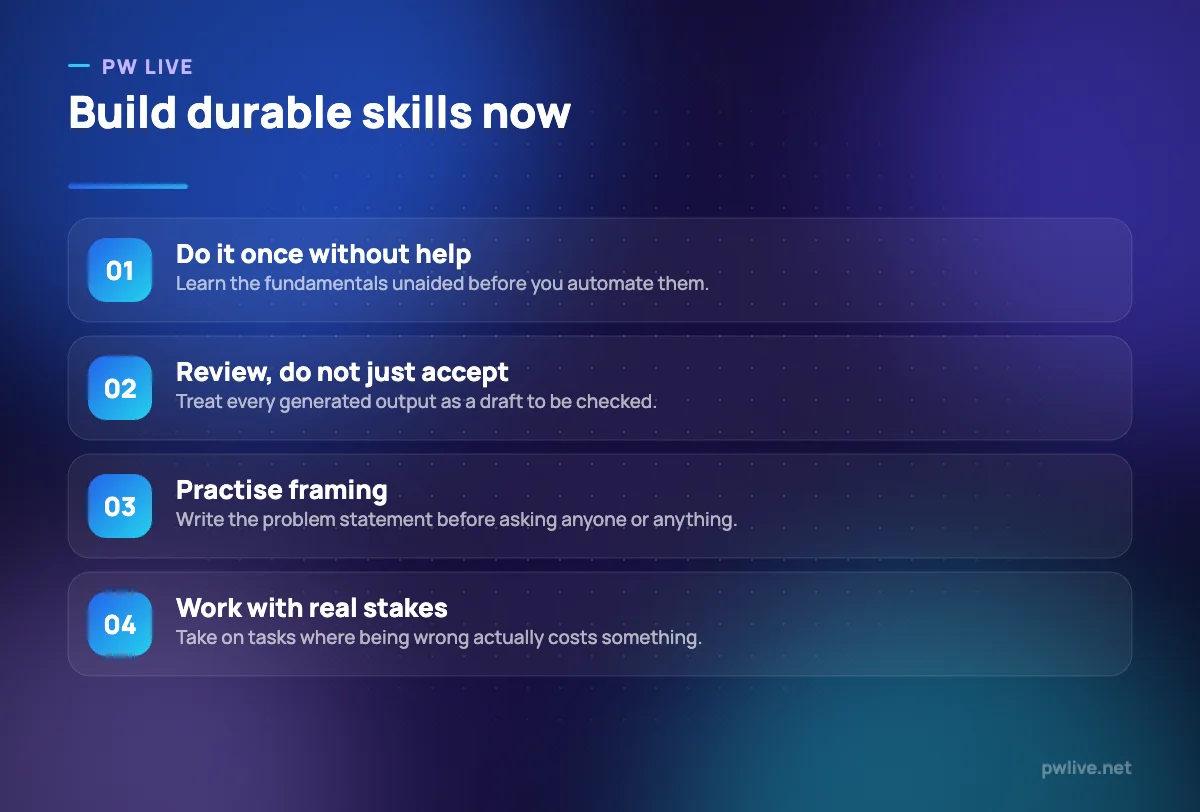
A workable rule: learn it unaided, then automate it. Use tools to remove work you have already mastered and to accelerate work where you can check the output. Do not use them for the exact thing you are currently trying to learn.
Practically, that looks like this:
- Attempt the task yourself first, then compare with the tool’s version and note the differences
- Ask the tool to critique your work rather than to produce it
- Always verify anything factual before it leaves your hands
- Automate the repetitive layers of your workflow, which our guide to automation for non-programmers covers, and keep the judgement layer manual
Students in particular should be careful about which tasks they hand over, a boundary our guide on using AI chat tools for studying sets out clearly. For the wider picture of how these tools work and where they are heading, the technology category is a good place to keep reading.
Key takeaways
- When production becomes cheap, value moves to judgement, framing and accountability.
- Tool tricks are worth learning but are not a career strategy, because they are easy to copy.
- Judgement comes from doing the fundamentals unaided and studying excellent work closely.
- Verification is the scarce skill in a world of abundant plausible content.
- Communication, trust and deep domain knowledge stay valuable because they sit outside the text.
- Learn a skill unaided first, then use tools to speed up what you already understand.
Frequently asked questions
Is it still worth learning to code?
Yes, if you want to build or evaluate software. Understanding what code does is exactly what lets you judge generated code, and the reasoning it teaches transfers well beyond programming.
Which skills are most at risk?
Roles built mainly on producing routine text, standard documents or repetitive first-pass output face the most pressure. The response is to move up a level into judgement, verification and client relationships rather than to compete on speed.
Do employers still care about degrees?
Degrees still open doors in many hiring processes, but demonstrated work carries increasing weight. A portfolio of things you built and can defend is the strongest signal available to most candidates.
How do I keep up when the tools change every few months?
Do not try to track every release. Learn the underlying concepts once, adopt tools that fit work you already do, and spend your learning time on the skills that outlast any particular product.
Keep learning with PW Live
Browse every guide in Skills Development, or pick a skill track and follow the roadmap step by step.





Leave a Reply